US Tax

Schedule K-1: Partnership & S Corporation

After understanding the basic differences between a C Corporation and an S Corporation, the next important concept in U.S. business taxation is Schedule K-1. For students, accountants, and professionals preparing for careers in U.S. tax, accounting, audit, or consulting, K-1 is an essential concept because it connects a pass-through entity with its owner’s tax reporting.

Schedule K-1: Partnership & S Corporation Read More »

U.S. INDIVIDUAL FEDERAL TAX: Dual Residency in U.S. Tax

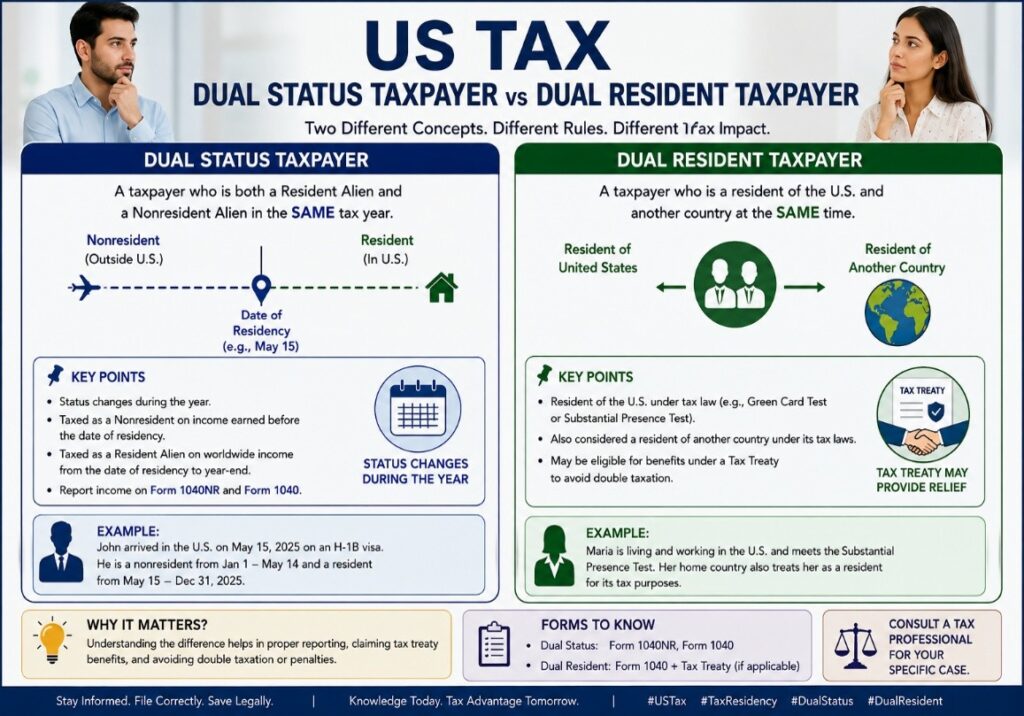
India to USA: A Practical Dual-Status Tax Case Study PART 3 OF 3  —  PRACTICAL CASE STUDY In Part 1, we understood the difference between a dual-status taxpayer and a dual-resident taxpayer. In Part 2, we examined the important elections, IRS forms and filing formalities. Now let’s put those rules into practice. The following case

U.S. INDIVIDUAL FEDERAL TAX: Dual Residency in U.S. Tax Read More »

Dual-status taxpayers

Dual-Status Taxpayers:Elections, Forms & Filing Formalities

From determining residency to preparing the correct U.S. tax return PART 2  OF  3 In Part 1, we learned that a taxpayer may become a dual-status taxpayer when U.S. tax residency changes during the year. We also distinguished a dual-status taxpayer from a dual-resident taxpayer, and examined the Green Card Test, Substantial Presence Test (SPT),

Dual-Status Taxpayers:Elections, Forms & Filing Formalities Read More »

AMT1

AMT IN ACTION

Single Filer vs. Married Filing Jointly — A Case Study 2025 Alternative Minimum Tax (AMT) Rules Illustrated The following two case studies illustrate how the 2025 AMT rules work in practice. By comparing a Single Filer with a Married Filing Jointly (MFJ) couple, we can see how the AMT exemption and 26%/28% rates affect the

AMT IN ACTION Read More »

Tax credits

How Tax Credits Can Reduce Your Tax Bill — and Sometimes Increase Your Refund

A student-friendly guide to U.S. federal tax credits, Tax Year 2025 After calculating taxable income and claiming all eligible deductions, the next important step in preparing a U.S. federal tax return is identifying tax credits. Unlike deductions, which only reduce taxable income, tax credits reduce actual tax liability dollar-for-dollar — and some credits can even

How Tax Credits Can Reduce Your Tax Bill — and Sometimes Increase Your Refund Read More »

Don`t copy text!