

Imagine a taxpayer who earns a substantial income and claims several deductions and tax preferences. Under the regular federal income tax system, these deductions may significantly reduce taxable income.
But the U.S. tax system asks another question: after applying a separate set of rules, should this taxpayer still pay at least a minimum level of federal income tax? That question is answered by the Alternative Minimum Tax (AMT).
| Quick take: The AMT is a parallel tax calculation. Taxpayers compare their regular tax liability with a “tentative minimum tax” — whichever is higher becomes what they actually owe. |
What Exactly is AMT?
The Alternative Minimum Tax is a parallel tax system that runs alongside the regular U.S. federal income tax framework. Certain deductions, exclusions, and preference items that receive favorable treatment under the regular tax system may be adjusted or added back for AMT purposes.
The taxpayer then calculates Alternative Minimum Taxable Income (AMTI) and applies AMT rules to arrive at a tentative minimum tax. The IRS uses Form 6251, Alternative Minimum Tax—Individuals, for this calculation.
Regular Tax vs. AMT — Two Parallel Paths
| Step | Regular Tax | AMT |
| Rules applied | Regular tax rules | Alternative tax rules |
| Deductions | Regular deductions | Certain deductions adjusted |
| Income base | Regular taxable income | AMTI |
| Rates | Regular tax rates | 26% / 28% AMT rates |
| Result | Regular liability | Tentative minimum tax |
| Final step | Compare both | Higher amount determines additional AMT owed |
A Worked Example
Suppose a taxpayer’s regular tax = $48,000, but their tentative minimum tax = $55,094. Because the tentative minimum tax is higher, the taxpayer owes the difference as additional AMT liability:
$55,094 − $48,000 = $7,094 additional AMT
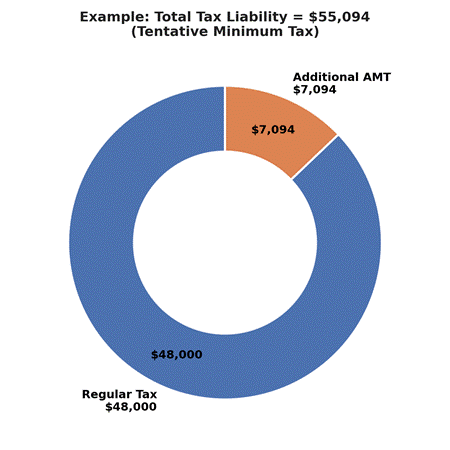
Figure 1. How the tentative minimum tax splits into regular tax and additional AMT in this example.
Why Was AMT Introduced?
The AMT is designed to prevent taxpayers with relatively high economic income from reducing their federal tax liability too substantially through deductions, exclusions, and other tax preferences.
In other words: AMT does not necessarily tax additional income — it often changes the way certain deductions and tax benefits are treated for a subset of higher-income filers.
AMT for Tax Year 2025 — Important Numbers
For Tax Year 2025, the IRS provides the following AMT exemption amounts and phaseout thresholds by filing status:
| Filing Status | AMT Exemption | Phaseout Begins | Complete Phaseout |
| Single / Head of Household | $88,100 | $626,350 | $978,750 |
| Married Filing Jointly (MFJ) | $137,000 | $1,252,700 | $1,800,700 |
| Married Filing Separately (MFS) | $68,500 | $626,350 | $900,350 |
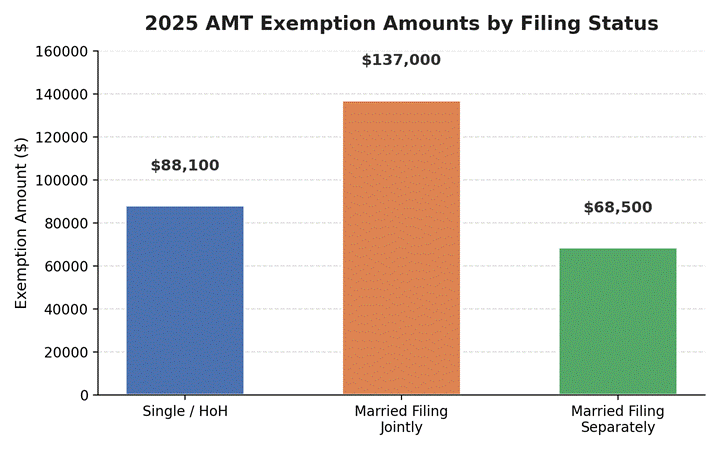
Figure 2. 2025 AMT exemption amounts by filing status.
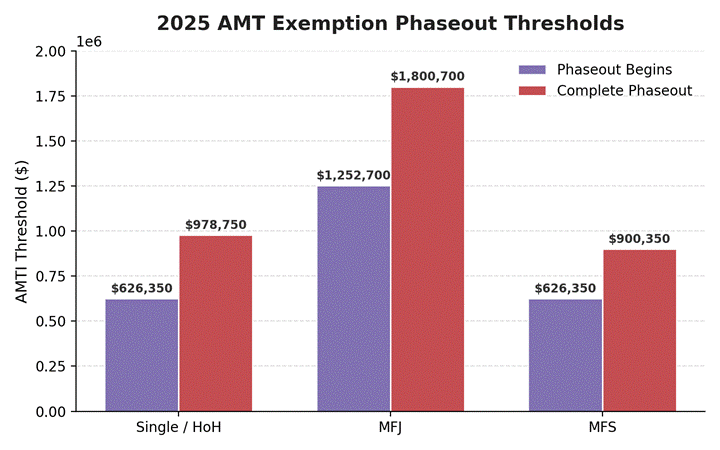
Figure 3. AMT exemption phaseout thresholds by filing status.
How the Phaseout Works — John’s Example
For a single taxpayer in 2025: the AMT exemption is $88,100, the phaseout begins once AMTI exceeds $626,350, the exemption is reduced by 25% of the AMTI above that threshold, and it is completely phased out at $978,750.
Suppose John has Alternative Minimum Taxable Income (AMTI) of $700,000.
| Particulars | Amount |
| AMTI | $700,000 |
| Less: Phaseout threshold | $626,350 |
| Excess AMTI | $73,650 |
| Phaseout reduction (25% of excess) | $18,412.50 |
| Original AMT exemption | $88,100 |
| Reduced AMT exemption | $69,687.50 |
So, John does not get the full $88,100 exemption — his reduced exemption is $69,687.50.
John’s Full AMT Calculation
| Particulars | Amount |
| AMTI | $700,000 |
| Normal 2025 AMT exemption | $88,100 |
| Excess over phaseout threshold | $73,650 |
| 25% phaseout reduction | ($18,412.50) |
| Actual AMT exemption available | $69,687.50 |
| AMT taxable amount | $630,312.50 |
Instead of $700,000 − $88,100 = $611,900, John ends up with $700,000 − $69,687.50 = $630,312.50 subject to AMT — meaning $18,412.50 more of his AMTI becomes taxable because his exemption was phased down.
AMT Tax Rates for 2025
For most individual taxpayers, the AMT applies two flat rates to the AMT taxable excess:
| 2025 AMT Rate | Applies to AMT Taxable Excess |
| 26% | Up to $239,100 |
| 28% | Above $239,100 |
Note: for Married Filing Separately (MFS), the 26%/28% breakpoint is lower, at $119,550.
2025 AMT — Quick Revision Table
A fast reference for exam prep or client conversations:
| Question | 2025 Answer |
| What is AMT? | Alternative Minimum Tax |
| Individual AMT form | Form 6251 |
| Single exemption | $88,100 |
| MFJ exemption | $137,000 |
| MFS exemption | $68,500 |
| Single phaseout starts | $626,350 |
| MFJ phaseout starts | $1,252,700 |
| Single complete phaseout | $978,750 |
| MFJ complete phaseout | $1,800,700 |
| First AMT rate | 26% |
| Second AMT rate | 28% |
| 26%/28% breakpoint | $239,100 |
| MFS breakpoint | $119,550 |
| Bottom line: AMT rarely changes what income you report — it changes which deductions and preferences you get to use. Running both the regular tax and AMT calculations each year is the only way to know which one applies to you. |
Thank you sir for such an insightful blog
Very informative blog, thank you sir.