

| From determining residency to preparing the correct U.S. tax return |
PART 2 OF 3
In Part 1, we learned that a taxpayer may become a dual-status taxpayer when U.S. tax residency changes during the year. We also distinguished a dual-status taxpayer from a dual-resident taxpayer, and examined the Green Card Test, Substantial Presence Test (SPT), residency starting date and income scope.
Now comes the practical question: what does the taxpayer actually file, and what elections or exceptions should be considered?
01 The Closer Connection Exception — Form 8840
A person who satisfies the Substantial Presence Test may, under specific conditions, still qualify for the Closer Connection Exception. Generally, the taxpayer must have:
- fewer than 183 days of actual presence in the United States during the current year;
- a tax home in a foreign country;
- a closer connection to that foreign country than to the United States; and
- satisfied the other statutory requirements.
| REMEMBER The taxpayer generally claims the exception by filing Form 8840 — Closer Connection Exception Statement for Aliens. This is an exception to SPT residency, not an election to become a U.S. resident. |
02 First-Year Choice
What happens if an individual does not meet the Green Card Test or SPT in the current year but expects to meet the SPT in the following year? Under specific conditions, the taxpayer may make the First-Year Choice — allowing a qualifying individual to be treated as a U.S. resident for part of the current year and taxed as a dual-status taxpayer.
The IRS requires, among other conditions:
- at least 31 consecutive days of presence in the United States during the current year; and
- presence for at least 75% of the days following that 31-day period through the end of the year, subject to the permitted five-day absence rule.
There is no separate “First-Year Choice Form.” The taxpayer makes the choice by attaching the required statement to Form 1040; the IRS prescribes the information that statement must include.
| KEY TAKEAWAY First-Year Choice = Statement attached to Form 1040 |
03 Election to Treat a Nonresident Spouse as a Resident
Marriage can create another important election.
A nonresident alien married to a U.S. citizen or resident alien may, subject to the applicable requirements, elect to be treated as a U.S. resident. Similarly, a qualifying dual-status individual married to a U.S. citizen or resident may elect to file a joint return and be treated as a resident for the entire year.
This can significantly change the tax computation, because resident treatment generally brings worldwide income into the U.S. tax calculation. The election should therefore be evaluated before filing — never assumed to be beneficial.
04 Which Return Does a Dual-Status Taxpayer File?
This is the most important filing rule. The answer depends on the taxpayer’s status on the last day of the tax year — December 31.
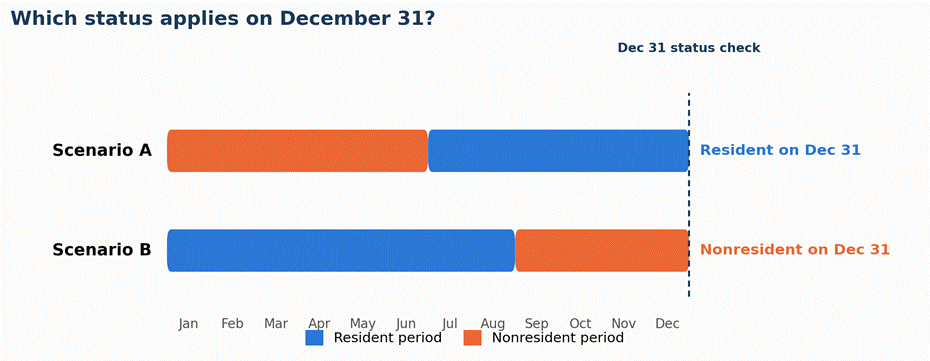
Two illustrative scenarios — the same rule, opposite outcomes
A. Resident on December 31
Suppose: January–June is a nonresident period, and July–December is a resident period. The taxpayer is a resident at year-end, and generally files Form 1040 — writing “DUAL-STATUS RETURN” across the top. The taxpayer attaches a statement showing income for the nonresident period; Form 1040-NR may be used as that statement and should be marked “DUAL-STATUS STATEMENT.” The attached statement is not separately signed.
05 Nonresident on December 31 — The Reverse Situation
Now consider the reverse: January–August is a resident period, and September–December is a nonresident period. On December 31 the taxpayer is a nonresident, so the taxpayer generally files Form 1040-NR — marked “DUAL-STATUS RETURN” — as the main return filed with the IRS. The taxpayer must also attach a statement covering the resident period; for this purpose, Form 1040 or Form 1040-SR may be used, marked “DUAL-STATUS STATEMENT.” This statement is not filed as a separate tax return and is not separately signed.
Filing structure at a glance — main return vs. attached statement
06 A Major Restriction — Standard Deduction
There is an important rule that students frequently miss: a dual-status taxpayer generally cannot claim the standard deduction. This restriction applies even to the portion of the year during which the taxpayer was a U.S. resident. However, certain allowable itemized deductions may be available.
| INTERVIEW QUESTION Can a dual-status taxpayer claim the standard deduction for the resident period? Answer: Generally, no. |
07 What About Filing a Joint Return?
A taxpayer following ordinary dual-status rules generally cannot file a joint return. However, a qualifying dual-status individual married to a U.S. citizen or resident may elect to be treated as a resident and file jointly with the spouse.
| REMEMBER Dual-status treatment and Married Filing Jointly are not automatically compatible. The taxpayer must first determine whether a qualifying election is available. |
08 Dual-Resident Taxpayer — Form 8833
Now let’s return to the second concept from Part 1. Suppose a taxpayer is considered a resident under both U.S. domestic law and foreign-country domestic law — the taxpayer may be a dual-resident taxpayer.
If the applicable U.S. tax treaty contains residence tie-breaker rules, the taxpayer may determine that the treaty treats them as a resident of the foreign country. In that situation, the IRS provides treaty-based treatment through Form 1040-NR together with Form 8833 — Treaty-Based Return Position Disclosure. Form 8833 is specifically used to disclose a treaty-based return position; it is not a general dual-residency election form.
| REMEMBER Form 8840 → Closer Connection Exception Form 8833 → Treaty-Based Position |
09 Income During a Dual-Status Year
The filing form is only part of the exercise — the taxpayer must also separate income according to the two periods.
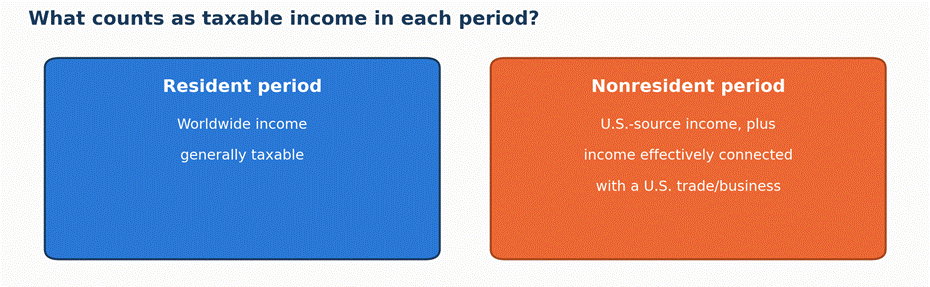
The IRS specifically states that foreign-source income received during the resident period is generally taxable, while foreign-source income received during the nonresident period generally is not taxable in most cases.
10 Filing Checklist
Before filing a dual-status return, ask:
- When did U.S. residency begin or end?
- Was the taxpayer a resident or nonresident on December 31?
- Does Form 8840 apply?
- Is First-Year Choice available?
- Is a spouse election available?
- Which return is the principal return?
- Which return becomes the Dual-Status Statement?
- Is a treaty position involved?
- Is Form 8833 required?
- Which income belongs to each residency period?
- Are foreign taxes potentially creditable?
QUICK REVISION — Memory Sheet
| Status on Dec 31 | Filing Structure |
| Resident | Form 1040 → Dual-Status Return Form 1040-NR → Dual-Status Statement |
| Nonresident | Form 1040-NR → Dual-Status Return Form 1040 / 1040-SR → Dual-Status Statement |
Key Forms
| Form | Purpose |
| Form 8840 | Closer Connection Exception |
| Form 8833 | Treaty-Based Return Position |
| First-Year Choice | Required statement attached to Form 1040 |
| WHAT COMES NEXT? We now know the rules and filing framework. But the real test comes when one taxpayer has Indian salary, U.S. salary, Indian bank interest, foreign rental income, U.S. investments, foreign taxes paid — and possibly residency in both India and the United States. In Part 3, we take a complete India-to-USA case study: Residency → Date → Income Allocation → Return → Elections → Foreign Tax Credit → Treaty Issues. That is where the rules become practical. |
Finance Mentor® | U.S. Individual Federal Tax Series · Part 2 of 3 — Elections, Forms & Filing Formalities
Very Easily Explained. Thank You sir for such an insightful blog
Very Easily Explained. Thank You sir for such an insightful blog