

| India to USA: A Practical Dual-Status Tax Case Study |
PART 3 OF 3 — PRACTICAL CASE STUDY
In Part 1, we understood the difference between a dual-status taxpayer and a dual-resident taxpayer.
In Part 2, we examined the important elections, IRS forms and filing formalities.
Now let’s put those rules into practice.
The following case study illustrates how a tax professional should approach an individual moving from India to the United States during the year.
Meet Arjun Mehta
| THE TAXPAYER Arjun Mehta, an Indian citizen, works in India until June 30, 2026. On July 1, 2026, he moves to the United States to join a U.S. employer. Under the applicable U.S. residency rules, Arjun becomes a U.S. tax resident from July 1, 2026 and remains a resident through December 31. |
The figures below are illustrative and are intended to demonstrate the analysis rather than calculate Arjun’s final tax liability.

Figure 1 — Arjun’s dual-status tax year at a glance
2026 Income Overview
| Income | Amount | Period |
| Indian salary | ₹18,00,000 | Before July 1 |
| U.S. salary | $80,000 | After July 1 |
| Indian bank interest | ₹1,20,000 | After July 1 |
| Indian rental income | ₹3,00,000 | After July 1 |
| U.S. bank interest | $2,000 | After July 1 |
| Capital gain | $5,000 | After July 1 |
| Indian income tax paid | ₹4,50,000 | During the year |
| STEP 1 Determine Arjun’s U.S. Status |
Arjun is:
| Period | Status |
| January 1 – June 30 | Nonresident alien |
| July 1 – December 31 | Resident alien |
Therefore: Arjun has a dual-status tax year.
| IRS GUIDANCE The IRS confirms that a dual-status year occurs when an individual is a resident for part of the year and a nonresident for the other part. |
| STEP 2 Divide the Tax Year |
This is the first practical step in preparing the return.
| IRS GUIDANCE A dual-status taxpayer is generally taxed on income from all sources during the resident period, and generally on U.S.-source income during the nonresident period. |
| STEP 3 Analyze the Income |
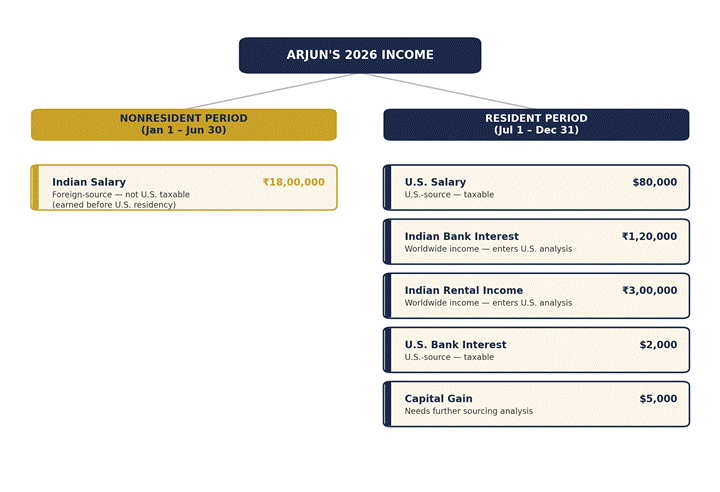
Figure 2 — How Arjun’s 2026 income splits across the two residency periods
Indian Salary — ₹18,00,000
Arjun earned this salary before becoming a U.S. resident. Therefore, it belongs to his nonresident period.
Foreign-source income received during the nonresident period is generally not taxable in the United States merely because the taxpayer later becomes a resident. The precise source and tax treatment should nevertheless be confirmed under the applicable rules.
U.S. Salary — $80,000
This income arises during Arjun’s resident period. Therefore, it is generally taxable in the United States.
Indian Bank Interest — ₹1,20,000
This interest is received after Arjun becomes a U.S. resident. Therefore, it generally enters the U.S. worldwide-income analysis.
The fact that the bank account is located in India does not by itself remove the income from U.S. taxation during the resident period.
Indian Rental Income — ₹3,00,000
The rental property is in India, but Arjun is a U.S. resident when the income is received. Therefore, the rental income generally needs to be considered in his U.S. worldwide-income computation, subject to the applicable U.S. rules.
U.S. Bank Interest — $2,000
This is U.S.-source income and is generally taxable. Because it is also received during the resident period, it falls within the resident-period analysis.
Capital Gain — $5,000
This item requires additional analysis. We need to know:
● What asset was sold?
● Where was the asset located?
● When was it acquired?
● When was it sold?
● Was Arjun a resident when the gain arose?
● What sourcing rules apply?
● Does a treaty provision affect the result?
| KEY TAKEAWAY A professional tax preparer should not automatically classify every capital gain simply by looking at the taxpayer’s country of residence. |
| STEP 4 Determine the Correct Return |
| Question | Answer |
| Arjun is a U.S. resident on: | December 31, 2026 |
| Therefore, he generally files: | Form 1040 |
| …and writes across the top: | DUAL-STATUS RETURN |
| He attaches: | Form 1040-NR (as the dual-status statement) |
The statement shows the income attributable to the period during which Arjun was a nonresident.
| IRS GUIDANCE The IRS specifically provides this filing structure for a taxpayer who is a resident at the end of the year. |
| STEP 5 What About the Standard Deduction? |
Arjun cannot simply claim the standard deduction because he became a U.S. resident. The IRS specifically states:
| IMPORTANT A dual-status taxpayer cannot claim the standard deduction, even for the resident portion of the year. |
Applicable itemized deductions must instead be considered under the relevant rules.
| STEP 6 What About the Indian Tax Paid? |
Arjun paid: ₹4,50,000 in Indian income tax.
Now we have reached another important international-tax concept: the Foreign Tax Credit.
If qualifying foreign income is also subject to U.S. tax, Arjun may potentially be eligible for a foreign tax credit, subject to the applicable requirements and limitations.
| IRS GUIDANCE The foreign tax credit is intended to reduce double taxation when qualifying foreign-source income is taxed by both the United States and a foreign country. |
| IMPORTANT Foreign tax paid does not automatically mean an equal U.S. tax credit. The foreign tax must satisfy the applicable qualification tests, and the credit is subject to limitations. |
| STEP 7 What if India Also Treats Arjun as a Resident? |
Suppose Indian domestic law also treats Arjun as a resident for the relevant year. Now we have:
● U.S. domestic law → Resident
● Indian domestic law → Resident
Arjun may therefore be a Dual-Resident Taxpayer.
The next step is to examine the applicable India–U.S. tax treaty.
| IRS GUIDANCE If the treaty’s residence provisions resolve the conflicting claims in favor of India, the taxpayer may be able to claim treaty-based treatment as a nonresident of the United States for purposes of computing U.S. income tax, subject to the applicable requirements. The IRS generally requires Form 1040-NR and Form 8833 for such a treaty-based position. |
| KEY TAKEAWAY Dual-status and dual-resident are two separate analytical questions. |
| STEP 8 Arjun’s Professional Tax Analysis |
The complete reasoning can now be summarized:
| 1. Determine residency | → Resident from July 1 |
| 2. Divide the year | → Nonresident period + Resident period |
| 3. Classify income | → U.S.-source / foreign-source / ECI |
| 4. Apply the correct tax scope | → Nonresident rules / worldwide-income rules |
| 5. Determine the return | → Form 1040 + Form 1040-NR statement |
| 6. Check deductions | → Standard deduction generally unavailable |
| 7. Examine foreign taxes | → Potential foreign tax credit |
| 8. Check foreign residency | → Possible dual-resident situation |
| 9. Examine treaty | → Tie-breaker and treaty-based position, where applicable |
The Golden Framework
For any international taxpayer moving to or from the United States, remember:
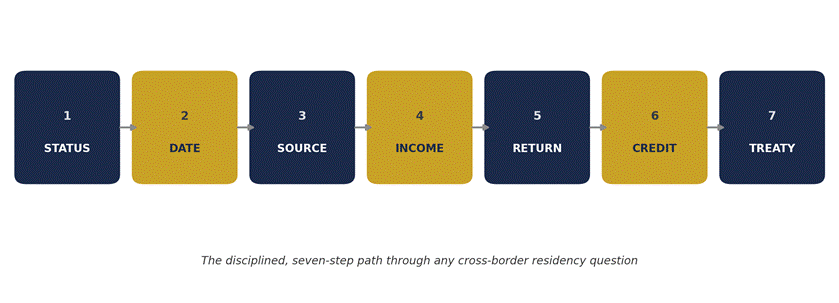
Figure 3 — The seven-step Golden Framework
| Status — Resident or nonresident? |
| Date — When did residency begin or end? |
| Source — Where did the income arise? |
| Income — What is taxable during each period? |
| Return — Form 1040 or 1040-NR? |
| Credit — Is foreign tax credit available? |
| Treaty — Does a tax treaty change the result? |
Final Takeaway
Arjun’s case demonstrates that international taxation is not simply a matter of:
‘I moved to America, so all my income is taxable in America.’
Nor is it:
‘My income came from India, so America cannot tax it.’
The correct approach is more disciplined:
First determine residency. Then determine the residency period. Then classify the income. Then apply the appropriate U.S. tax rules. Finally, examine foreign-tax relief and treaty provisions.
That is the essence of dual-status taxation.
| FINANCE MENTOR® | U.S. INDIVIDUAL FEDERAL TAX SERIES Part 3 of 3 — Practical Case Study |
All the 3 parts were engaging and I learned a lot from them. Thank you sir for uploading.