

After understanding the basic differences between a C Corporation and an S Corporation, the next important concept in U.S. business taxation is Schedule K-1.
For students, accountants, and professionals preparing for careers in U.S. tax, accounting, audit, or consulting, K-1 is an essential concept because it connects a pass-through entity with its owner’s tax reporting.
Partnership → Schedule K-1 (Form 1065)
But there is an important distinction:
Partnership → Schedule K-1 (Form 1065)
■ S Corporation → Schedule K-1 (Form 1120-S)
■ C Corporation → No Schedule K-1
Let us understand this step by step.
01 What is Schedule K-1?
Andrew: Professor, I understand that partnerships and S Corporations are generally pass-through entities. But what exactly is Schedule K-1?
Professor: Think of Schedule K-1 as a tax information statement that communicates an owner’s share of applicable income, deductions, credits, and other tax items from a pass-through entity.
The entity first prepares its own federal tax return. The relevant tax items are then allocated to the owners and reported through their respective K-1s.
The basic concept is:
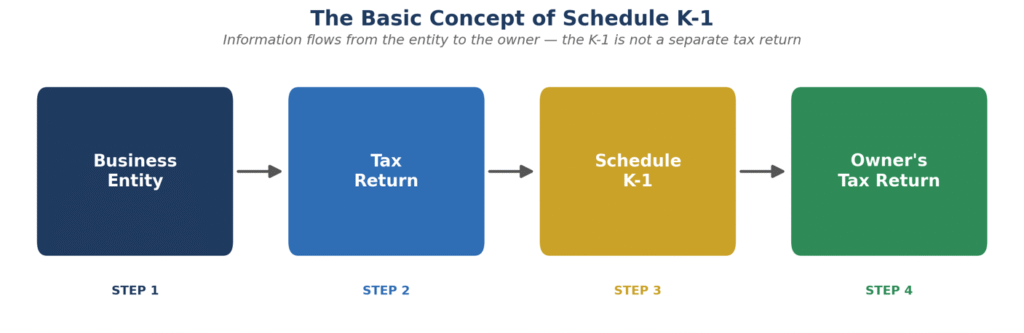
The K-1 is NOT a separate tax return.
The important point is that the K-1 is not a separate tax return. It provides information that the partner or shareholder generally uses when preparing their own tax return.
02 Partnership K-1 — Form 1065
A partnership generally files Form 1065, U.S. Return of Partnership Income.
The partnership reports its income, deductions, gains, losses, credits, and other relevant tax information.
The partner’s share of these items is generally reported on:
Schedule K-1 (Form 1065)
The simplified flow is:
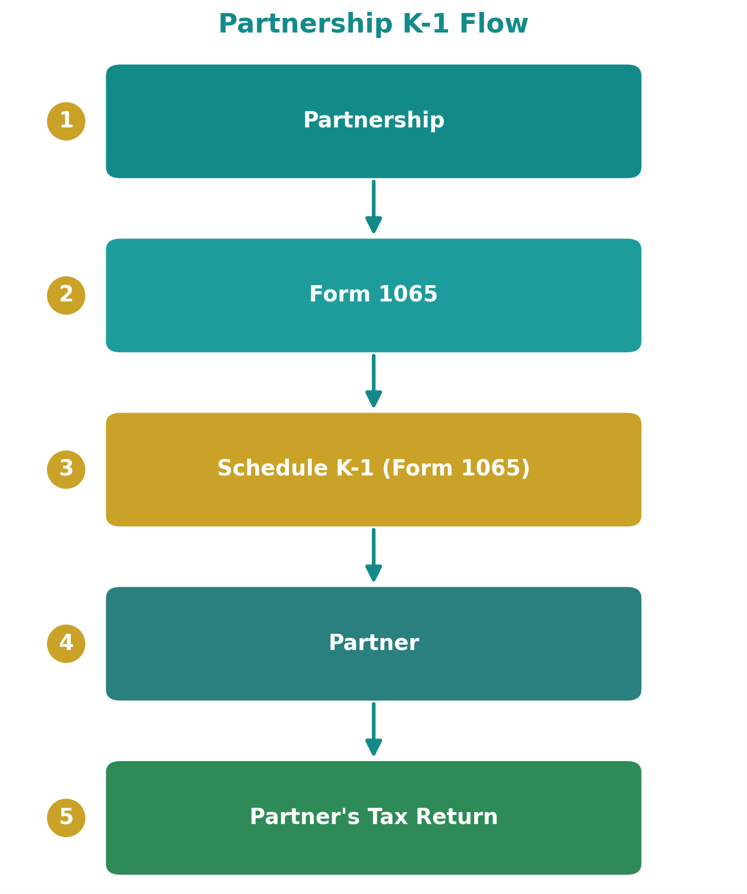
Each partner generally receives a K-1 reflecting the partner’s applicable share of partnership tax items.
03 S Corporation K-1 — Form 1120-S
An S Corporation generally files Form 1120-S, U.S. Income Tax Return for an S Corporation.
The corporation reports its relevant tax information, and the shareholder’s applicable share is reported on:
Schedule K-1 (Form 1120-S)
The flow is:
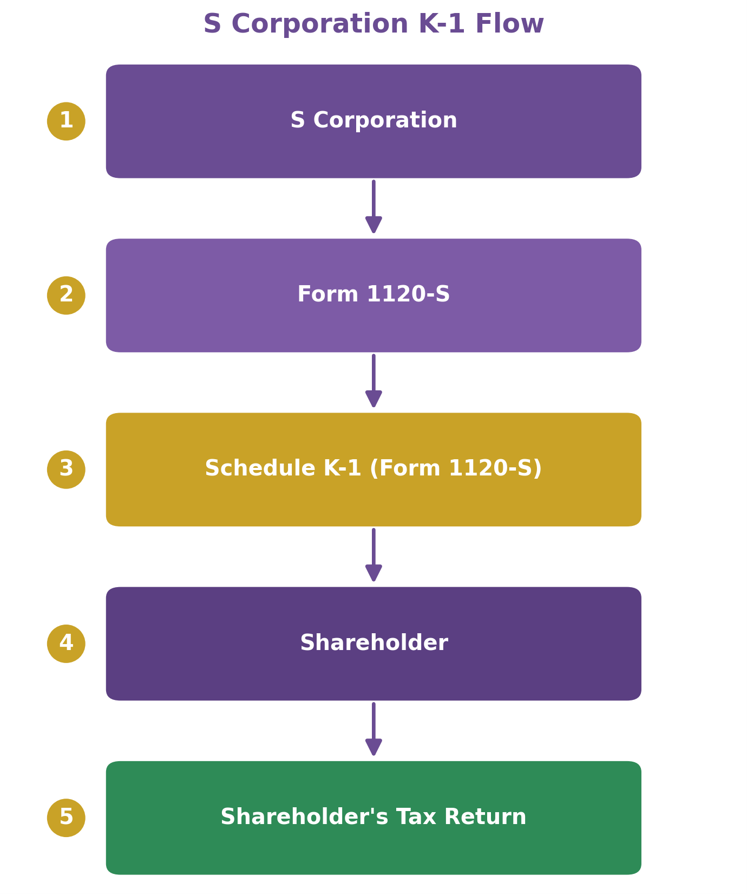
Thus, both partnerships and S Corporations use Schedule K-1, but they use different K-1 forms.
04 Partnership K-1 vs S Corporation K-1
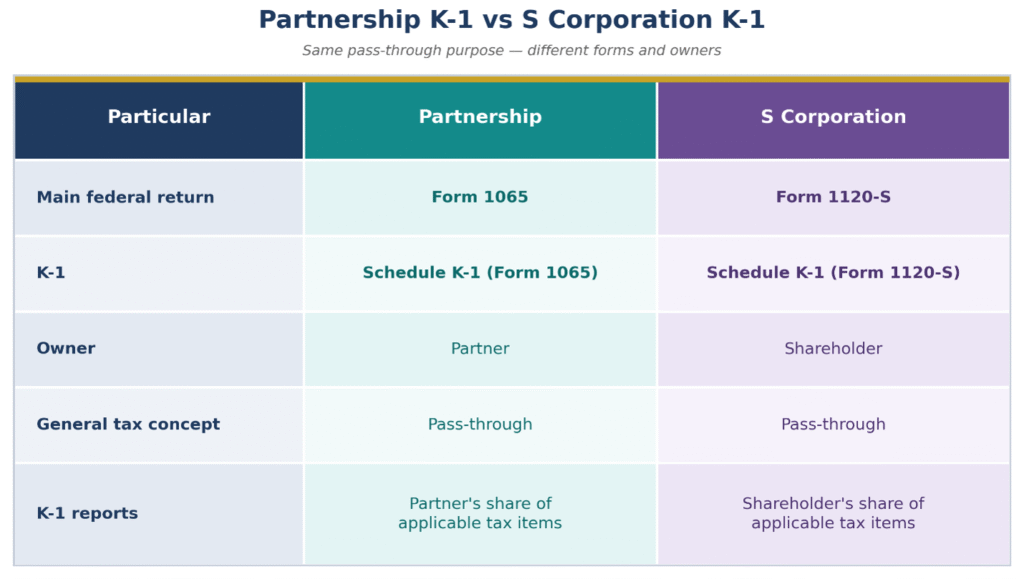
Although the purpose is similar, the tax rules governing partnerships and S Corporations are not identical.
This distinction becomes important when working with actual tax returns.
05 What Information Does a K-1 Report?
A Schedule K-1 can contain various types of tax information.
Depending on the entity and circumstances, this may include:
- Ordinary business income or loss
- Rental income or loss
- Interest income
- Dividend income
- Capital gains and losses
- Certain deductions
- Tax credits
- Other separately reported tax items
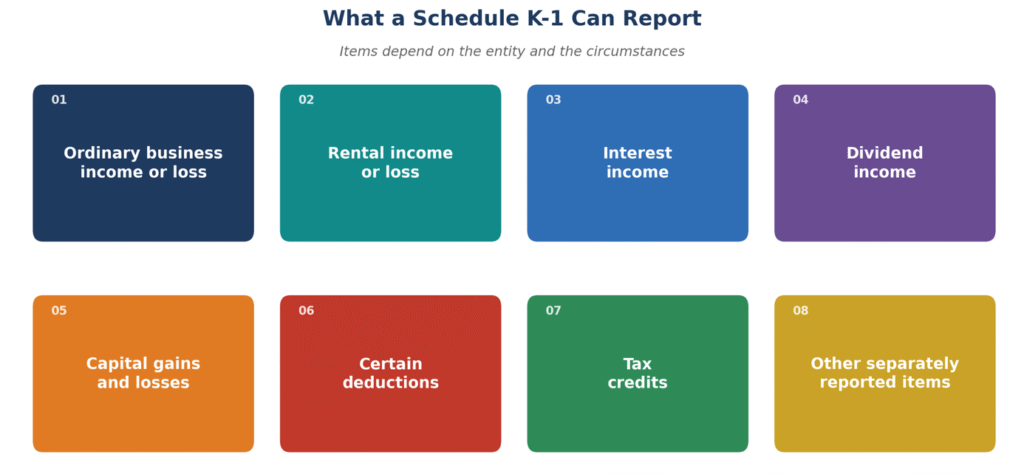
The K-1 therefore provides more than a single “income” figure.
Different tax items may receive different treatment when they reach the owner’s individual tax return.
For a tax professional, the ability to read and interpret a K-1 correctly is therefore important.
06 K-1 Income is Not Necessarily Cash Received
Andrew: Professor, if my K-1 shows $50,000 of income, does that mean I received $50,000 in cash?
Professor: Not necessarily.
This is an important distinction.
A K-1 generally reports the owner’s share of applicable tax items. It should not automatically be treated as a statement of cash distributions.
For example, suppose a partnership allocates $50,000 of taxable income to a partner. The partner may not necessarily have received $50,000 in cash during the year.
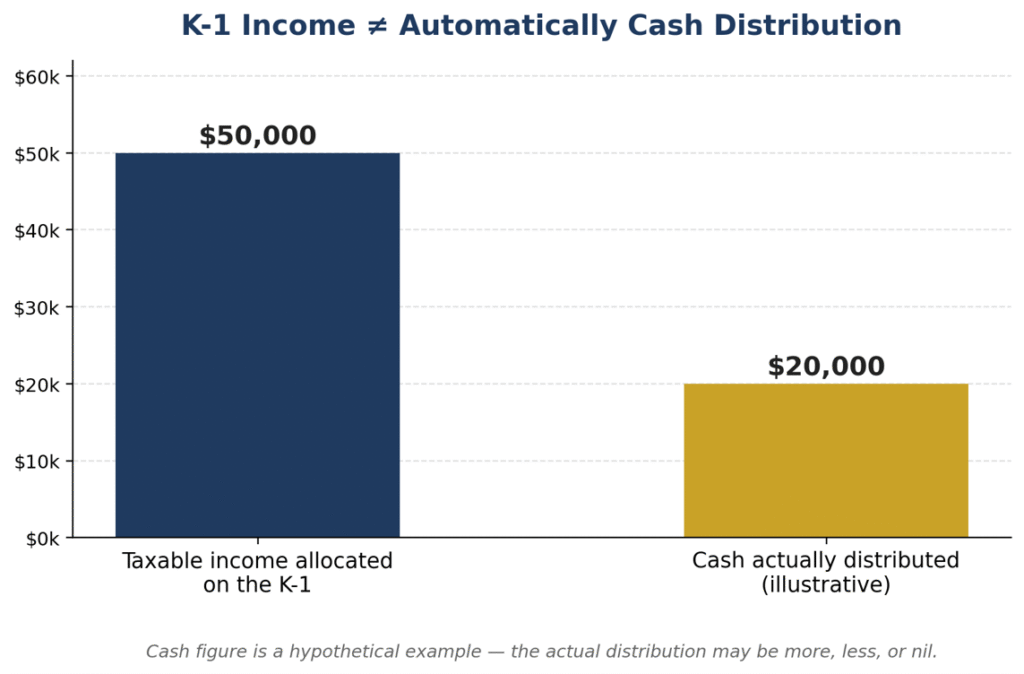
Therefore:
K-1 Income ≠ Automatically Cash Distribution
This concept is particularly important when analyzing pass-through taxation.
07 What About a C Corporation?
This is where the distinction becomes very important.
A C Corporation does not use Schedule K-1 to pass its corporate income through to shareholders.
A C Corporation generally files:
Form 1120 — U.S. Corporation Income Tax Return
The corporation’s taxable income is generally subject to corporate-level federal income taxation.
If shareholders subsequently receive dividends, those dividends are generally dealt with separately under the applicable tax rules.
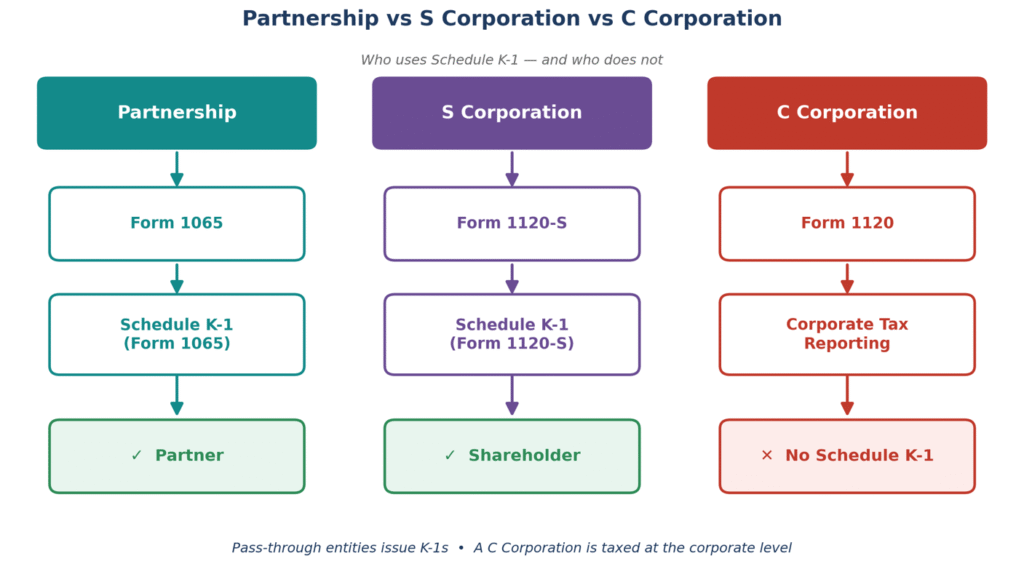
This is one of the most important differences between the three structures.
08 The K-1 Tax Flow — Remember This!
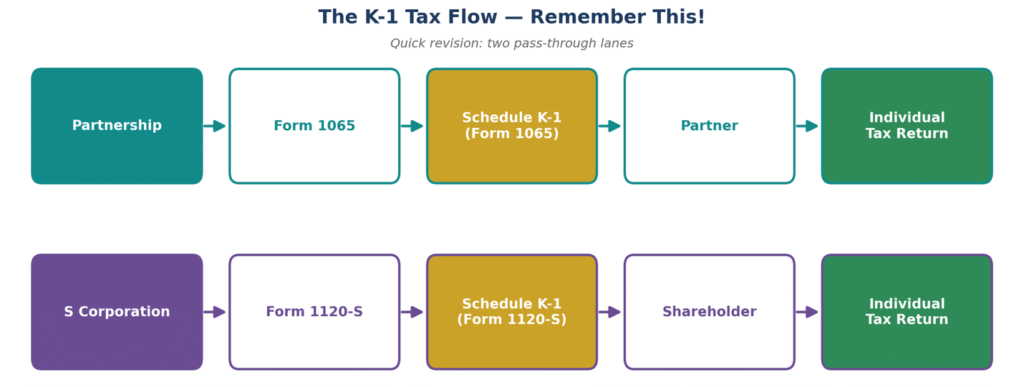
Once this flow is understood, the purpose of Schedule K-1 becomes much easier to remember.
09 U.S. Tax Interview Quick Questions
| Q1. Which K-1 is used by a partnership? Answer: Schedule K-1 (Form 1065). |
| Q2. Which K-1 is used by an S Corporation? Answer: Schedule K-1 (Form 1120-S). |
| Q3. Does a C Corporation use Schedule K-1 to pass corporate income to shareholders? Answer: No. |
These three questions alone can help establish whether a candidate understands the basic structure of U.S. pass-through taxation.
✔ Quick Check
Q1. A partnership generally files:
A. Form 1040
B. Form 1065
C. Form 1120
D. Form 1120-S
Q2. An S Corporation generally files:
A. Form 1065
B. Form 1120
C. Form 1120-S
D. Form 1040
Q3. A partnership’s K-1 is:
A. Schedule K-1 (Form 1065)
B. Schedule K-1 (Form 1120)
C. Schedule K-1 (Form 1040)
D. Schedule K-1 (Form 1120-S)
Q4. An S Corporation’s K-1 is:
A. Schedule K-1 (Form 1065)
B. Schedule K-1 (Form 1120-S)
C. Schedule K-1 (Form 1120)
D. Schedule K-1 (Form 1040)
Q5. Does a C Corporation generally use Schedule K-1 to pass corporate income through to shareholders?
A. Yes
B. No
| ANSWERS 1 — B | 2 — C | 3 — A | 4 — B | 5 — B |
Conclusion
Schedule K-1 is a fundamental concept in understanding U.S. pass-through taxation.
The simplest way to remember it is:
| Partnership: Form 1065 → Schedule K-1 → Partner S Corporation: Form 1120-S → Schedule K-1 → Shareholder C Corporation: Form 1120 → Corporate Tax Reporting → No Schedule K-1 |
Andrew: Professor, so the key is not just remembering ‘K-1,’ but knowing which K-1 belongs to which entity.
Professor: Exactly. Once you understand that connection, you have a strong foundation for moving into the taxation of each business structure.
⚠ DISCLAIMER
For educational purposes only. This content provides a high-level overview of U.S. federal tax fundamentals for students and should not be construed as tax, legal, or professional advice. U.S. federal tax rules can vary depending on the taxpayer’s facts, entity classification, tax year and applicable exceptions. Always refer to current IRS instructions and applicable law before filing.
Really appreciate the self assessment part of this blog.
Expecting the way of practice for our upcoming blog.
Thank You Sir