

When we think about U.S. federal income tax returns, Form 1040 usually comes to mind.
But what happens when the taxpayer is not an individual? A nonprofit organization, a deceased person’s estate, or a trust may have completely different federal filing obligations.
Two important forms in this area are:
Form 990 — Return of Organization Exempt From Income Tax
Form 1041 — U.S. Income Tax Return for Estates and Trusts
Although both forms relate to entities rather than ordinary individual taxpayers, they serve completely different purposes. Let’s understand the difference through a practical example.
01 THE BIG PICTURE
Think of the two forms this way:
FORM 990 ASKS:
What did this tax-exempt organization do financially and operationally during the year?
FORM 1041 ASKS:
What income did this estate or trust earn, what deductions are available, and how much income is taxable to the entity or passed through to beneficiaries?
That distinction is the starting point for understanding the two forms.
02 WHAT IS FORM 990?
Form 990 is an annual information return generally filed by organizations that are exempt from federal income tax under Section 501(a). It provides the IRS and the public with information about the organization’s:
- Activities
- Revenue and expenses
- Assets and liabilities
- Governance
- Compensation
- Programs and operations
- Certain transactions and relationships
The IRS explains that organizations generally must file Form 990 when they have gross receipts of $200,000 or more or total assets of $500,000 or more, subject to specific exceptions.
IMPORTANT POINT
Being tax-exempt does not automatically mean “no IRS filing.” A tax-exempt organization may still have an annual reporting obligation — one of the most important concepts for students to remember.
03 WHICH FORM 990 SHOULD AN ORGANIZATION FILE?
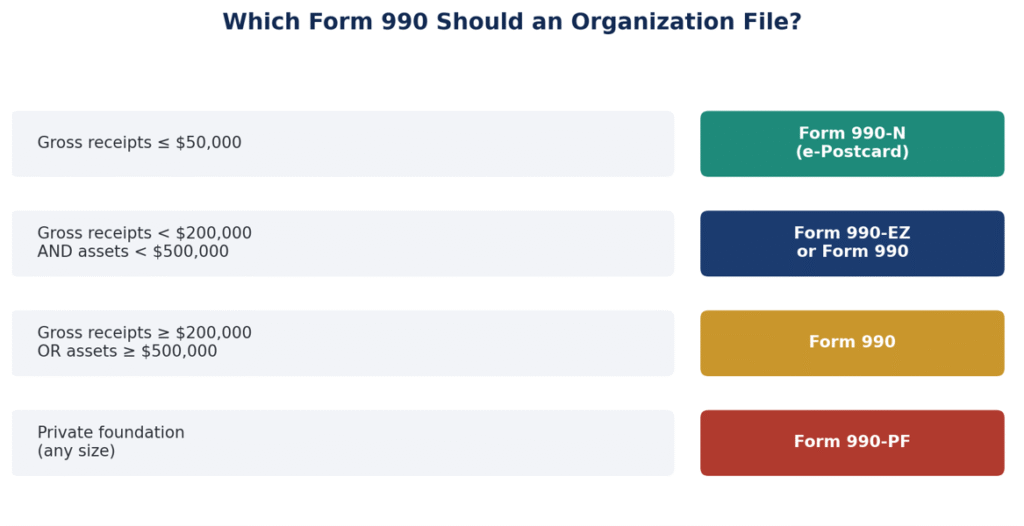
The Form 990 family contains several forms. These thresholds come from the IRS’s current Form 990-series guidance:
| Organization’s Situation | Generally Applicable Filing |
| Gross receipts normally ≤ $50,000 | Form 990-N may generally be used |
| Gross receipts < $200,000 AND assets < $500,000 | Form 990-EZ or Form 990 |
| Gross receipts ≥ $200,000 OR assets ≥ $500,000 | Form 990 |
| Private foundation | Form 990-PF |
A NOTE ON FORM 990-N
Form 990-N is commonly called the e-Postcard. It is designed for most small tax-exempt organizations whose annual gross receipts are normally $50,000 or less.
04 ARE ALL TAX-EXEMPT ORGANIZATIONS REQUIRED TO FILE FORM 990?
No.
A COMMON MISCONCEPTION
All tax-exempt organizations must file Form 990. This statement is too broad. Certain organizations are excepted from the Form 990 / 990-EZ filing requirement.
Examples include certain:
- Churches
- Integrated auxiliaries of churches
- Religious organizations
- Governmental organizations
- Certain foreign organizations
- Other specifically excluded organizations
Private foundations generally file Form 990-PF instead of Form 990. The organization’s type and financial circumstances must always be examined.
Tax-exempt status ≠ automatic Form 990 filing in every case.
05 WHAT IS FORM 1041?
Now let’s move to a completely different world. Form 1041 — U.S. Income Tax Return for Estates and Trusts — is generally used by a fiduciary to report the income, deductions, gains, losses and other tax information of a domestic estate or trust.
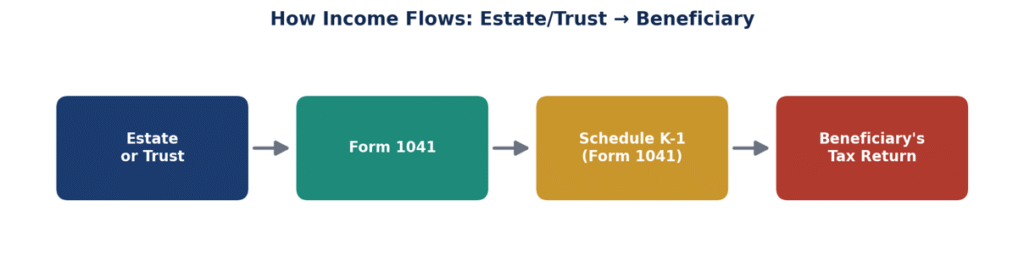
Form 1041 reports income earned by an estate or trust, and distributions to beneficiaries may be reported through Schedule K-1. Typical income may include:
- Interest
- Dividends
- Capital gains
- Rental income
- Business income, where applicable
- Other investment income
For an estate, the return commonly covers income earned by estate assets after the person’s death while the estate is being administered.
06 WHO MUST FILE FORM 1041?
For a Domestic Estate — the fiduciary generally must file if:
- Gross income is $600 or more, or
- The estate has a nonresident alien beneficiary, or
- Certain other filing triggers apply.
For a Domestic Trust — the fiduciary generally must file if:
- The trust has any taxable income, or
- Gross income is $600 or more, regardless of taxable income, or
- The trust has a nonresident alien beneficiary, or
- Certain other filing triggers apply.
So, unlike Form 990, Form 1041 is not about whether the organization is “nonprofit.” It is about income taxation and reporting of estates and trusts.
07 FORM 1041 AND SCHEDULE K-1
An estate or trust may earn income and then distribute income to beneficiaries. The fiduciary may report the beneficiary’s distributive share on Schedule K-1 (Form 1041). The beneficiary then uses that information in determining what must be reported on their own tax return.
IN SIMPLE TERMS
The IRS describes estates and trusts as having an income distribution deduction, with beneficiaries generally reporting their distributive share of income.
08 FORM 990 VS FORM 1041 — THE CORE DIFFERENCE
| Particulars | Form 990 / 990-EZ | Form 1041 |
| Primary taxpayer / entity | Tax-exempt organization | Estate or trust |
| Main purpose | Annual information / reporting return | Income tax return |
| Main focus | Activities, finances & governance | Income, deductions, gains, losses & distributions |
| Typical filer | Nonprofit / tax-exempt organization | Fiduciary |
| Beneficiary reporting | Generally, not the central concept | Schedule K-1 is important |
| Tax-exempt status | Generally relevant | Not the defining feature |
| Small-entity threshold | 990-N / 990-EZ rules apply | $600 and other filing tests apply |
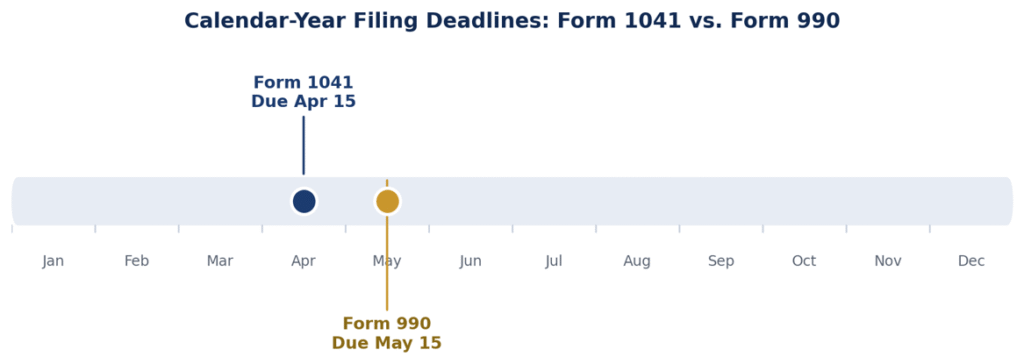
| Typical calendar-year due date | May 15 (5th month after year-end) | April 15 (4th month after year-end) |
| Extension form | Form 8868 (automatic 6-month extension) | Form 7004 (5.5 months for trusts; 6 months for estates) |
09 DUE DATE — FORM 1041
For a calendar-year estate or trust, Form 1041 and applicable Schedule K-1s are generally due by April 15 of the following year. For a fiscal-year estate or trust, the return is generally due on the 15th day of the fourth month following the close of the tax year.
EXAMPLE
Suppose a trust’s tax year ends December 31, 2025.
Its Form 1041 is generally due April 15, 2026.
An automatic extension can generally be requested using Form 7004.
10 DUE DATE — FORM 990
For an organization whose accounting period ends December 31, Form 990 is generally due May 15 of the following year. The general rule: 15th day of the 5th month after the end of the organization’s accounting period.
| Fiscal Year-End | Initial Form 990 Due Date | With Form 8868 Extension (6 months) |
| December 31, 2025 (calendar year) | May 15, 2026 | November 15, 2026 |
| June 30, 2025 | November 15, 2025 | May 15, 2026 |
| March 31, 2026 | August 15, 2026 | February 15, 2027 |
An organization can generally request an automatic six-month extension using Form 8868.
11 A SMALL CASE STUDY
Let’s meet two very different taxpayers.
Case A — Hope Community Foundation
Hope Community Foundation is a U.S. tax-exempt charitable organization. During 2025:
- Gross receipts = $350,000
- Total assets = $650,000
- It operates charitable programs
- It is not a private foundation
- It is not one of the organizations specifically exempted from Form 990 filing
QUESTION
Which form should Hope Community Foundation generally consider?
ANSWER
Because its gross receipts exceed $200,000 and its assets exceed $500,000, it generally falls into the Form 990 filing category. If it follows a calendar year, its Form 990 due date is May 15, 2026.
Case B — The Estate of Mr. Robert Brown
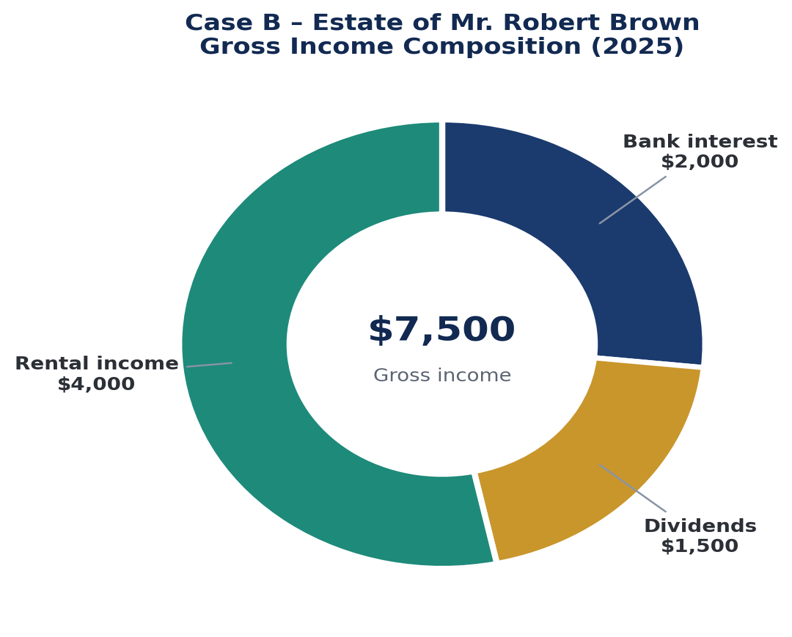
Mr. Brown passed away in 2025. After his death, his estate continued to hold bank deposits, dividend-paying shares, and a rental property. During the estate’s administration in 2025, the estate earned:
| Income | Amount |
| Bank interest | $2,000 |
| Dividends | $1,500 |
| Rental income | $4,000 |
| Gross income | $7,500 |
QUESTION
Does the estate have a Form 1041 filing issue?
ANSWER
Yes. The estate has gross income exceeding $600, so the fiduciary generally must file Form 1041. If it is a calendar-year estate, the Form 1041 due date is April 15, 2026.
12 THE INTERESTING TWIST
Now imagine that the estate distributes part of its income to a beneficiary. Suppose estate income available for distribution is $7,500, and the estate distributes $5,000 to the beneficiary.
The fiduciary may need to report the beneficiary’s distributive share through Schedule K-1 (Form 1041). The beneficiary then considers the K-1 information when preparing their own tax return.
Form 1041 can connect the tax reporting of an estate or trust with the tax reporting of its beneficiaries.
13 ONE MORE IMPORTANT DISTINCTION: EXEMPT DOES NOT MEAN ‘NO FILING’
This is perhaps the most important lesson from the comparison. A nonprofit organization may be exempt from federal income tax but still have an annual IRS reporting obligation.
Similarly, an estate or trust is not simply “exempt” because it is not an individual. Its income may be taxable at the estate/trust level, passed through to beneficiaries, or subject to specific fiduciary tax rules.
NEVER START WITH
‘Is it tax-exempt?’ — Instead, ask what type of entity it is, what income it received, and whether a filing requirement applies.
14 QUICK MEMORY TRICK
For students preparing for interviews or practical tax work, remember:
| Code | Stands For | Due Date Rule (Calendar Year) |
| 990 | Organization (nonprofit) | 5th month → May 15 |
| 1041 | Estate / Trust | 4th month → April 15 |
15 FINTAXLENS TAKEAWAY
Form 990 and Form 1041 may appear together in discussions of U.S. tax compliance, but they belong to two very different tax worlds.
Form 990 focuses on the reporting and transparency obligations of qualifying tax-exempt organizations. Form 1041 focuses on the federal income tax reporting of estates and trusts, and can act as the bridge between fiduciary income and beneficiary reporting through Schedule K-1.
Understanding the entity first is therefore the key to selecting the correct U.S. tax form:
Understanding the entity first is therefore the key to selecting the correct U.S. tax form:
STEP 1 Identify the taxpayer
STEP 2 Identify the income
STEP 3 Identify the filing requirement
STEP 4 Identify the form
STEP 5 Identify when the return is due
US Tax | Individual Tax | Business Tax | Estates & Trusts | Nonprofit Tax
DISCLAIMER
For educational purposes only. This content provides a high-level overview of U.S. federal tax fundamentals for students and should not be construed as tax, legal, or professional advice. U.S. federal tax rules can vary depending on the taxpayer’s facts, entity classification, tax year and applicable exceptions. Always refer to current IRS instructions and applicable law before filing.