
Understanding How a Manufacturing Business Really Works

David, a young MBA Finance student, had joined Aarohan Manufacturing Ltd. as a Finance Intern for a six-month internship.
The company manufactured industrial components used in engineering and infrastructure projects. Its factory was busy with production activities, while the corporate office handled procurement, sales, finance and administration.
David reported to Mr. Sen, the Finance Controller.
David: Good morning, Sir. I am excited to begin my internship. During my MBA, I studied accounting, corporate finance, costing and financial management. But I am curious to understand how these subjects actually work together in a manufacturing company.
Mr. Sen: Good morning, David. That’s a good starting point. Let me tell you something. A manufacturing company is not merely a place where raw materials are converted into finished products. It is a business ecosystem where every operational activity has a financial consequence.
David: Does that mean the finance department is connected with almost every department?
Mr. Sen: Exactly! Let’s take a journey through our factory. You will gradually understand why finance professionals must understand the business before interpreting its numbers.
1. Understanding the Business Cycle
Mr. Sen takes David to the factory floor.
Mr. Sen: David, before opening an accounting ledger, you must understand how the business operates.
David: Where does the financial journey begin?
Mr. Sen: It begins with procurement.
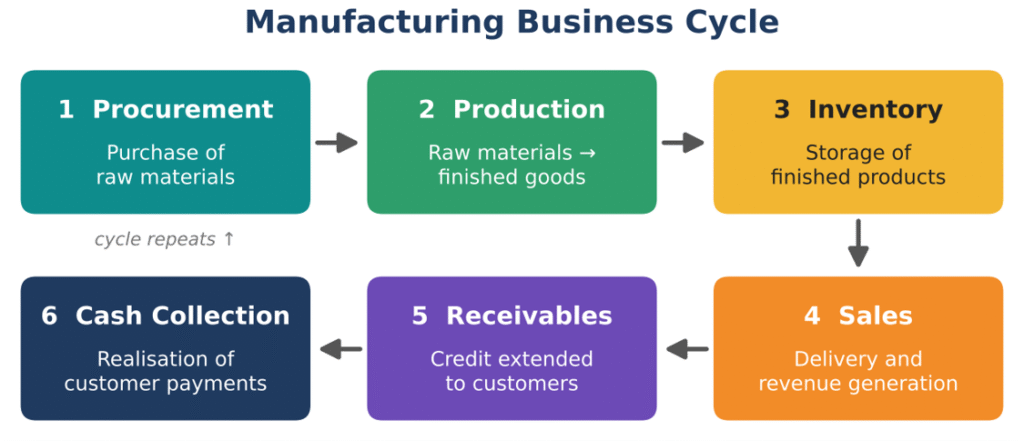
The company purchases raw materials, uses labour and machinery to manufacture products, stores finished goods, sells them to customers and eventually collects the money.
David: I can see the sequence now. But where does accounting enter this picture?
Mr. Sen: At every stage! A purchase creates an accounting transaction. Production involves cost accumulation. Sales generate revenue and receivables. Collections affect cash and bank balances
David: So, accounting records the financial impact of business activities, while finance analyses what those activities mean for the organisation?
Mr. Sen: Well said!


2. The First Numerical Lesson: What Does It Cost to Manufacture?
Mr. Sen gives David a simple production statement
Mr. Sen: Suppose our factory manufactures 1,000 industrial components in a month. Let’s understand the production cost.


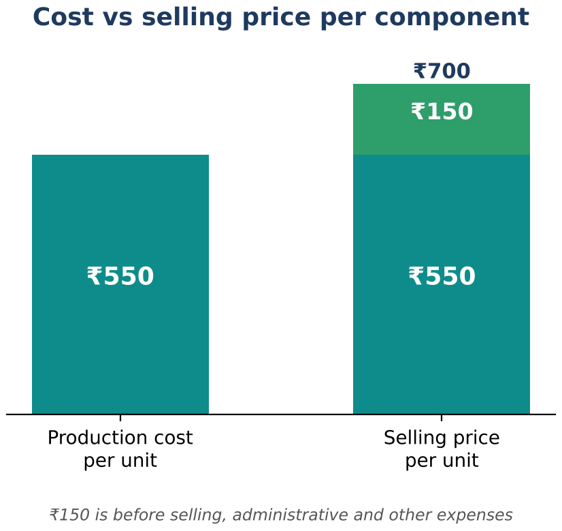
David: Then the cost of manufacturing one component is ₹550?
Mr. Sen: Correct. Let’s calculate it.

David: If we sell each component for ₹700, the difference is ₹150 per unit.
Mr. Sen: Correct, but remember that this is the difference between selling price and production cost. Selling, administrative and other expenses must also be considered to determine overall profitability.
David: I understand. Costing helps us determine what we spend to manufacture, while pricing and profitability analysis help us understand whether the business is commercially viable.
Mr. Sen: Exactly. You are beginning to connect the concepts.
3. A Question That Changes David’s Thinking
David: Sir, if the company manufactures products, sells them at a profit and records revenue, does that mean its financial position is healthy?
Mr. Sen smiles.
Mr. Sen: Not necessarily, David. Here is something you should never forget: profitability and liquidity are two different dimensions of financial performance.

Suppose the company sells products worth ₹20 lakh on 60 days’ credit. Its suppliers, however, expect payment within 30 days.

David: That means the company may have to pay suppliers before collecting money from customers.
Mr. Sen: Precisely. Even a profitable business can face a cash shortage.
This is where working capital management becomes important. We will explore this in our next episode.
4. Connecting the Concepts
David now begins to understand that different areas of finance are not isolated subjects. They are interconnected parts of the same business process.