

Imagine a manufacturing company that expects the price of copper to rise over the next three months. At the same time, another company that produces copper is worried that market prices may fall before it sells its inventory.
Both companies face price uncertainty. But can they protect themselves without necessarily buying or selling the underlying commodity today?
This is where financial options become relevant.
In the derivatives market, Call Options and Put Options provide participants with the right, but not the obligation, to buy or sell an underlying asset at a predetermined price within a specified period or on a specified date.
Let us understand these concepts through a conversation between a Professor and a Finance student.
Understanding the Call Option
Student: Professor, I understand that derivatives derive their value from an underlying asset. But what exactly is a Call Option?
Professor: A Call Option gives its buyer the right, but not the obligation, to purchase an underlying asset at a predetermined price, known as the Strike Price, within or on the specified expiry period.
Student: So, if I expect the price of a share to increase, I should consider purchasing a Call Option?
Professor: Precisely! You are anticipating a price increase. A Call Option allows you to participate in that potential upside without purchasing the underlying asset immediately.
Business Scenario 1: Rantix Ltd. – Managing Rising Raw Material Prices
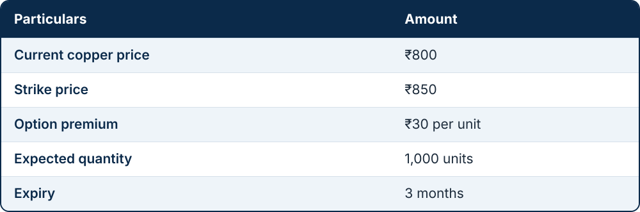
Consider Rantix Ltd., a manufacturing company that requires 1,000 units of copper after three months for its production process.
The current market price of copper is ₹800 per unit.
The procurement manager anticipates that copper prices may rise to ₹950. However, the company does not want to purchase and store the copper immediately.
Instead, the company purchases a Call Option with the following terms:
Student: Professor, why would Rantix Ltd. pay ₹30 per unit when it can simply wait and purchase copper later?
Professor: Because the company is purchasing price protection. The premium of ₹30 gives it the right to purchase copper at ₹850, even if the market price increases substantially.
Let us examine three possible market situations at expiry.
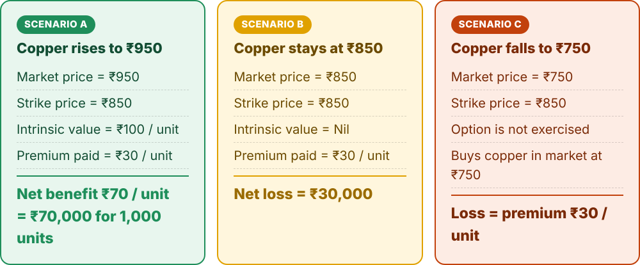
Student: So, the company exercises the option only when the market price is higher than the strike price?
Professor: Correct. Remember, the buyer has a right, not an obligation.

Understanding the Put Option
Student: Professor, what happens when a business expects prices to fall rather than rise?
Professor: Excellent question! This is where a Put Option becomes useful.
A Put Option gives its buyer the right, but not the obligation, to sell an underlying asset at a predetermined strike price.
The buyer generally purchases a Put Option when anticipating a decline in the market price or when seeking protection against a fall in the value of an asset.
Business Scenario 2: Green Harvest Ltd. – Protecting Selling Prices
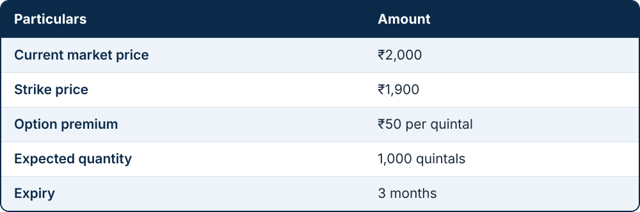
Consider Green Harvest Ltd., an agricultural producer, expecting to sell 1,000 quintals of a commodity after three months.
The current market price is ₹2,000 per quintal.
The company is concerned that market prices may decline before the harvest is sold.
It purchases a Put Option with these terms:
Student: Professor, how does the Put Option protect Green Harvest Ltd.?
Professor: It gives the company the right to sell at ₹1,900, even if the market price falls below that level.
Let us evaluate three possible outcomes.
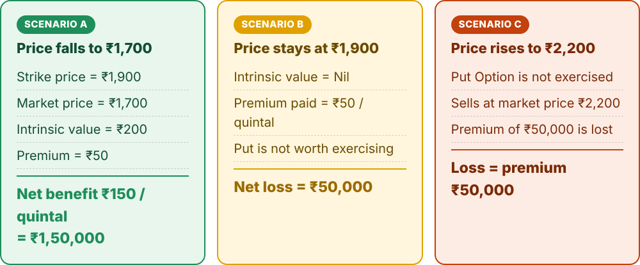
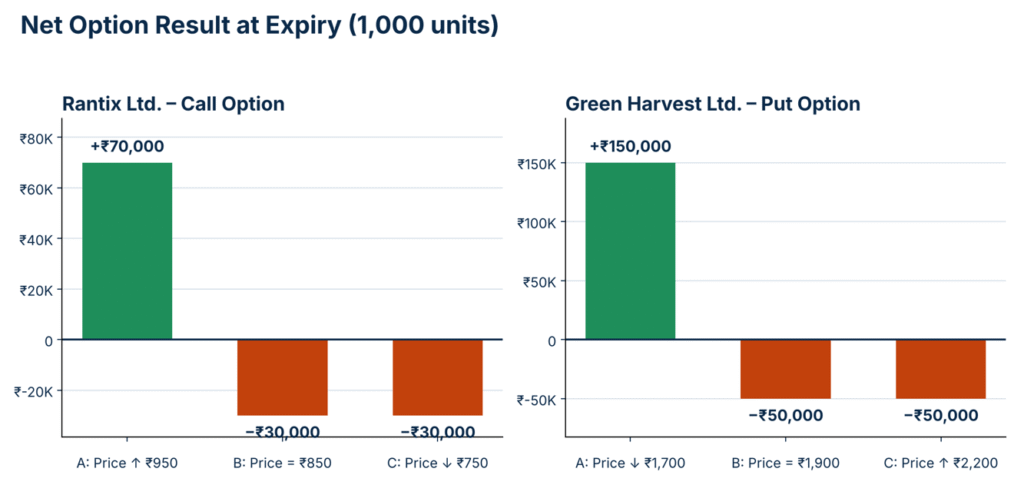
Student: So, a Put Option buyer benefits when the market price falls, whereas a Call Option buyer benefits when the market price rises?
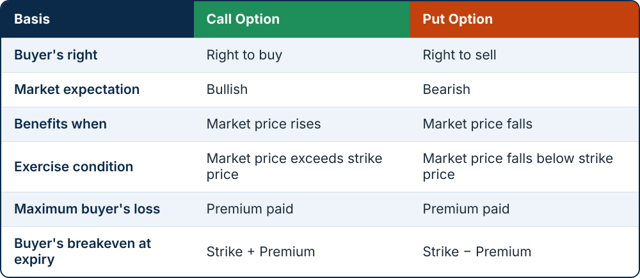
Professor: Exactly! That is the fundamental distinction.
Call vs Put – The Fundamental Difference
What About the Option Seller?
Student: Professor, we have discussed the buyer of an option. Who sells these options?
Professor: An option seller is also known as an Option Writer. The writer receives the premium from the buyer and undertakes the corresponding contractual obligation.
There is an important difference between the buyer and the writer.
- The option buyer has a right but no obligation to exercise.
- The option writer receives the premium but must honour the contractual obligation if the option is exercised.
Student: Does the option writer always make a profit because the premium is received upfront?
Professor: Not necessarily! Consider the following:
- A Call Option writer may incur substantial losses if the underlying market price rises significantly.
- A Put Option writer may incur substantial losses if the underlying market price falls substantially.
Therefore, the premium received is not automatically a profit. It is compensation for accepting risk.
Understanding the Payoff – A Quick Numerical Comparison
Let us assume the following:
- Call Option strike price: ₹100
- Call premium: ₹10
- Put Option strike price: ₹100
- Put premium: ₹8
The following table illustrates the buyer’s net profit or loss at expiry.
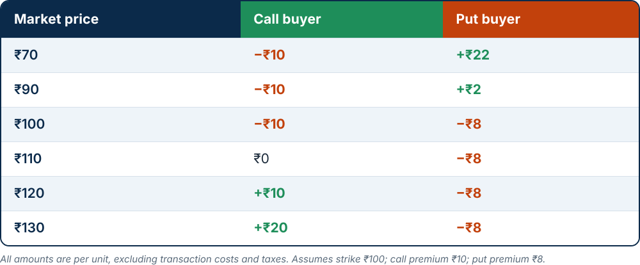
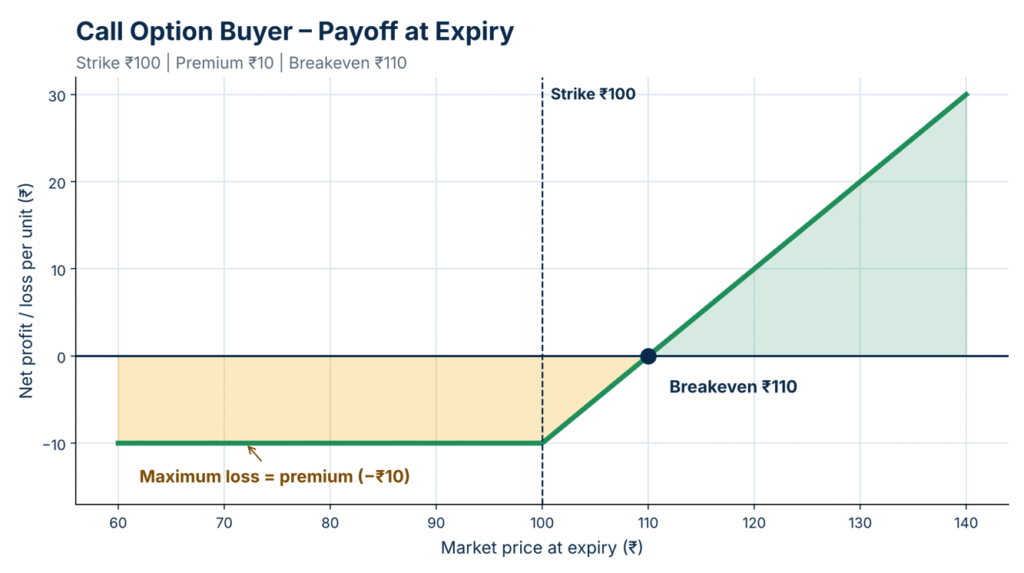
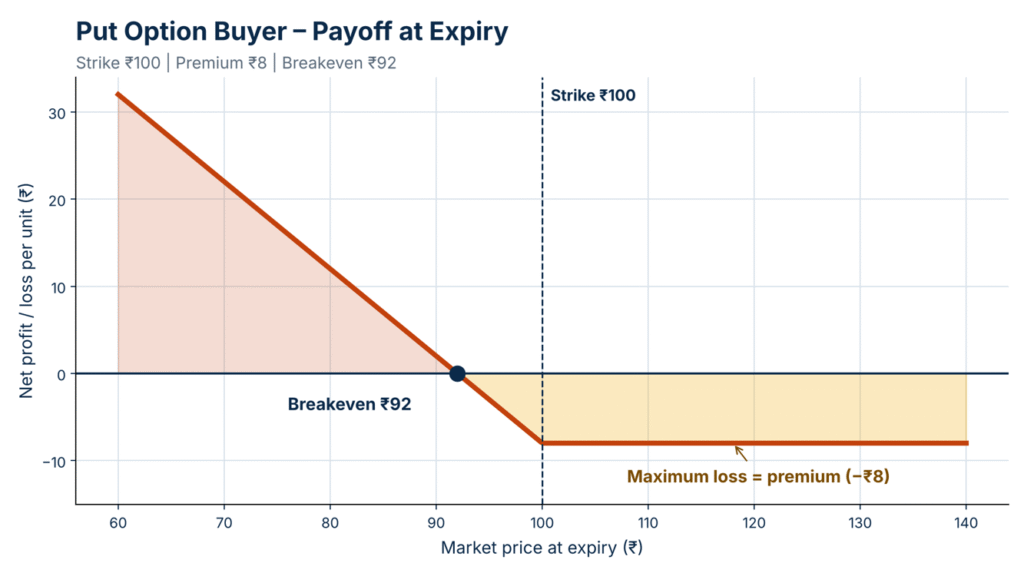
Professor’s observation: Notice that the Call Option buyer starts earning a net profit only above ₹110, whereas the Put Option buyer starts earning a net profit below ₹92.
These are their respective breakeven prices.
The Business Decision – Which Option Should You Choose?
Student: Professor, can we summarise the business applications?
Professor: Certainly. Consider these practical situations:
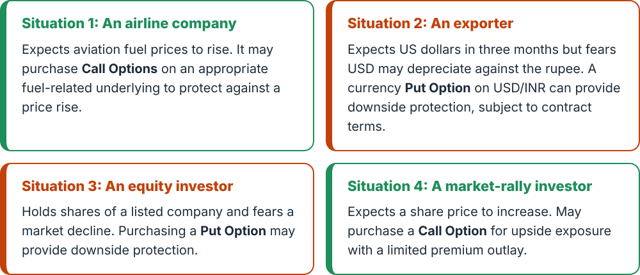
Professor: Remember, options are not merely instruments for speculation. They are also important tools for corporate risk management, financial planning and portfolio protection.
Test Your Understanding – Professor’s Classroom Challenge
Professor: Let me give you three situations. Identify the appropriate option strategy.
- Question 1: A company expects the price of crude oil to increase over the next three months. Which option should it consider purchasing?
- Question 2: An investor holds shares worth ₹5 lakh and anticipates a possible decline in their market value. Which option could provide downside protection?
- Question 3: A trader purchases a Call Option with a strike price of ₹500 by paying a premium of ₹25. At expiry, the share price is ₹560. What is the net profit per share?
Answer Key
- Call Option.
- Put Option.
- Intrinsic value = ₹560 − ₹500 = ₹60. Net profit = ₹60 − ₹25 = ₹35 per share.
The Professor’s Final Word
Professor: Financial derivatives become easier to understand when we connect them with actual business decisions.
A Call Option provides the right to buy at a predetermined price and is generally useful when anticipating a price increase.
A Put Option provides the right to sell at a predetermined price and is generally useful when anticipating a price decline or protecting an existing position.
But remember one important principle:
An option is a right, not an obligation. The premium is the price paid for that right.
Understanding this distinction is the foundation of options trading and risk management.

Educational Disclaimer: This article is intended solely for academic and educational purposes. The business scenarios and numerical illustrations are hypothetical and do not constitute investment advice or a recommendation to trade in financial derivatives.