
Understanding EOQ, Stock Levels, Procurement Documentation, GST and Practical Accounting
David had spent the previous few days understanding inventory, receivables and working capital. Today, Mr. Sen, the Finance Controller, had something different planned for him.
Mr. Sen: Good morning, David. Today, we are going to move from financial analysis to practical accounting.
David: Good morning, Sir. Does that mean I will finally get to work with actual purchase documents and accounting entries?
Mr. Sen: Exactly! I want you to understand how a manufacturing company controls its raw materials, authorises purchases, receives goods, records supplier invoices and accounts for materials issued to production.
David: That sounds interesting. But where does the process begin?
Mr. Sen: It begins much before the purchase journal. First, we must understand how much material the company should order and when it should order.
1. Economic Order Quantity — How Much Should We Order?
Mr. Sen takes David to the inventory planning section.
Mr. Sen: David, suppose our factory requires 24,000 units of a particular raw material every year. Should we order all 24,000 units at once?
David: That would reduce the number of purchase orders, but it could increase storage and holding costs.
Mr. Sen: Correct. What if we order very small quantities frequently?
David: Then ordering and procurement costs may increase.
Mr. Sen: Precisely. We need to find an economical order quantity that balances ordering costs and inventory holding costs.
This is where Economic Order Quantity, commonly known as EOQ, becomes useful.


David: So, the company should ideally order approximately 2,191 units each time?
Mr. Sen: Under the assumptions of the EOQ model, yes. However, actual purchase decisions must also consider supplier conditions, storage capacity, price discounts, production schedules and lead times.
David: Does EOQ mean that we should always maintain 2,191 units in the store?
Mr. Sen: Not at all! EOQ determines the economical order quantity. It does not determine the minimum or maximum stock level.
That brings us to another important aspect of inventory control.
2. Understanding Inventory Stock Levels
David: Sir, how does the stores department decide when to place the next order?
Mr. Sen: Through stock-level monitoring. Let us understand four important concepts.
A. Reorder Level
The stock level at which a fresh purchase order should be initiated.

B. Minimum Stock Level
The lowest stock level that should normally be maintained to avoid interruption in production.

C. Maximum Stock Level
The upper limit of inventory that should normally be maintained.

D. Safety Stock
An additional buffer maintained to meet unexpected demand or supply delays.
Practical Illustration
Assume the following material consumption data:
Assume the following material consumption data:



David: So, if stock falls to 840 units, the stores department should initiate a fresh order?
Mr. Sen: Correct. And the minimum stock of 340 units acts as a safeguard under our assumed normal consumption and lead-time conditions.
David: And the maximum stock level helps us avoid unnecessary accumulation of materials.
Mr. Sen: Exactly!

3. The Procurement Process — From PR to GRN
Mr. Sen now takes David to the procurement and stores department.
Mr. Sen: David, let us assume the stores department identifies a requirement for 1,000 units of raw material.
David: Does the stores department directly place an order with the supplier?
Mr. Sen: No. A controlled procurement process must be followed.
Step 1: Purchase Requisition (PR)
The user department or stores department raises a Purchase Requisition indicating:
- Material description and specification.
- Quantity required.
- Required delivery date.
- Purpose or production requirement.
- Departmental approval.
David: So, the PR is an internal request for purchasing materials?
Mr. Sen: Correct. It is not a purchase order and does not by itself create a purchase liability.
Step 2: Purchase Order (PO)https://fintaxlens.com/the-finance-behind-the-factory/
After approval, the procurement department issues a Purchase Order to the selected supplier.
A PO normally contains:

David: Does issuing a PO create an accounting entry?
Mr. Sen: Normally, no. A purchase order is an authorisation and commitment document, not by itself a recognised purchase transaction.
Step 3: Goods Receipt Note (GRN)
When the supplier delivers the materials, the stores department checks:
- Quantity received.
- Material specifications.
- Physical condition.
- Quality inspection.
- Accepted and rejected quantities.
The stores department prepares a Goods Receipt Note (GRN).
David: So, the GRN confirms that the goods have actually been received?
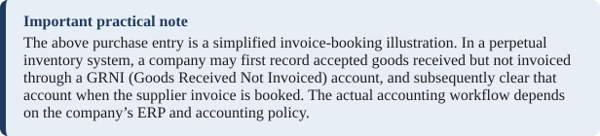
Mr. Sen: Yes. But remember, receipt of goods and receipt of a valid supplier tax invoice are two different events.
Step 4: Supplier Tax Invoice and Three-Way Matchinghttps://fintaxlens.com/the-finance-behind-the-factory-episode-2/
The accounts department compares:
- Purchase Order — What did we order?
- GRN — What did we receive and accept?
- Supplier Tax Invoice — What has the supplier billed?
This is known as Three-Way Matching.
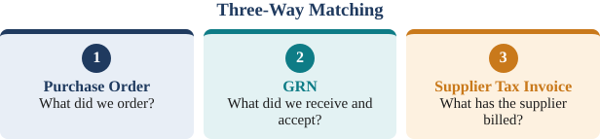
If the quantities, rates and other relevant terms agree, the invoice can proceed for accounting and payment processing.
If discrepancies exist, they must be investigated before the invoice is approved.
Illustrative Procurement Document Flow


David: I now understand that the purchase transaction is supported by several documents, each serving a different control purpose.
Mr. Sen: Precisely. Documentation is an important part of internal financial control.
4. Practical Case — Purchase of Raw Materials with GSThttps://fintaxlens.com/new-gen-gst-a-revolutionary-approach/
Mr. Sen gives David a set of procurement documents.
Mr. Sen: Now, let’s record a purchase transaction.
Aarohan Manufacturing Ltd. places an order for 1,000 units of raw material at ₹500 per unit.
Assume the entire quantity is received, inspected and accepted. The supplier issues a valid intra-state tax invoice, and the company is eligible for the stated input tax credit.
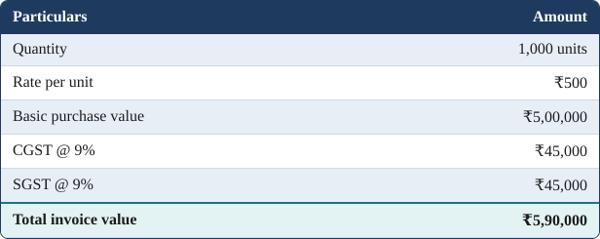

David: Sir, why are we recording CGST and SGST separately?
Mr. Sen: Because this is an illustrative intra-state transaction. In an inter-state transaction, the applicable integrated GST would generally be recorded instead.
Journal Entry 1 — Recording Material Purchase
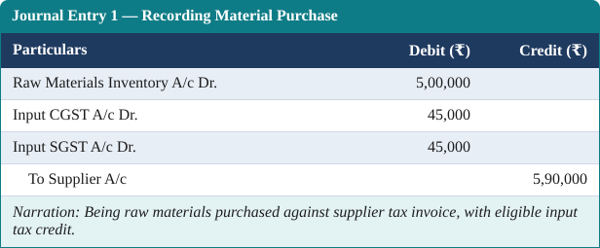
David: So, the input GST is not added to the cost of raw materials when the credit is eligible?
Mr. Sen: Correct. Recoverable input GST is accounted for separately. If the input tax credit is unavailable or ineligible, the applicable tax may form part of the cost, subject to the relevant accounting requirements.
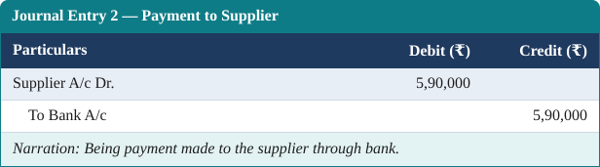
David: What happens when we make payment to the supplier?
Mr. Sen: Let us assume the company pays the supplier through its bank account.
Journal Entry 2 — Payment to Supplierhttps://fintaxlens.com/understanding-journal-entries-in-accounting/
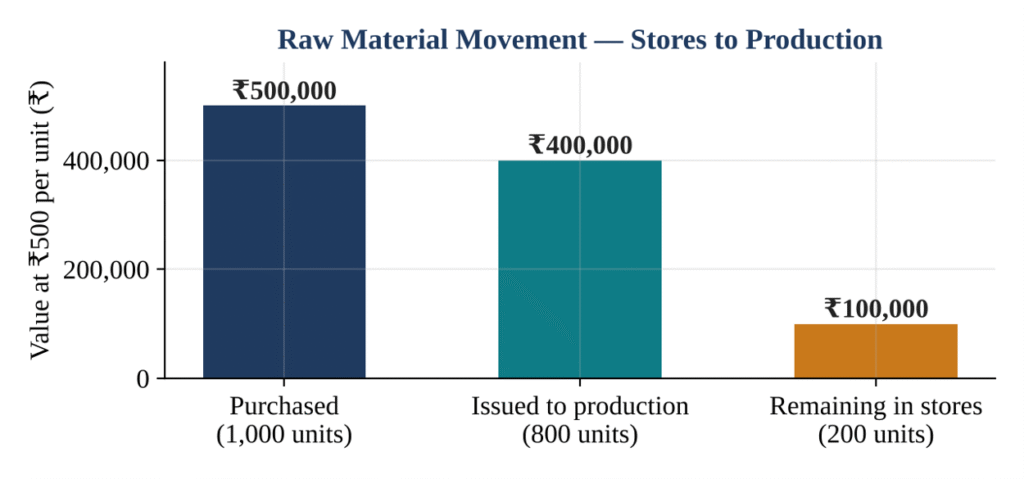
5. Material Issue and Consumption — From Stores to Production
David: Sir, once materials are purchased and recorded in the inventory account, how are they transferred to production?
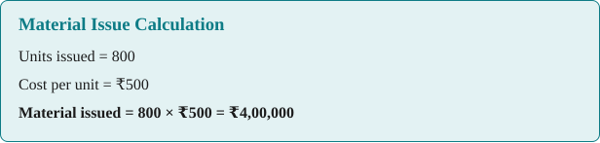
Mr. Sen: Through a Material Requisition or Material Issue Note authorised by the production department.
Suppose production requires 800 units of raw material.
Journal Entry 3 — Issue of Materials to Production
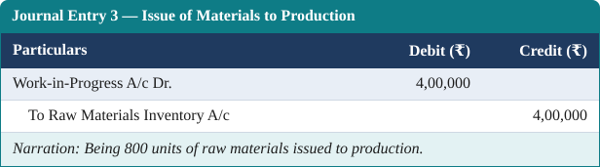
David: So, the material cost moves from raw material inventory into Work-in-Progress?
Mr. Sen: Exactly. This is how direct material cost becomes part of production cost.
The remaining 200 units continue to remain in raw material inventory, assuming no other material movements.
6. Scrap Accounting — What Happens to Material Waste?
During the production process, David notices that some material pieces are separated and placed in a designated scrap area.
David: Sir, what happens to these leftover material pieces? Are they simply written off?
Mr. Sen: Not necessarily. We must first identify the nature of the scrap.
There are different categories:

David: How does accounting treat these categories?
Mr. Sen: The treatment depends on their nature and recoverable value.
A. Normal and Recoverable Scrap
Assume normal scrap generated during production has an estimated recoverable value of ₹12,000.
For this simplified illustration, the scrap is separately recognised at that value, reducing the cost attributable to production.
Journal Entry 4 — Recognition of Recoverable Scrap

B. Sale of Scrap
Suppose the company subsequently sells the scrap for ₹12,000 plus GST at an assumed illustrative rate of 18%.

Journal Entry 5 — Sale of Scrap


C. Abnormal Material Loss
David: What if the scrap arises because of machine breakdown or careless handling?
Mr. Sen: That may be an abnormal loss rather than normal process scrap.
Abnormal material loss is not treated as an ordinary production cost. It is separately identified and charged to the appropriate loss or expense account, subject to the applicable accounting framework.

Very easily explained in simple term sir . thank you for this.