
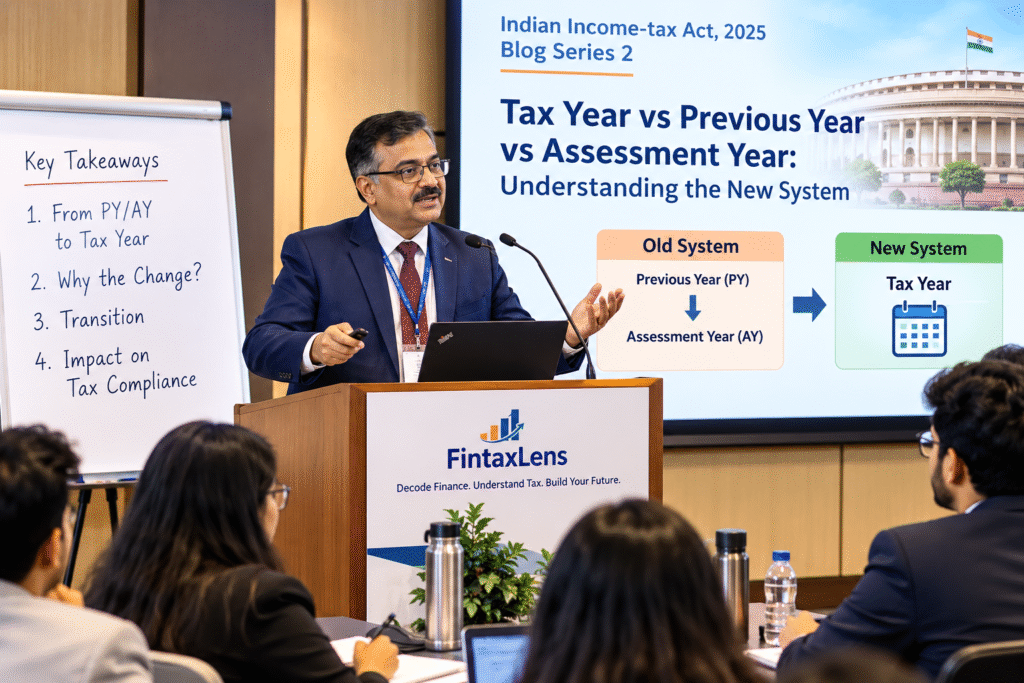
If you have been filing income-tax returns in India, you are probably familiar with terms such as Financial Year (FY), Previous Year (PY), and Assessment Year (AY).
But from 1 April 2026, the new Income-tax Act, 2025 introduces a simpler framework centred around the term ‘Tax Year.‘
So, what exactly has changed?
And more importantly, how should a student, employee, professional or business owner understand the new system?
Let us decode it step by step.
1 First, understand the old system
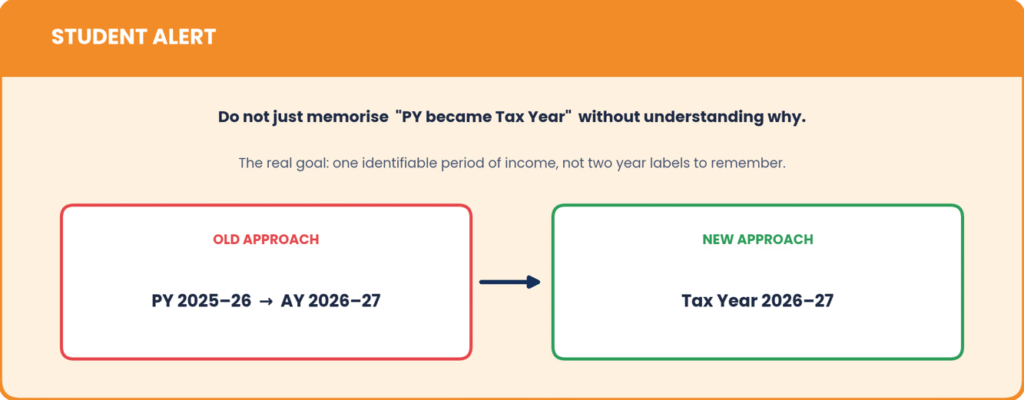
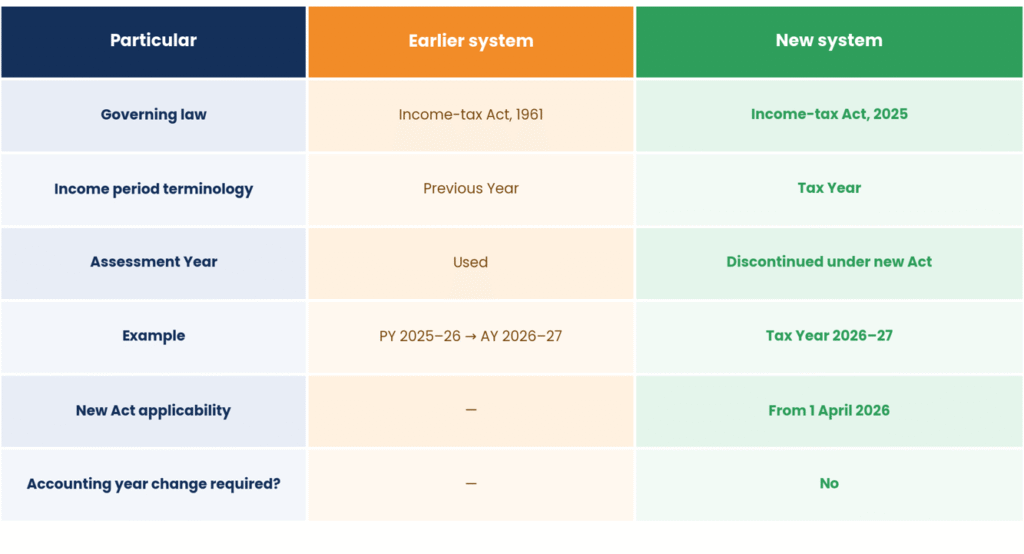
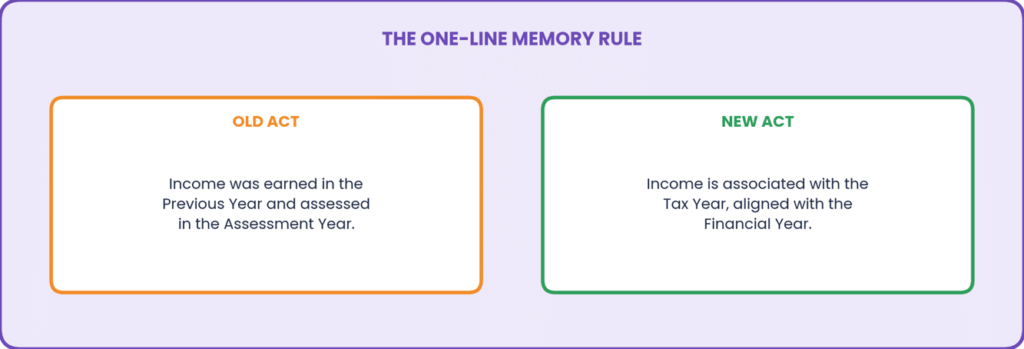
Under the Income-tax Act, 1961, two different years were commonly used: the Previous Year (PY), in which income was earned, and the Assessment Year (AY), in which the income of the Previous Year was assessed and the return was filed.
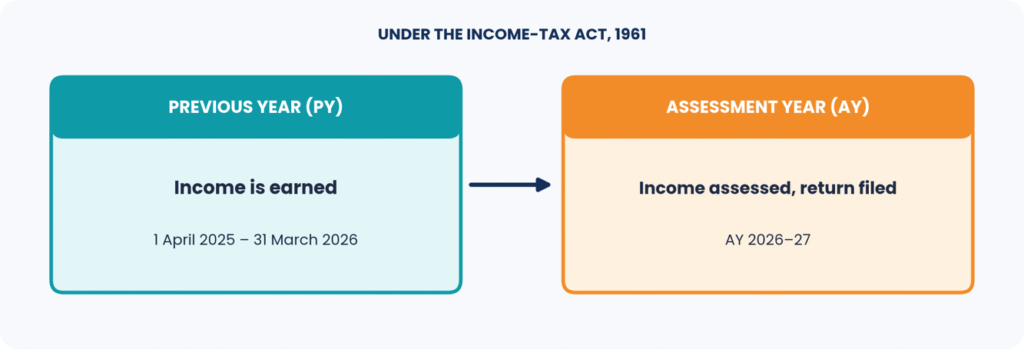
So, one period of income was identified using PY 2025–26, while its tax assessment was identified using AY 2026–27.
This dual terminology could be confusing, particularly for students and new taxpayers.
2 What changes under the Income-tax Act, 2025?
The new Act replaces the term “Previous Year” with “Tax Year.” It also discontinues the concept of Assessment Year under the new Act.
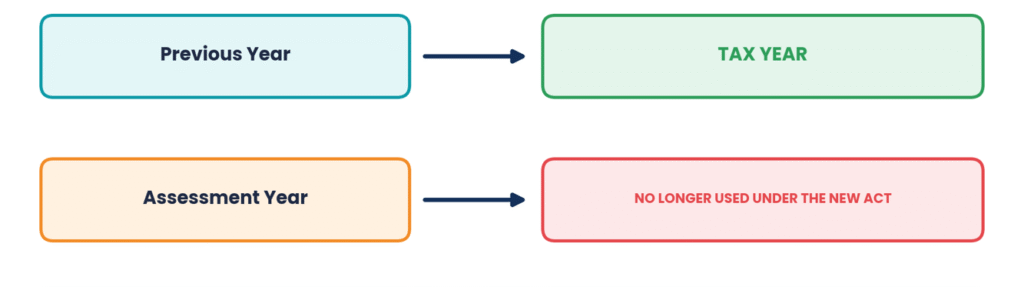
The important idea is that the Tax Year corresponds to the period in which the income is earned. For income earned from 1 April 2026 onwards, the relevant period is referred to as Tax Year 2026–27.
3 The easiest way to understand the change
Think of it this way:
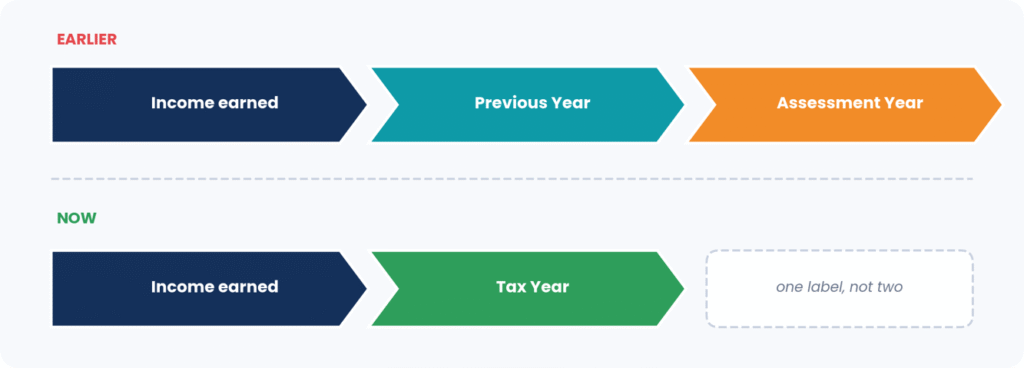
This is intended to remove the confusion created by having two different year labels for essentially connected stages of taxation. The Income Tax Department explains that aligning the Tax Year with the Financial Year/Previous Year eliminates the confusion created by the dual-year reference system.
4 A simple example
Suppose Riya earns salary from 1 April 2026 to 31 March 2027. Under the new Act, her income period, Financial Year and Tax Year line up as shown below.
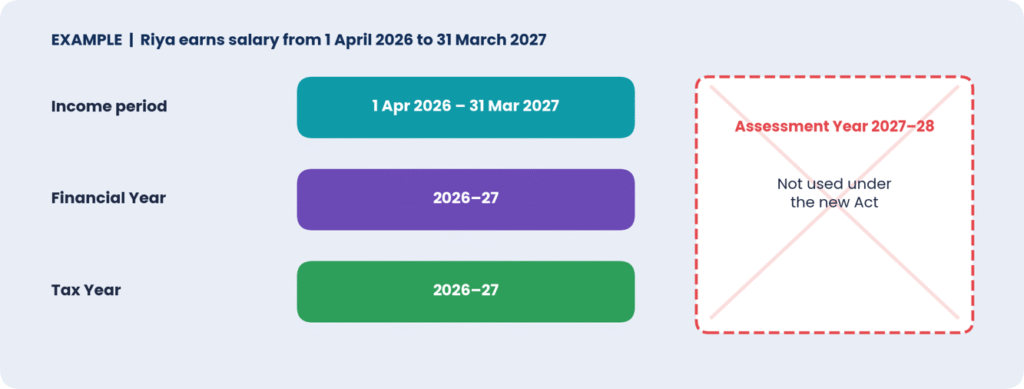
There is no separate Assessment Year 2027–28 under the new Act. The tax computation and return process will relate to the relevant Tax Year 2026–27. This makes the terminology much easier for a learner to follow.
5 What happens to FY 2025–26?
This is an extremely important transition point. There is no missing year and there is no overlap. Income earned during 1 April 2025 – 31 March 2026 continues to be governed by the Income-tax Act, 1961 and is associated with Assessment Year 2026–27. Income earned from 1 April 2026 – 31 March 2027 is governed by the Income-tax Act, 2025 and is referred to as Tax Year 2026–27.
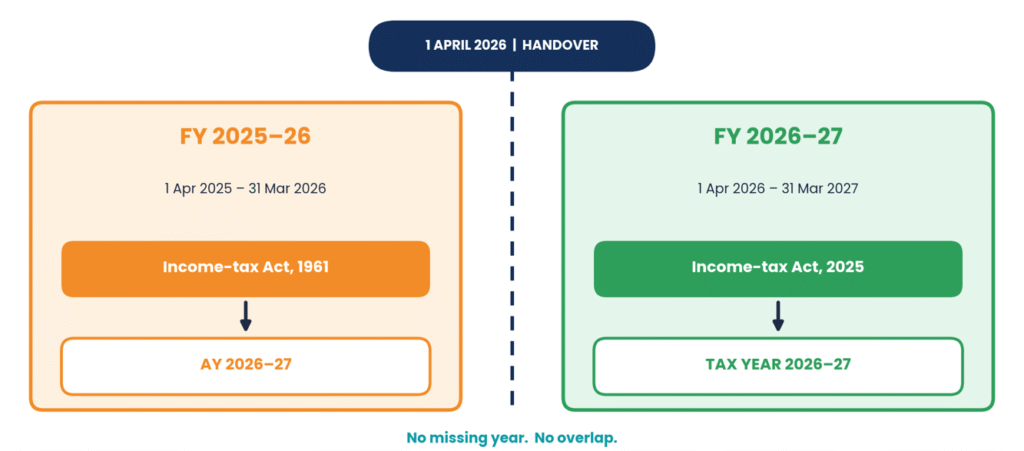
So, there is a clean handover on 1 April 2026.
6 Does the new Tax Year always mean 12 months?
Generally, a Tax Year corresponds to a period of twelve months contained in a Financial Year. However, there is an important exception. If a new business is established or a new source of income comes into existence during the Financial Year, the Tax Year can be shorter.
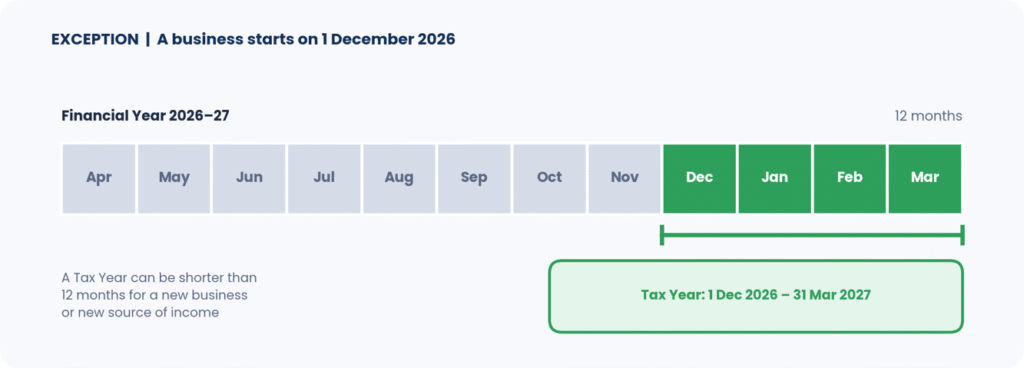
The Income Tax Department specifically provides this example in its guidance. This is an important point for students to remember.
7 What happens to earlier years?
The introduction of the new Act does not invalidate everything that happened under the Income-tax Act, 1961. For example, an assessment for an earlier year completed under the old Act remains valid. Similarly, certain pending proceedings relating to earlier years continue under the applicable transitional provisions.
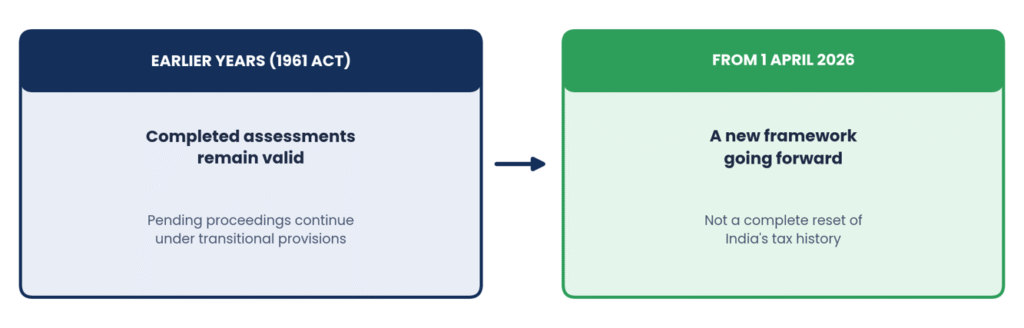
Therefore, we should not think of 1 April 2026 as a complete reset of India’s tax history. Instead, think of it as a new framework going forward, with transitional rules protecting the treatment of earlier years.
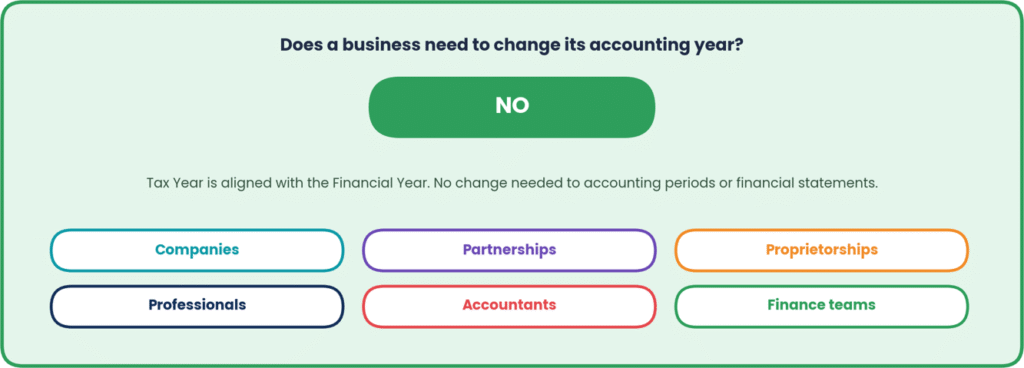
8 Does a business need to change its accounting year?
No. The introduction of the Tax Year does not require businesses to change their accounting periods. Since the Tax Year is aligned with the Financial Year, there is no requirement merely because of the new terminology to change the accounting year or financial statements. This is particularly important for:
9 What does this mean for tax compliance?
The change is more than a terminology exercise. Taxpayers will still need to manage the full compliance cycle:
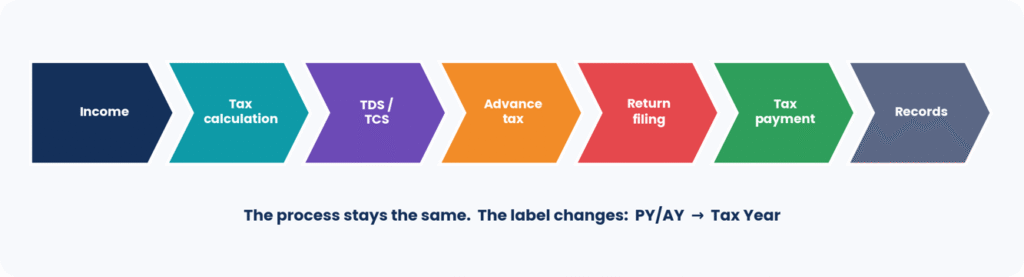
The difference is that the new framework uses Tax Year rather than the old PY/AY combination. For earlier Assessment Years, the old ITR forms continue to be relevant. The Income Tax Department has also stated that new ITR forms for Tax Year 2026–27 will be notified under the new framework.
10 A quick comparison
11 The one-line memory rule

Disclaimer:
Educational Purpose Only: This article is intended for general educational and informational purposes only. It does not constitute tax, legal, or professional advice. Tax laws and procedures may change; readers should refer to the latest official guidance or consult a qualified tax professional before making any tax-related decision
Sources (Income Tax Department)