Indian Direct Tax

Depreciation and provision for depreciation

Understanding Depreciation, Provision for Depreciation and Sale of Assets

Fixed assets such as machinery, furniture, vehicles and buildings are used by a business for generating income over several years. However, these assets generally lose their value over time due to usage, wear and tear, technological changes or obsolescence. This reduction in value is recognized as Depreciation. Accounting does not treat depreciation as an actual […]

Understanding Depreciation, Provision for Depreciation and Sale of Assets Read More »

Alternative Minimum Tax

Alternative Minimum Tax (AMT) and AMT Credit Adjustment – A Conceptual Overview

Alternative Minimum Tax (AMT), introduced for non-corporate taxpayers to address disparities in tax payments and prevent individuals from significantly reducing their tax liability through tax benefits. The AMT includes a provision for the carry forward of the AMT credit, which allows taxpayers to use the excess amount paid as AMT against their regular tax liability

Alternative Minimum Tax (AMT) and AMT Credit Adjustment – A Conceptual Overview Read More »

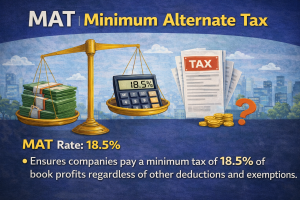
Minimum Alternate Tax (MAT): Concept and Practical Application

Minimum Alternate Tax (MAT) is an important provision under the Income Tax Act, 1961, designed to ensure that taxpayers with substantial income do not avoid tax liability by claiming various deductions and exemptions. However, students often face confusion regarding its applicability, computation, and differences. To build conceptual clarity, case-based learning can be highly effective. By

Minimum Alternate Tax (MAT): Concept and Practical Application Read More »

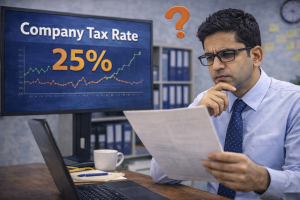
Tax rates for Indian Domestic Companies—Normal vs Concessional Regime

Under the Income Tax Act, 1961, domestic companies in India have the option to be taxed either under the normal provisions or under concessional tax regimes such as Section 115BAA of Income Tax Act and Section 115BAB. Under the normal provisions, the applicable tax rate depends on the company’s turnover. Companies with turnover up to

Tax rates for Indian Domestic Companies—Normal vs Concessional Regime Read More »

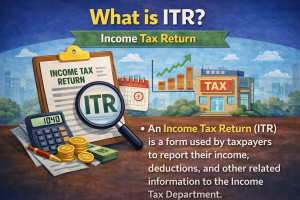
Understand ITR: Choosing the Right Form for Filing Income Tax

Filing the correct Income Tax Return (ITR) form is a crucial responsibility for taxpayers. However, many people—especially students and first-time filers—often get confused about which ITR form applies to their specific situation. This blog aims to simplify that confusion by providing a clear guide on ITR form numbers and their practical applicability, helping students and

Understand ITR: Choosing the Right Form for Filing Income Tax Read More »

Retirement benefits under income from salary

A Conceptual Overview of Retirement Benefits under the Head “Income from Salary”

During employment, many employees tend to focus mainly on their monthly take-home salary. However, an equally important aspect of compensation lies in retirement benefits such as Provident Fund (PF), Gratuity, Pension, Commuted Pension, and Leave Encashment. Under the provisions of the Income Tax Act, these benefits are taxed under the head “Income from Salary”, though

A Conceptual Overview of Retirement Benefits under the Head “Income from Salary” Read More »

Allowances and perquisites

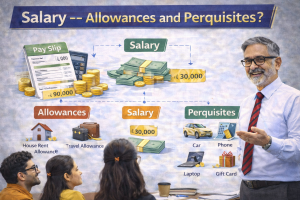
Allowances and Perquisites under Income from Salary

When you receive your first appointment letter, you will often find several components listed in your salary structure—basic pay, allowances, perquisites, reimbursements, and other benefits. For many fresh professionals, the terms “allowances” and “perquisites” can be confusing. It is important not to overlook these terms. Understanding them properly helps you interpret your salary structure, estimate

Allowances and Perquisites under Income from Salary Read More »

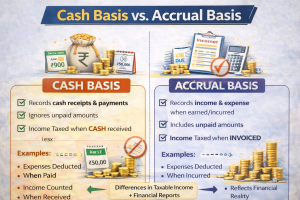
Understanding Accrual and Cash Basis of Accounting under PGBP

Accrual Basis of accounting is a fundamental accounting assumption for the preparation and presentation of financial statements as per Accounting Standard (AS) 1, disclosure of Accounting Policies. Additionally, Section 128 of the Companies Act,2013 requires maintenance of books of accounts by Companies on the Accrual Basis. Many businesses prefer to use cash accounting because the

Understanding Accrual and Cash Basis of Accounting under PGBP Read More »

PGBP vs Book Profit

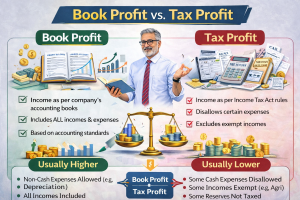
PGBP vs Book Profit – Including Cash Disallowance –Section 40A (3)

Section 43B of the Income Tax Act provides a list of expenses can be claimed as deductions from business income only in the year of actual payment and not in the year when the liability to pay such expenses is incurred. Section 40A (3) disallows tax deductions on expenses above Rs. 10,000 made in cash in a

PGBP vs Book Profit – Including Cash Disallowance –Section 40A (3) Read More »

TDS on Salary and Consequences of Non-Compliance

Good morning, students. This is my second class on TDS, because in our previous session some important questions remained unanswered. Today, we shall clarify them properly. He looked around the class and paused thoughtfully and asked Sweta… what is your question Sweta:Sir, in a company we make payments to contractors, suppliers, transporters and employees. We

TDS on Salary and Consequences of Non-Compliance Read More »