Accounting

Golden rules of accounting

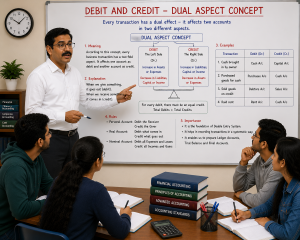
Basics of Golden Rules of Accounting and Accounting Equation with Dual Aspect Concept

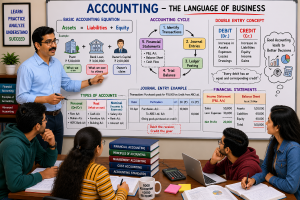
Accounting is often referred to as the language of business, but every language has its own grammar and rules. Similarly, the entire accounting system is built upon a few fundamental principles that ensure every business transaction is recorded accurately and systematically. Among these, the concepts of debit and credit, the Golden Rules of Accounting, the […]

Basics of Golden Rules of Accounting and Accounting Equation with Dual Aspect Concept Read More »

Cash Book, BRS and Cash Flow Statement

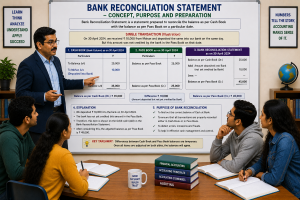
Cash Book, BRS and Cash Flow Statement (AS 3): How they are connected

Cash and bank balances represent the most liquid resources of a business. Their accurate recording is essential because they not only affect day-to-day operations but also influence the Balance Sheet and the Cash Flow Statement. To ensure proper control over these balances, accountants maintain a Cash Book and periodically prepare a Bank Reconciliation Statement (BRS).

Cash Book, BRS and Cash Flow Statement (AS 3): How they are connected Read More »

Accounting concepts and conventions

Concepts and Conventions in Accounting: Practical Insights for Students

Accounting is the language of business but often introduced as a subject of rules, formats, and calculations. But it is built on a set of fundamental concepts that give meaning and consistency to every number recorded. If students understand these concepts clearly, they don’t need to “memorize accounting”—they can reason out answers, even in interviews

Concepts and Conventions in Accounting: Practical Insights for Students Read More »

Historical cost vs fair value accounting

Historical Cost vs Fair Value Accounting: A Practical Understanding under AS and Ind AS

Financial statements are prepared according to a framework of accounting principles commonly known as GAAP (Generally Accepted Accounting Principles). GAAP includes accounting concepts, conventions, standards and disclosure requirements that guide companies in preparing financial statements in a consistent and comparable manner. Traditionally, Indian Accounting Standards (AS) largely emphasized the historical cost concept, under which assets

Historical Cost vs Fair Value Accounting: A Practical Understanding under AS and Ind AS Read More »

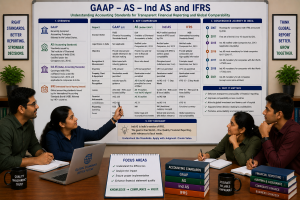
Understanding GAAP, AS, Ind AS and IFRS

In the modern business environment, financial statements are not prepared merely to calculate profit; they are prepared to communicate financial information in a structured, reliable and globally understandable manner. While studying accounting and corporate reporting, students frequently encounter terms such as GAAP, Accounting Standards (AS), Ind AS and IFRS, which often create conceptual confusion because

Understanding GAAP, AS, Ind AS and IFRS Read More »

PAT vs cash flow from operating activities

PAT vs Cash Flow from Operating Activities: A Practical Understanding under AS 3

In the world of accounting, “profit” and “cash” are not always the same. A company may report a strong Profit After Tax (PAT) under the Statement of Profit & Loss prepared in accordance with GAAP, Accounting Standards and Schedule III of the Companies Act, yet still face cash shortages in day-to-day operations. This happens because

PAT vs Cash Flow from Operating Activities: A Practical Understanding under AS 3 Read More »

Break-even point

Understanding Break-Even Point within Cost Concepts

In business, every activity involves a sacrifice of resources—materials, manpower, money and time. This sacrifice, when expressed in monetary terms, is known as cost. Whether a firm is manufacturing a product or providing a service, cost becomes the starting point for all financial decisions. But understanding cost is not just about knowing “how much” is

Understanding Break-Even Point within Cost Concepts Read More »

AS or IND AS – What’s the difference?

Accounting is a process of recording an organization’s financial transactions in order to make important decisions. In accounting, every financial transaction must be recorded in the books following a standard and consistent format.  If there were no common standards, different firms might follow their own rules and formats to record transactions and present financial statements.

AS or IND AS – What’s the difference? Read More »