
Introduction
The Federal Insurance Contributions Act (FICA) and the Self-Employment Contributions Act (SECA) are the two primary U.S. laws that finance the nation’s Social Security and Medicare programs. These programs provide financial security and healthcare benefits to eligible retirees, disabled individuals, and surviving family members.
Under FICA, employers are required to withhold Social Security and Medicare taxes from employees’ wages and contribute an equal matching amount. In addition, high-income employees may be subject to the Additional Medicare Tax of 0.9% on earnings above the prescribed threshold.
Individuals who are self-employed, such as consultants, freelancers, and independent contractors, are covered under SECA. Since they do not have an employer to share the employment tax burden, they are responsible for paying both the employee’s and employer’s portions of Social Security and Medicare taxes. However, the tax law provides relief by allowing them to deduct one-half of the self-employment tax when computing their Adjusted Gross Income (AGI).
It is important to understand that these employment taxes are separate from federal income tax. The contributions made under FICA and SECA help determine future Social Security retirement, disability, and survivor benefits.

1. Social Security wage base — a hard cap
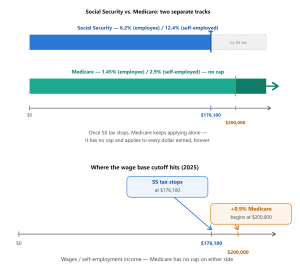
For 2025, an employee pays 6.2% Social Security tax on the first $176,100 of wages, making the maximum tax $10,918.20. Above that amount, Social Security tax simply stops entirely — it’s a hard cutoff. Once an employee’s wages exceed the wage base, only Medicare tax continues to be withheld.
For self-employed people (SECA), the same $176,100 cap applies to the 12.4% Social Security portion, for a maximum tax of $21,836.40.
2. Additional Medicare Tax — an add-on that kicks in, not a phase-out either
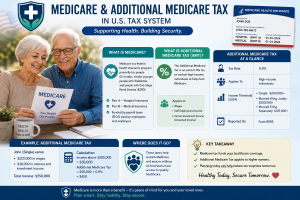
Medicare itself has no wage cap at all — all covered wages are subject to Medicare tax, with no wage base limit. But once wages cross a separate, higher threshold, an extra 0.9% get added on top of the regular 1.45%. 1.45% Medicare tax on the first $200,000 of wages ($250,000 for joint returns, $125,000 for married filing separately), plus 2.35% Medicare tax (regular 1.45% plus 0.9% additional) on all wages more than that threshold.
Learn
- Social Security: hard stop — the tax disappears completely above $176,100.
- Additional Medicare Tax: a step up — the rate jumps from 1.45% to 2.35% (employee) or stays 2.9%→3.8% (self-employed) once you cross $200,000/$250,000 and stays elevated on every dollar after that.
The following case study illustrates the practical differences between FICA and SECA through two taxpayers with similar incomes but different employment statuses.
Case Study: FICA vs. SECA – Who Pays What?
Learning Objective
After completing this case study, you should be able to:
- Distinguish between FICA and SECA.
- Calculate Social Security and Medicare taxes.
- Explain why self-employed individuals pay more employment tax than employees.
Case Background
Bob and Rahana each earn $100,000 during the tax year.
- Bob is a self-employed management consultant.
- Rahana is a software engineer employed by ABC Inc.
Both must contribute to the U.S. Social Security and Medicare system, but the tax rules applicable to them are different.
For this case, ignore:
- Social Security wage base limit
- Additional Medicare Tax
- Any deductions or income tax implications
Use the following tax rates:
| Particular | Rate |
| Social Security | 6.2% (Employee) + 6.2% (Employer) |
| Medicare | 1.45% (Employee) + 1.45% (Employer) |
Questions with Answers
Q1. Which tax law applies to Bob and which applies to Rahana?
Answer
Bob is self-employed, therefore SECA (Self-Employment Contributions Act) applies.
Rahana is an employee; therefore, FICA (Federal Insurance Contributions Act) applies.
Q2. How much FICA tax is deducted from Rahana’s salary?
Answer
| Social Security |
| = $100,000 × 6.2% |
| = $6,200 |
| Medicare |
| = $100,000 × 1.45% |
| = $1,450 |
| Total Employee FICA |
| = $7,650 |
Q3. How much will Rahana’s employers contribute?
Answer
Under FICA, the employer contributes an equal amount.
| Particular | Amount |
| Social Security | $6,200 |
| Medicare | $1,450 |
| Employer Contribution | $7,650 |
Q4. What is the total Social Security and Medicare contribution generated from Rahana’s employment?
Answer
| Employee Contribution | $7650 |
| Employer Contribution | $7650 |
| Total Contribution | $15300 |
Q5. How much SECA tax does Bob have to pay?
Answer
Since Bob has no employer, he must pay both the employee’s and employer’s portions.
| Social Security |
| = $100,000 × 12.4% |
| = $12,400 |
| Medicare |
| = $100,000 × 2.9% |
| = $2,900 |
| Total SECA Tax = $15,300 |
Q6. Why does Bob pay $15,300 while Rahana pays only $7,650?
Answer
Rahana pays only the employee’s share of Social Security and Medicare taxes. Her employer contributes an equal amount.
Bob, being self-employed, acts as both the employee and the employer. Therefore, he is responsible for paying both portions, resulting in a total SECA tax of 15.3%.
Q7. Does Bob receive any tax benefit for paying both portions?
Answer
Yes. Although Bob pays the full SECA tax, he is generally allowed to deduct one-half of the self-employment tax when calculating his Adjusted Gross Income (AGI). This deduction reduces taxable income for income tax purposes but does not reduce the SECA tax itself.
Q8. Compare Bob and Rahana.
| Particular | Bob (Self-Employed) | Rahana (Employee) |
| Annual Income | $100,000 | $100,000 |
| Applicable Law | SECA | FICA |
| Employee Pays | — | $7,650 |
| Employer Pays | — | $7,650 |
| SECA Paid | $15,300 | — |
| Total Social Security & Medicare Contribution | $15,300 | $15,300 |
Learning Point
FICA applies to employees, where the tax burden is shared equally between the employee and employer. SECA applies to self-employed individuals, who pay both portions because they have no employer to share the responsibility. However, they are generally allowed to deduct one-half of the self-employment tax when computing their Adjusted Gross Income (AGI).Disclaimer: This content is intended solely for educational purposes and classroom learning. It should not be interpreted as professional tax, legal, accounting, or financial advice. Readers should consult a qualified professional or refer to the latest IRS guidance for advice specific to their circumstances.
Very Very Insightful, helped me to get the actual concept behind fica and seca. Thanks a Lot sir.
nice to hear that the contents are becoming useful for your study!!
Very Good!
Thank you, Sir, for simplifying such an important US tax topic, Really helpful.
Very Easy to Learn
Good… Keep following
good to know… keep following
ok
Simple to understand Sir. Thank You.