

Accounting is not merely about preparing financial statements, it is about understanding how a business earns profit.
Every business performs several activities. Some are directly related to its core operations, such as purchasing raw materials, manufacturing products and selling goods. Others arise from supporting or financing activities, such as earning interest on bank deposits, selling old machinery or paying interest on loans.
For meaningful financial reporting, accounting separates these activities into operating and non-operating categories. This classification helps managers, investors and other stakeholders evaluate whether profits are generated from the core business operations or from incidental activities.
In this blog, we shall understand how direct income and manufacturing costs contribute to Gross Profit through the Trading Account, and how administrative expenses, selling and distribution expenses, finance costs and non-operating income are recognized in the Profit & Loss Account. By the end of this discussion, students will appreciate the logic behind the preparation of financial statements rather than simply memorizing their formats.
Professor: Good morning, everyone! Last class, we learned how to prepare the Trading Account and the Profit & Loss Account. Today, let’s understand why some incomes and expenses appear in the Trading Account while others appear in the Profit & Loss Account.
I have a simple question for all of you.
Suppose Stylish Furniture Ltd. manufactures and sells office furniture.
Question 1
Professor: What is the main objective of Stylish Furniture Ltd.?
Student A: Sir, to manufacture and sell furniture.
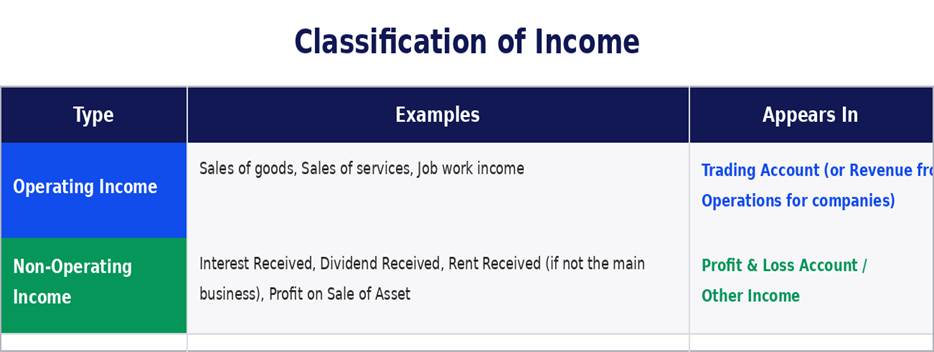
Professor: Exactly. Therefore, whatever income is earned from selling furniture is called Operating Income because it arises from the company’s principal business activity.
Now suppose the company earns interest on a fixed deposit or sells an old machine.
Is that its main business?
Students: No, Sir.
Professor: Therefore, these are Non-Operating Income.
Likewise, expenses incurred in manufacturing furniture are different from expenses incurred in running the office or paying interest on loans.
Professor: Imagine the company sells one of its old machines and earns a profit of ₹30,000.
Should this profit be treated like sales revenue?
Student E: No, Sir. Selling machinery is not the company’s regular business.
Professor: Very good! Therefore, profit on sale of fixed assets is also a Non-Operating Income.
That is why accounting separates them before arriving at the final profit.
Professor: Let’s think about expenses now.
The company pays wages to factory workers, purchases raw materials and incurs factory electricity expenses.
Where should these expenses be shown?
Student F: Trading Account, Sir.
Professor: Correct! Why?
Student G: Because these expenses are directly related to manufacturing the product.
Professor: Excellent. These are known as Direct or Manufacturing Expenses, and they help us determine the Gross Profit.
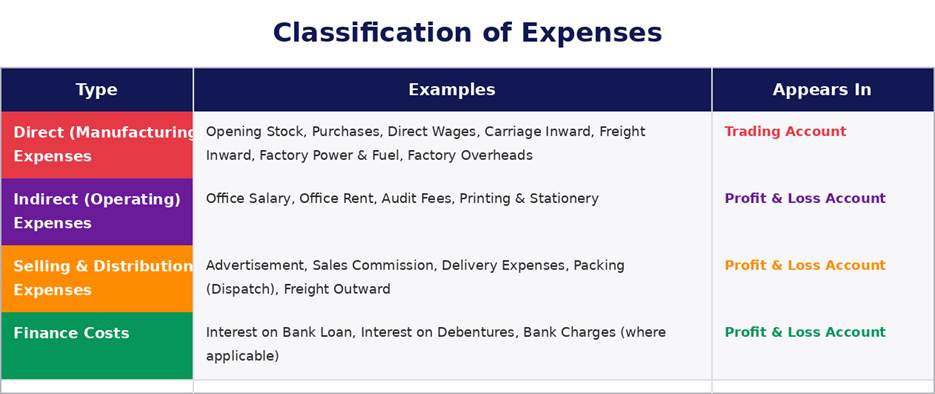
Professor: Now consider office salary, audit fees, office rent, advertising expenses and interest on a bank loan.
Should these be shown in the Trading Account?
Students: No, Sir.
Professor: Why not?
Student H: Because they are incurred after production or for running the business, not for manufacturing the product.
Professor: Precisely! These are Indirect Expenses, and they are recorded in the Profit & Loss Account to arrive at Net Profit.
Professor: So, can anyone summarize today’s discussion?
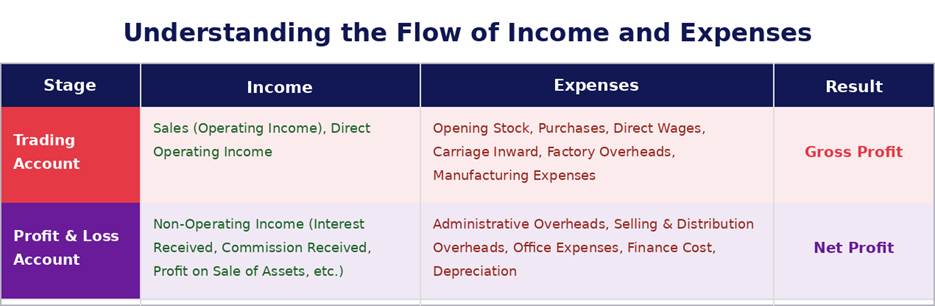
Student I: Sir, the Trading Account records income and expenses directly related to manufacturing or trading activities and helps calculate Gross Profit.
Student J: The Profit & Loss Account records indirect expenses, finance costs and non-operating income to determine Net Profit.
Professor: Well, done! Remember this simple rule:
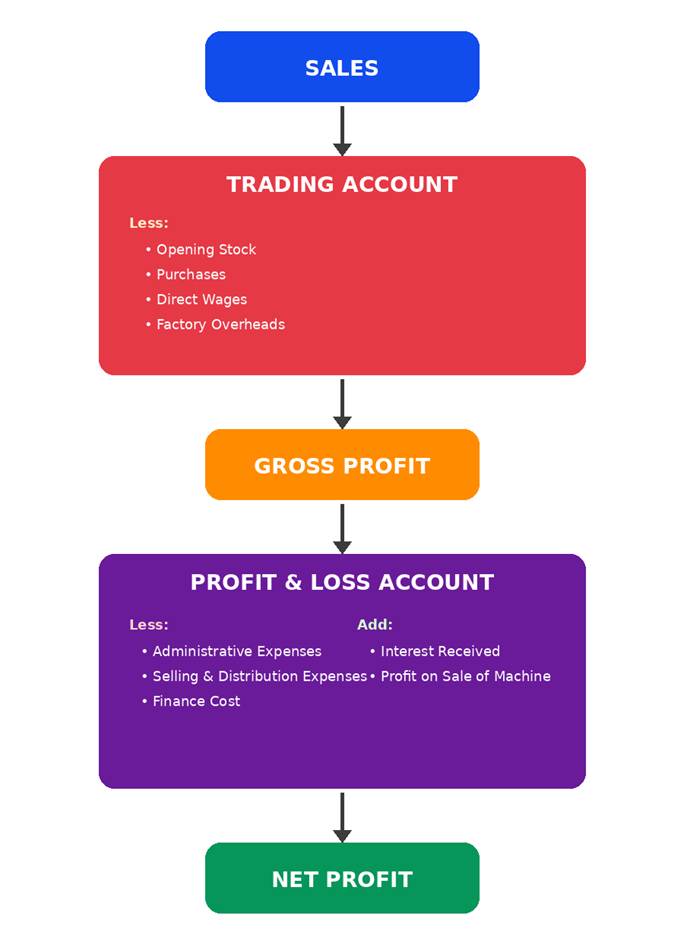
The Trading Account answers: “Did our core business operations generate a Gross Profit?”
The Profit & Loss Account answers: “After considering all other operating, administrative, selling, financing and non-operating items, what is the final Net Profit?”
Memory Chart
Very Easily Explained Sir, Thanks a lot
Ok. keep updated
This was very helpful, thank you soo much sir .
keep you updated.
Tables and charts makes easy for understanding. Thank You sir.