

Transforming Financial Data into Business Intelligence
Many finance professionals assume that accounting ends when journal entries are posted and financial statements are prepared. However, in modern organizations, accounting is no longer a mere record-keeping function. It has evolved into a strategic business process that supports managerial decision-making, operational control, regulatory compliance, and business growth.
Record-to-Report (R2R) is an end-to-end finance process that collects, validates, reconciles, consolidates, and transforms financial information into meaningful reports for management, investors, lenders, regulators, and other stakeholders. In simple words, R2R converts transactions into financial intelligence.
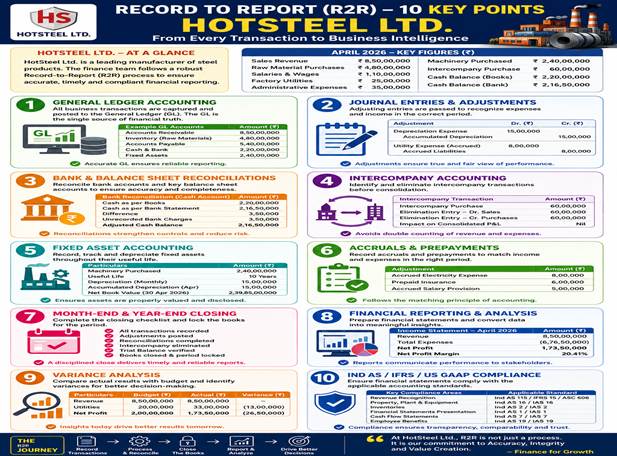
Let us understand the complete R2R cycle through the example of HotSteel Ltd., a leading manufacturer of steel products, using its financial data for April 2026.
Key Financial Information of HotSteel Ltd. (April 2026)
| Particulars | Amount (₹) |
| Sales Revenue | 8,50,00,000 |
| Raw Material Purchases | 4,80,00,000 |
| Salaries and Wages | 1,10,00,000 |
| Factory Utilities | 25,00,000 |
| Administrative Expenses | 35,00,000 |
| Machinery Purchased | 2,40,00,000 |
| Intercompany Purchases | 60,00,000 |
| Cash Balance (Books) | 2,20,00,000 |
| Cash Balance (Bank) | 2,16,50,000 |
Source data extracted from the HotSteel Ltd. case study.
| 1 | GENERAL LEDGER ACCOUNTING: THE SINGLE SOURCE OF TRUTH |
The first stage of the R2R cycle is the recording of transactions in the General Ledger (GL). Every transaction related to purchases, sales, salaries, inventories, fixed assets, receivables, and payables is captured in the accounting system.
The General Ledger serves as the central repository of financial information and forms the foundation for all subsequent accounting activities.
Without an accurate GL, no organization can prepare reliable financial statements or make informed business decisions.
✓ Accurate GL ensures reliable reporting.
| 2 | JOURNAL ENTRIES AND ADJUSTMENTS: RECOGNIZING THE CORRECT PERIOD |
Accounting follows the accrual basis, which requires income and expenses to be recognized in the period in which they are earned or incurred.
During April 2026, HotSteel Ltd. recorded depreciation on newly acquired machinery through the following adjustment:
| Journal Entry | Debit (₹) | Credit (₹) |
| Depreciation Expense | 15,00,000 | |
| Accumulated Depreciation | 15,00,000 |
Adjusting entries ensure that the financial statements present a true and fair view of business performance.
✓ Adjustments ensure true and fair view of performance.
| 3 | BANK AND BALANCE SHEET RECONCILIATION: VERIFYING ACCURACY |
Reconciling accounting records with external documents is one of the most important control mechanisms in the R2R process.
At HotSteel Ltd., the cash balance in the accounting records was ₹2,20,00,000, whereas the bank statement reflected a balance of ₹2,16,50,000.
| Bank Reconciliation | Amount (₹) |
| Cash Balance as per Books | 2,20,00,000 |
| Cash Balance as per Bank Statement | 2,16,50,000 |
| Difference | 3,50,000 |
The difference was attributed to unrecorded bank charges, which were subsequently adjusted in the accounting records. Reconciliations strengthen internal controls, reduce errors, and improve the reliability of financial information.
✓ Reconciliations strengthen controls and reduce risk.
| 4 | INTERCOMPANY ACCOUNTING: ELIMINATING DOUBLE COUNTING |
Large organizations often conduct transactions between subsidiaries, divisions, or related entities.
HotSteel Ltd. recorded an intercompany purchase of ₹60,00,000. Before preparing consolidated financial statements, the R2R team eliminated these transactions to prevent the double counting of revenue and expenses.
Intercompany accounting ensures that consolidated financial statements accurately reflect transactions with external parties only.
✓ Avoids double counting of revenue and expenses.
| 5 | FIXED ASSET ACCOUNTING: MANAGING THE ASSET LIFE CYCLE |
Fixed assets require proper capitalization, depreciation, tracking, and disclosure.
| Particulars | Amount / Value |
| Machinery Purchased | 2,40,00,000 |
| Useful Life | 10 Years |
| Depreciation (Monthly) | 15,00,000 |
| Net Book Value (30 Apr 2026) | 2,39,85,000 |
Proper fixed asset accounting ensures compliance with accounting standards while providing an accurate measurement of asset values.
✓ Ensures assets are properly valued and disclosed.
| 6 | ACCRUALS AND PREPAYMENTS: APPLYING THE MATCHING PRINCIPLE |
The matching principle requires companies to match revenues with the expenses incurred to generate those revenues.
During the closing process, HotSteel Ltd. recorded:
■ Accrued electricity expenses: ₹8,00,000
■ Prepaid insurance: ₹6,00,000
■ Accrued salary provision: ₹5,00,000
Failure to record accruals and prepayments can significantly distort profitability and financial position.
✓ Follows the matching principle of accounting.
| 7 | MONTH-END AND YEAR-END CLOSING: CLOSING THE BOOKS |
The month-end closing process is one of the most critical responsibilities of the R2R team.
Before closing the accounting period, HotSteel Ltd. completed the following activities:
■ All transactions were recorded.
■ All adjustment entries were posted.
■ Bank reconciliations were completed.
■ Intercompany transactions were eliminated.
■ The trial balance was verified.
■ The accounting books were closed and locked.
A disciplined closing process improves reporting accuracy and reduces the risk of financial misstatements.
✓ A disciplined close delivers timely and reliable reports.
| 8 | FINANCIAL REPORTING AND ANALYSIS: CONVERTING DATA INTO INSIGHTS |
The ultimate objective of the R2R process is to prepare financial statements that support decision-making.
Income Statement of HotSteel Ltd. (April 2026)
| Particulars | Amount (₹) |
| Revenue | 8,50,00,000 |
| Total Expenses | (6,76,50,000) |
| Net Profit | 1,73,50,000 |
| Net Profit Margin | 20.41% |
Financial reports do not merely present numbers; they communicate the operational efficiency, profitability, and financial health of an organization.
✓ Reports communicate performance to stakeholders.
| 9 | VARIANCE ANALYSIS: UNDERSTANDING DEVIATIONS FROM BUDGET |
Variance analysis compares actual results with budgeted expectations and identifies the reasons for deviations.
| Particulars | Budget (₹) | Actual (₹) | Variance (₹) |
| Revenue | 8,50,00,000 | 8,50,00,000 | Nil |
| Utilities | 20,00,000 | 33,00,000 | (13,00,000) |
| Net Profit | 2,00,00,000 | 1,73,50,000 | (26,50,000) |
The increase in utility expenses reduced overall profitability. Variance analysis helps management identify inefficiencies, control costs, and improve future performance.
✓ Insights today drive better results tomorrow.
| 10 | IND AS COMPLIANCE: ENSURING TRANSPARENCY AND COMPARABILITY |
The final responsibility of the R2R function is to ensure that financial statements comply with the applicable accounting framework. HotSteel Ltd. reviewed the following standards during the reporting process:
| Compliance Area | Applicable Standard |
| Revenue Recognition | Ind AS 115 / IFRS 15 / ASC 606 |
| Property, Plant and Equipment | Ind AS 16 / IAS 16 |
| Inventories | Ind AS 2 / IAS 2 |
| Financial Statement Presentation | Ind AS 1 / IAS 1 |
| Cash Flow Statement | Ind AS 7 / IAS 7 |
| Employee Benefits | Ind AS 19 / IAS 19 |
Before issuing the final financial statements, the finance team verified that:
■ Revenue was recognized in the correct accounting period.
■ Inventory was measured according to applicable standards.
■ Machinery was capitalized and depreciated appropriately.
■ Accruals and prepayments were properly recorded.
■ Related-party transactions were adequately disclosed.
■ Financial statements complied with the applicable reporting framework.
Compliance is not merely a regulatory requirement. It improves transparency, consistency, comparability, and stakeholder confidence.
✓ Compliance ensures transparency, comparability and trust.
Final Takeaway
At HotSteel Ltd., the R2R cycle is not simply an accounting exercise. It is a structured process that transforms thousands of transactions into actionable business intelligence.
From recording transactions in the General Ledger to preparing compliant financial statements under Ind AS, IFRS, and US GAAP, every stage of the R2R process contributes to better decision-making, stronger internal controls, improved transparency, and sustainable value creation.
| Record → Reconcile → Close → Report → Analyze → Comply → Improve |
That is the true journey of the modern Record-to-Report process.
Thank you sir for providing this knowledge riched blog