
Fixed assets such as machinery, furniture, vehicles and buildings are used by a business for generating income over several years. However, these assets generally lose their value over time due to usage, wear and tear, technological changes or obsolescence. This reduction in value is recognized as Depreciation.
Accounting does not treat depreciation as an actual cash outflow every year; rather, it is a systematic allocation of the cost of an asset over its useful life, following the principles of Matching Concept and Accrual Accounting.
A common confusion among students is the difference between Depreciation and Provision for Depreciation (Accumulated Depreciation). While depreciation represents the expense charged for the current period, accumulated depreciation represents the total depreciation charged on an asset up to a particular date.
When an asset is sold, the business compares the sale value with the book value (cost less accumulated depreciation) to determine profit or loss on sale. For small businesses, this profit or loss is generally shown through the Profit & Loss Account, whereas companies following Schedule III of the Companies Act, 2013 present such gains or losses under appropriate income/expense disclosures (often within Other Income or related items depending on the nature of the transaction).
This blog will help students understand:
- Why depreciation is charged and how AS/Ind AS guide the treatment of fixed assets.
- Difference between depreciation expense and accumulated depreciation/provision for depreciation.
- How the book value of assets is calculated.
- How profit or loss on sale of assets is determined.
- Why the treatment differs between traditional financial statements of small businesses and corporate financial statements under Schedule III.
This is a very good next step because students often memorize depreciation formulas but do not understand the complete accounting cycle:
Purchase of Asset → Depreciation → Accumulated Depreciation → Sale of Asset → Profit/Loss → Financial Statement Impact → Relevant AS/Ind AS

Case Study: Understanding Depreciation and Sale of Asset
Background
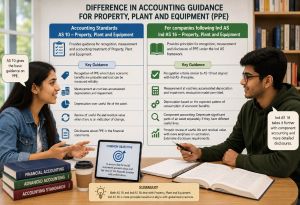
ABC Traders purchased machinery for their business. The machinery is used for production activities and is expected to provide benefits for several years. The business follows accounting principles for recognition and measurement of Property, Plant and Equipment (PPE).
(For small businesses following Accounting Standards: AS 10 – Property, Plant and Equipment.
For companies following Ind AS: Ind AS 16 – Property, Plant and Equipment.)
Information
ABC Traders purchased machinery on 1 April 2025 for Rs.5,00,000.
Additional details:
- Useful life of machinery: 5 years
- Depreciation method: Straight Line Method
- Residual value: Nil
- Machinery sold on 31 March 2027 for Rs.3,20,000

Step 1: Purchase of Machinery
Journal Entry
| Particulars | Debit (Rs.) | Credit (Rs.) |
| Machinery A/c Dr. | 5,00,000 | |
| To Bank A/c | 5,00,000 |
Effect:
- Asset increases
- Cash/Bank decreases
Step 2: Calculation of Depreciation
Depreciable Amount:
Rs.5,00,000 − Nil = Rs.5,00,000
Useful Life = 5 years
Annual Depreciation:
Rs.5,00,000 ÷ 5 = Rs.1,00,000 per year
Year 1: Depreciation Entry
Journal Entry
| Particulars | Debit (Rs.) | Credit (Rs.) |
| Depreciation Expense A/c Dr. | 1,00,000 | |
| To Accumulated Depreciation A/c | 1,00,000 |
Impact on Financial Statements
| Particulars | Effect |
| Profit & Loss Account | Depreciation expense Rs.1,00,000 reduces profit |
| Balance Sheet | Asset value reduced by accumulated depreciation |
After Two Years
Total Depreciation:
Rs.1,00,000 × 2 = Rs.2,00,000
Book Value
Machinery costs = 5,00,000
Less: Accumulated Depreciation = Rs.2,00,000
Book Value = Rs. 3,00,000
Step 3: Sale of Machinery
Selling Price = Rs.3,20,000
Book Value = Rs.3,00,000
Therefore:
Profit on Sale = Rs.20,000
Journal Entry on Sale
First, transfer accumulated depreciation:
| Particulars | Debit (Rs.) | Credit (Rs.) |
| Accumulated Depreciation A/c Dr. | 2,00,000 | |
| To Machinery A/c | 2,00,000 |
Record sale:
| Particulars | Debit (₹) | Credit (₹) |
| Bank A/c Dr. | 3,20,000 | |
| To Machinery A/c | 3,00,000 | |
| To Profit on Sale of Machinery A/c | 20,000 |
Impact on Profit & Loss Account
| Particulars | Amount |
| Depreciation Expense (2 years) | Rs.2,00,000 (Expense) |
| Profit on Sale of Machinery | Rs.20,000 (Income) |
Accounting Treatment under Standards
| Area | AS Treatment | Ind AS Treatment |
| Recognition of Asset | AS 10 – PPE | Ind AS 16 – PPE |
| Depreciation | Systematic allocation over useful life | Same principle |
| Useful Life | Based on expected usage and economic benefits | Reviewed periodically |
| Residual Value | Considered for depreciation calculation | Considered and reviewed |
| Sale of Asset | Profit/Loss recognized in P&L | Gain/Loss recognized in Statement of Profit & Loss |
Important Concept for Students
Student: Sir, depreciation reduces profit, but no cash is paid. Why?
Professor:
Because depreciation represents the consumption of economic benefits of an asset, not a current cash payment.
The cash was paid when the asset was purchased. Depreciation only allocates that cost over the years in which the asset helps the business earn income.
Takeaway
Depreciation connects the cost of an asset with the revenue generated from its use. Accumulated depreciation helps determine the true book value of the asset, and when the asset is sold, the difference between sale value and book value determines profit or loss.
Memory chart
| Particulars | Depreciation | Accumulated Depreciation / Provision for Depreciation |
| Meaning | Expense charged for the current year | Total depreciation accumulated over years |
| Nature | Expense | Reduction from asset cost |
| Appears in | Profit & Loss Account | Balance Sheet adjustment |
| Purpose | Allocate cost for the year | Determine asset book value |
I was eagerly waiting for this for a long , thank you sir.
Thank you for this blog sir
Tough topic explained very easily. Thank you so much for your contribution sir.