

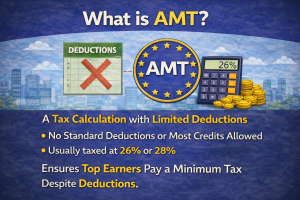
Alternative Minimum Tax (AMT), introduced for non-corporate taxpayers to address disparities in tax payments and prevent individuals from significantly reducing their tax liability through tax benefits.
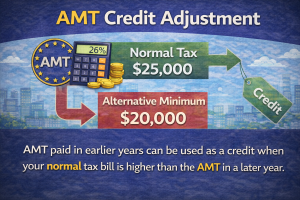
The AMT includes a provision for the carry forward of the AMT credit, which allows taxpayers to use the excess amount paid as AMT against their regular tax liability in future years, up to a limit of fifteen years.
Exemption from Applicability of AMT
The provisions for Alternative Minimum Tax (AMT) apply to the following groups of taxpayers:
- Individuals, Hindu Undivided Families (HUFs), Associations of Persons (AOPs), Bodies of Individuals (BOIs), or artificial juridical persons, provided their adjusted total income surpasses Rs. 20,00,000.
- Taxpayers who are subject to AMT provisions must obtain Form No. 29C from a Chartered Accountant certifying the AMT and adjusted total income has been computed by the Income Tax Act. The report must be submitted on or before the due date for filing the income tax return. (ITR).
- AMT Credit is allowed to be carried forward for only up to 15 FYs succeeding the FY in which such AMT is paid. No interest will be payable on the AMT credit to the taxpayer.
AMT (For Non-Corporate Assesses)
Applicable under Section 115JC of Income Tax Act
AMT Rate
- 18.5% of Adjusted Total Income
- Add:
- Surcharge (if applicable)
- Cess @ 4%
Effective = 19.24% (excluding surcharge)
Special Case (IFSC Units): AMT Rate –9%
- If the person is a unit located in an International Financial Services Centre (IFSC) and receives income solely in convertible foreign currency, the AMT rate will be 9%.
- The AMT rate for cooperative societies is reduced to 15%.
Normal Tax Rate (Individuals – FY 2025–26)
Default Regime (New Tax Regime under
Section 115BAC of Income Tax Act)
| Income Slab | Tax Rate |
| Up to Rs.4,00,000 | Nil |
| Rs. 4L – Rs.8L | 5% |
| Rs 8L – Rs.12L | 10% |
| Rs.12L – Rs.16L | 15% |
| Rs.16L – Rs.20L | 20% |
| Rs.20L – Rs.24L | 25% |
| Above Rs. 24L | 30% |
Important for AMT
- AMT generally applies when deductions under Chapter VI-A are claimed (like 80-IA, 80JJAA, etc.)
- These deductions are mostly not available in the new regime.
So: AMT relevance is higher in old regime cases.
Practical Classroom Insight
Individuals:
- Compare:
- Normal slab rates
- AMT (18.5%)
Takeaway:
- AMT applicable only if Adjusted Total Income > Rs.20 lakh.
Always compute both methods and choose higher tax.
Case: Mr. Richard
Mr. Richard is an individual claiming deduction under Section 80-IA.
| Particulars Amount (Rs.) |
| Total Income (before deduction) 30,00,000 |
| Deduction u/s 80-IA 15,00,000 |
Step 1: Normal Tax Computation
Taxable Income =
Tax Calculation (Old Regime assumed)
- Up to Rs.2,50,000 → Nil
- Rs.2,50,000 – Rs.5,00,000 → 5% = Rs.12,500
- Rs.5,00,000 – Rs.10,00,000 → 20% = Rs.1,00,000
- Rs.10,00,000 – Rs.15,00,000 → 30% = Rs.1,50,000
Total Tax = Rs.2,62,500
Cess 4% =Rs. 10,500
Normal Tax = Rs.2,73,000
Step 2: AMT Computation
As per Section 115JC of Income Tax Act
Adjusted Total Income: 15,00,000 + 15,00,000 = 30,00,000
AMT Calculation
- AMT 18.5% = Rs.5,55,000
- Cess 4% = Rs.22,200
AMT = Rs.5,77,200
Step 3: Applicability Check
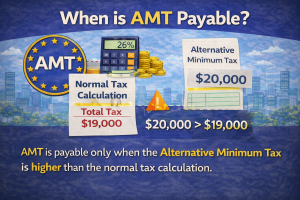
| Particulars | Amount (Rs.) |
| Normal Tax | 2,73,000 |
| AMT | 5,77,200 |
| Tax payable (higher) | 5,77,200 |
Mr. Richard will pay AMT = Rs.5,77,200
(because AMT > Normal Tax)
Example: AMT Credit Adjustment (Sec 115JD)
Tax Paid = AMT = Rs.5,77,200
- AMT Credit Generated = 5,77,200 – 2,73,000 = Rs. 3,04,200
Next Year (PY 2026–27)
Assume:
| Particulars | Amount (Rs.) |
| Normal Tax | 6,00,000 |
| AMT | 4,00,000 |
- Adjustment of AMT Credit
Since:
✔ Normal Tax > AMT, so AMT credit can be utilized
- Maximum Credit Allowed
Normal Tax – AMT = Rs. 6,00,000 – Rs. 4,00,000 = Rs. 2,00,000
Credit utilized
- Available credit = Rs.3,04,200
- Allowed to use = Rs.2,00,000
Credit used = Rs.2,00,000
- Final Tax Payable= Rs. 6,00,000 – Rs. 2,00,000 = Rs. 4,00,000
- Balance Credit Carried Forward = Rs. 3,04,200 – Rs. 2,00,000 = Rs. 1,04,200
Key Rules for Students
- Credit arises when AMT > Normal Tax
- Can be used when Normal Tax > AMT
- Set off limited to difference between Normal Tax & AMT
- Carry forward allowed for 15 assessment years.
This Explanation helped me a lot. Thank You Sir
good….keep going
Ok!!!