
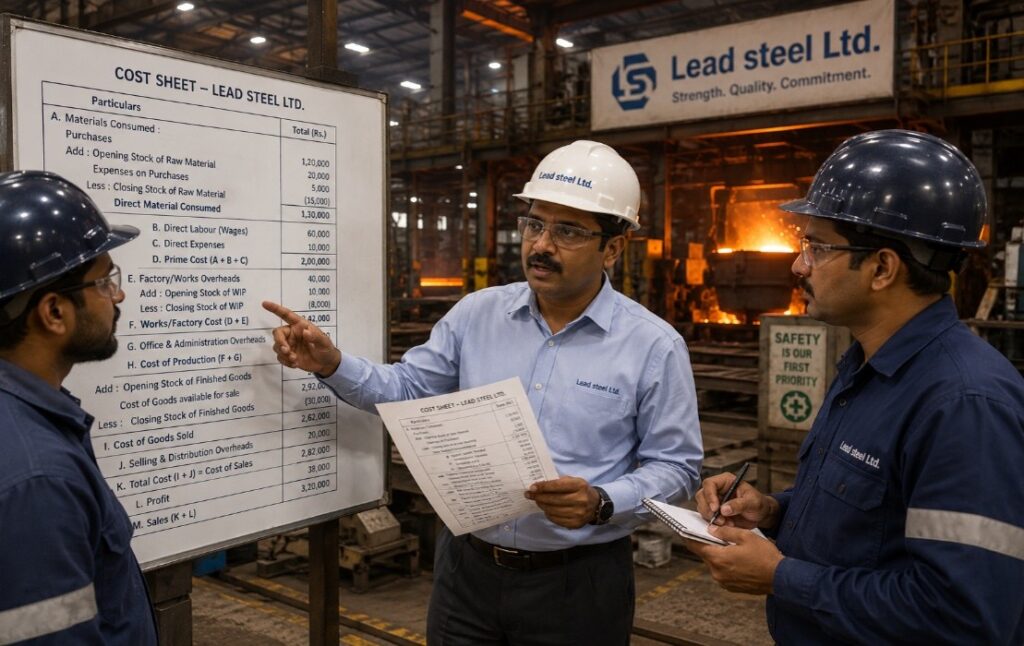
| LeadSteel Manufacturing Ltd. |
Case Background
| LeadSteel Manufacturing Ltd. manufactures industrial steel components. At the end of the financial year, the management team is preparing its Cost Sheet and Financial Statements. The Finance Manager explains that determining Cost of Goods Sold (COGS) is important because it directly affects the company’s gross profit and profitability. |
Costs Incurred During the Year
| Particulars | Amount (₹) |
| Direct Materials Consumed | 20,000 |
| Direct Labour | 7,000 |
| Direct Expenses | 2,000 |
| Factory / Works Overheads | 5,000 |
| Opening Work-in-Progress | 3,000 |
| Closing Work-in-Progress | 2,000 |
| Office & Administration Overheads | 4,000 |
| Opening Finished Goods | 6,000 |
| Closing Finished Goods | 5,000 |
| Selling & Distribution Overheads | 3,000 |
The company sells its products for ₹50,000 during the year.
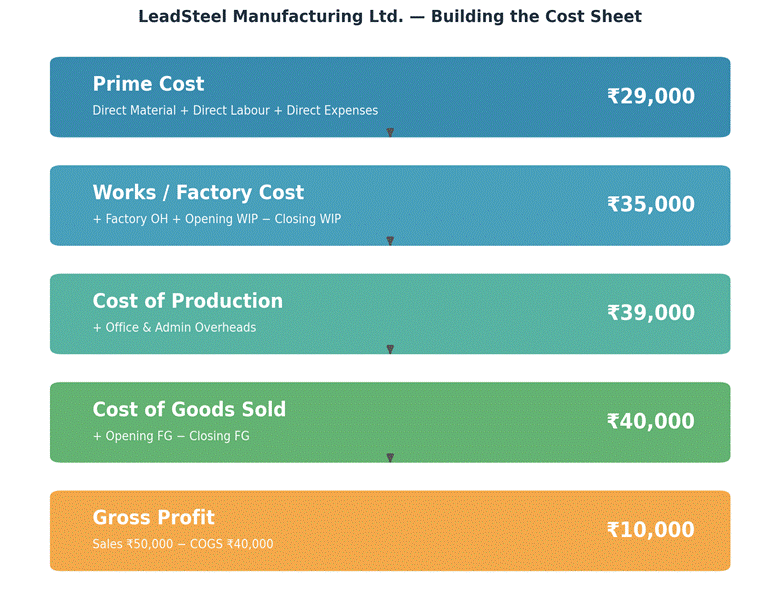
Building the Cost Sheet — Visual Flow
Step 1 — Determine Prime Cost
| STEP 1 Prime Cost Prime Cost = Direct Material + Direct Labour + Direct Expenses = ₹20,000 + ₹7,000 + ₹2,000 Prime Cost: ₹29,000 |
| The Prime Cost represents the major direct costs associated with manufacturing the product. The Cost Sheet format places direct material, direct labour and direct expenses before Prime Cost. |
Step 2 — Determine Works / Factory Cost
| STEP 2 Works / Factory Cost Prime Cost = ₹29,000 Add: Factory Overheads = ₹5,000 Add: Opening WIP = ₹3,000 Less: Closing WIP = ₹2,000 Works / Factory Cost: ₹35,000 |
| Factory overheads are considered along with the adjustment for Work-in-Progress, following the Cost Sheet structure. |
Step 3 — Determine Cost of Production
| STEP 3 Cost of Production Works / Factory Cost = ₹35,000 Add: Administration Overheads = ₹4,000 Cost of Production: ₹39,000 |
| This is the cost associated with the finished goods produced during the period, following the Cost Sheet format. |
Step 4 — Determine Cost of Goods Sold (COGS)
| Goods Available for Sale Opening Finished Goods = ₹6,000 Add: Cost of Production = ₹39,000 Goods Available for Sale = ₹45,000 |
| STEP 4 Cost of Goods Sold COGS = Opening Finished Goods + Cost of Production − Closing Finished Goods = ₹6,000 + ₹39,000 − ₹5,000 COGS: ₹40,000 |
| This is exactly the transition in the Cost Sheet from Cost of Production to Cost of Goods Sold. |
Step 5 — COGS and Gross Profit
| Particulars | ₹ |
| Sales | 50,000 |
| Less: COGS | (40,000) |
| Gross Profit | 10,000 |
| STEP 5 Gross Profit Margin Gross Profit Margin = Gross Profit ÷ Sales × 100 = ₹10,000 ÷ ₹50,000 × 100 Gross Profit Margin: 20% |
The Management Issue — Can We Increase Inventory?
| Suppose management wants to report a higher gross profit. Someone suggests: “If we increase the value of closing finished goods inventory, COGS will fall and gross profit will increase.” Mathematically, that statement is correct — but is it allowed? |
If closing inventory were reported as ₹8,000 instead of ₹5,000:
| STEP — Hypothetical (Not Permitted) COGS = ₹6,000 + ₹39,000 − ₹8,000 = ₹37,000 Gross Profit = ₹50,000 − ₹37,000 Gross Profit: ₹13,000 |
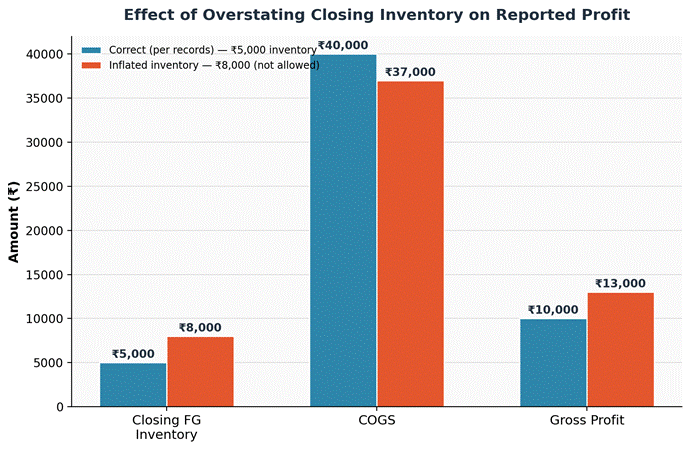
| But can LeadSteel simply choose ₹8,000? — No. The inventory figure cannot be increased merely to improve reported profit. It must be based on proper inventory records. |
Financial Accounting Touchpoint
| This is an excellent place to connect Costing with Financial Accounting. The Costing perspective helps us understand: how much did it cost to manufacture the goods? Financial Accounting then asks: at what amount should the inventory be recognised and reported in the financial statements? |
| STEP Ind AS 2 Measurement of Inventories Under Ind AS 2 — Inventories, inventories are generally measured at the lower of Cost and Net Realisable Value (NRV). I f LeadSteel’s finished goods have a cost of ₹5,000 but their recoverable NRV is only ₹4,500, the company cannot retain the inventory at ₹5,000 merely because that was its manufacturing cost. Measurement Rule: Lower of Cost & NRV |
The Important Connection
| Manufacturing Cost → Cost of Production → Finished Goods Inventory → COGS → Gross Profit → Financial Reporting |
What Students Should Learn from the Case
| Costing Concept | Business Meaning |
| Prime Cost | Direct manufacturing cost |
| Works Cost | Manufacturing cost after factory overheads and WIP adjustment |
| Cost of Production | Cost of goods produced |
| Finished Goods Inventory | Goods produced but not yet sold |
| COGS | Cost relating to goods actually sold |
| Gross Profit | Sales less COGS |
| Gross Margin | Indicator of product-level profitability |
| Inventory Valuation | Important for correct financial reporting |
Takeaway
| • Costing tells us how the cost is built. • COGS tells us the cost of what has been sold. • Financial Accounting tells us how the resulting inventory and profit should be reported. |