
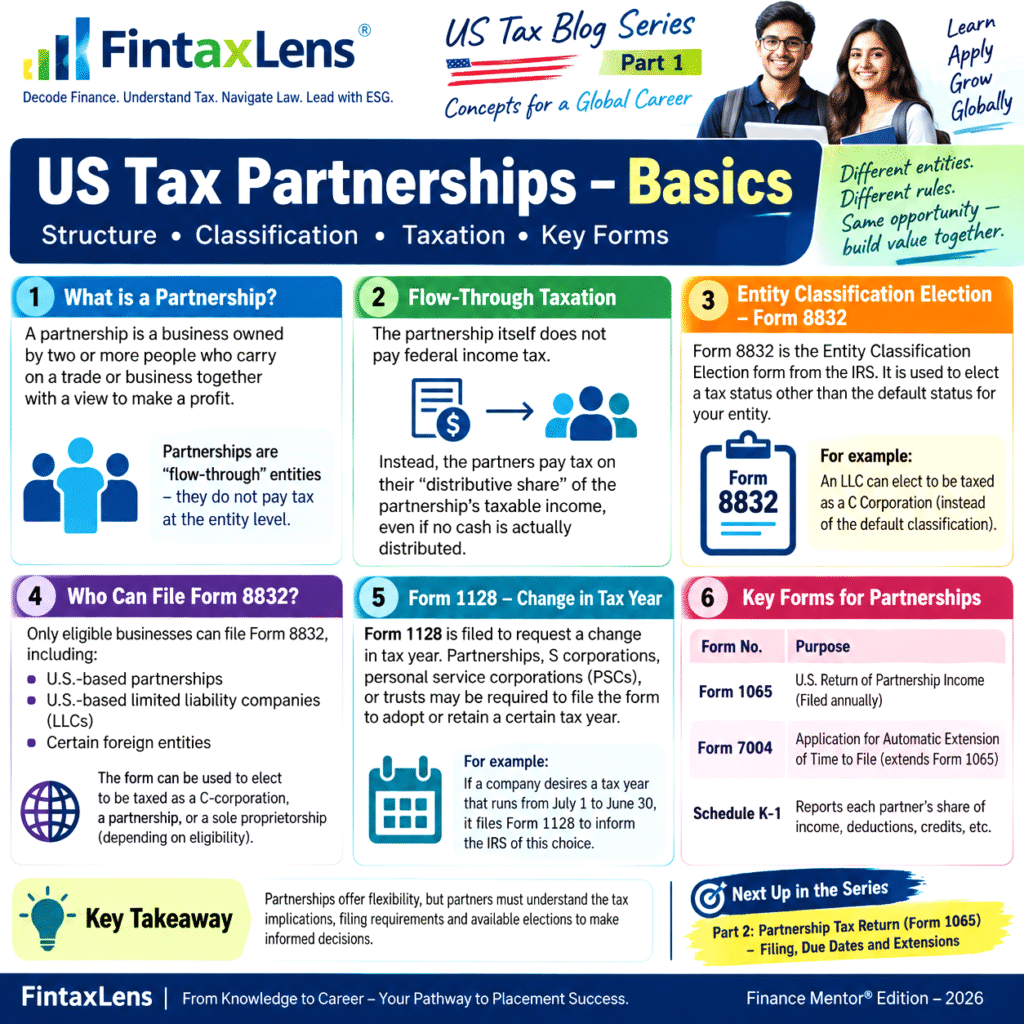
Understanding the Basics
Andrew had just started working on a project involving US partnership taxation. He opened his notebook, looked at a list of forms, and frowned.
Andrew: Professor, I have a question.
Professor: Of course, Andrew. What is confusing you?
Andrew: I keep seeing terms like partnership, flow-through entity, TIN, EIN, Form 8832, Form 1128, Form 1065 and Schedule K-1. They all seem connected — but I don’t quite understand how.
Professor: That’s a very common problem. The mistake is trying to learn the forms individually. First, you need to understand the big picture. Once you understand the structure, the forms will start making sense.
Andrew: So where should I start?
Professor: Let’s start with the most basic question.
1. What is a Partnership?
Professor: Andrew, suppose two or more people decide to carry on a business together with the intention of making a profit. What would you call that arrangement?
Andrew: A partnership?
Professor: Exactly. A partnership involves people coming together to carry on a trade or business and sharing the economic results of that business.
Andrew: So partnership taxation begins with the business relationship?
Professor: Yes. But for a tax professional, knowing what a partnership is is only the first step. The more important question is: How does the US federal tax system treat partnership income?
Andrew quickly wrote that question in his notebook.
2. The Big Concept: Flow-Through Taxation
Andrew: Professor, is the partnership itself taxed on its income?
Professor: This is where one of the most important concepts in partnership taxation comes in — flow-through taxation.
Andrew: What exactly does flow-through mean?
Professor: In simple terms, the partnership generally does not pay federal income tax at the entity level in the same manner as a C corporation. Instead, the partnership’s taxable items flow through to its partners.
Andrew: So the partners pay tax?
Professor: Generally, yes. Each partner takes into account their distributive share of the partnership’s taxable income and other relevant items.
Andrew: But what if the partnership doesn’t distribute the money?
Professor: Excellent question.
REMEMBER THIS
A partner’s taxable share and the cash actually distributed to the partner are not necessarily the same thing.
Andrew: So I could have taxable income allocated to me even though I haven’t received the cash?
Professor: Yes. That’s why understanding the words distributive share and flow-through is fundamental to partnership taxation
3. Andrew Asks: ‘What is a TIN?’
Andrew: Professor, I keep seeing the term TIN. What does it mean?
Professor: TIN stands for Taxpayer Identification Number.
Andrew: Is TIN the number of the partnership?
Professor: Not necessarily. Think of TIN as a broader category of taxpayer identification numbers.
Andrew: So there are different types
Professor: Exactly
TYPES OF TIN
• SSN — Social Security Number
• EIN — Employer Identification Number
• ITIN — Individual Taxpayer Identification Number
Andrew: Then where does a business fit into this?
Professor: For business entities, including partnerships, you will frequently encounter the EIN.
4. TIN and EIN: Don’t Confuse Them
Andrew drew two boxes in his notebook.
TIN → EIN
TIN is the broader concept. EIN is a specific taxpayer identification number used for businesses and other entities.
Andrew: So EIN is a type of TIN?
Professor: Correct.
Andrew: So, for a partnership, I should be thinking about its EIN?
Professor: Exactly. When you’re looking at the tax identity of a business partnership, the EIN becomes particularly important.
Andrew: That makes the terminology much clearer.
Professor: Good. And remember, Andrew — tax professionals must be precise with terminology. TIN and EIN are related, but they are not interchangeable terms in every context.
5. Can an Entity Choose its Tax Classification?
Andrew: Professor, I have another question. What happens when the business is an LLC?
Professor: Now we move into another important area — entity classification.
Andrew: Is an LLC automatically taxed as a partnership?
Professor: Not necessarily. Certain eligible entities can make an election regarding their federal tax classification.
Andrew: Which form is used for that?
Professor: Form 8832 — Entity Classification Election.
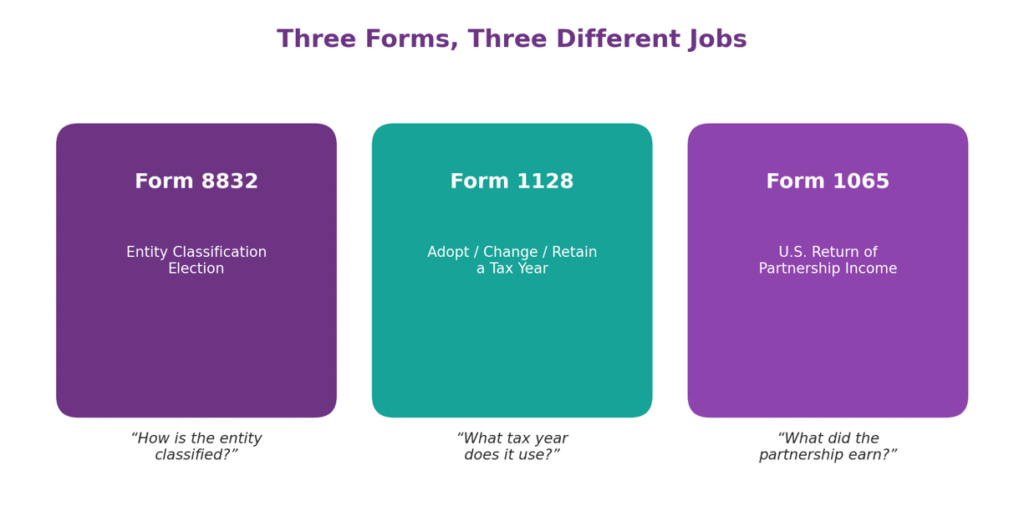
FORM 8832 — Entity Classification Election
An eligible entity can use Form 8832 to elect its federal tax classification, subject to the applicable rules.
Possible classifications: Corporation • Partnership • Disregarded Entity
Andrew: So, Form 8832 is about how the IRS classifies the entity for federal tax purposes?
Professor: Exactly.
Andrew: It isn’t the partnership tax return?
Professor: Correct. That’s an important distinction
DON’T MIX THEM UP
Form 8832 → Entity Classification
Form 1065 → Partnership Tax Return
6. Professor, What is Form 1128?
Andrew noticed another form on the infographic.
Andrew: And what about Form 1128?
Professor: That’s a different issue altogether.
Andrew: What does it deal with?
Professor: Form 1128 is used to request to adopt, change, or retain a tax year, where applicable.
Andrew: So this isn’t about entity classification?
Professor: Exactly.
Andrew: So if Form 8832 answers ‘How is the entity classified?’, Form 1128 deals with ‘What tax year does it use?’
Professor: Very good, Andrew.
Andrew: Now I can see why I was getting confused. The forms look like separate pieces, but they deal with different parts of the same tax structure.
Professor: Precisely.
7. Now We Come to Form 1065
Andrew: Professor, then where does Form 1065 come in?
Professor: Now you’re reaching the heart of partnership tax reporting.
Andrew: Is Form 1065 the partnership’s tax return?
Professor: Yes. Form 1065 — U.S. Return of Partnership Income is the principal federal return used for partnership reporting.
Andrew: So, the partnership’s income and deductions are reported there?
Professor: That’s the basic idea. The partnership reports the relevant income, deductions, credits and other tax information through the partnership return.
ANDREW’S NOTES : FORM 1065 = U.S. RETURN OF PARTNERSHIP INCOME
8. Then What Is Schedule K-1?
Andrew: Professor, I’ve also heard about Schedule K-1.
Professor: Excellent. This is where the partnership-level reporting connects with the individual partners.
Andrew: How?
Professor: Think of it this way.
Partnership → Form 1065 → Schedule K-1 → Partner
Schedule K-1 communicates the relevant share of partnership items attributable to each partner
Andrew: So the partnership files Form 1065, and the partners receive information about their respective shares through Schedule K-1?
Professor: Exactly.
Andrew: So, if I’m Partner A, my K-1 tells me what portion of the partnership’s relevant tax items belong to me?
Professor: That’s the basic concept.
Andrew: And then I use that information for my own tax reporting?
Professor: Correct.
9. Andrew Tries to Connect Everything
Andrew closed his notebook for a moment.
Andrew: Professor, let me try to put the whole thing together.
ANDREW’S SUMMARY
A partnership carries on a business → the partnership generally operates as a flow-through entity → taxable items flow through to the partners → the partnership reports through Form 1065 → each partner’s relevant share is reported through Schedule K-1.
Professor: Very good.
Andrew: And the identification and classification pieces come before that?
Professor: Yes. Think of the complete structure like this.
10. The US Partnership Tax Map
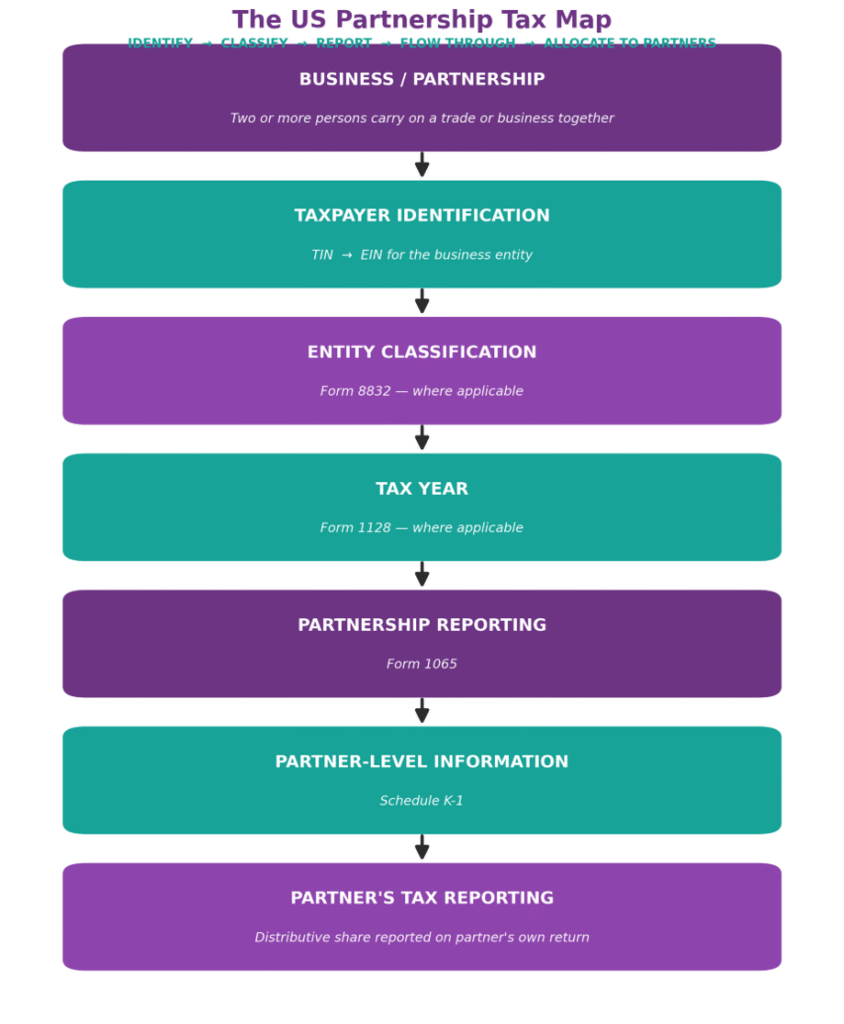
Andrew: Professor, now the forms don’t look like isolated forms anymore.
Professor: Exactly. That’s the purpose of learning tax conceptually.
11. One More Question, Professor…
Andrew: Before we finish, can I ask one more question?
Professor: Of course.
Andrew: If partnership taxation is flow-through taxation, does that mean there is no tax compliance at the partnership level?
The Professor smiled.
Professor: That’s an important distinction, Andrew.
Andrew: Because the partnership still has reporting responsibilities?
Professor: Exactly. Flow-through does not mean flow-away.
The partnership still has important federal tax reporting obligations. Understanding the difference between entity-level reporting and partner-level taxation is essential.
Andrew: That’s a good line, Professor.
Professor: Then write it down.
KEY TAKEAWAYFLOW-THROUGH DOES NOT MEAN FLOW-AWAY.
Concept Check
Q1. What is a partnership?
A business arrangement involving two or more persons carrying on a trade or business together
Q2. What is flow-through taxation?
The partnership’s relevant taxable items generally flow through to its partners rather than being taxed at the partnership level in the same manner as a C corporation.
Q3. What does TIN mean?
‘Taxpayer Identification Number
Q4. What is an EIN?
Employer Identification Number — a specific type of taxpayer identification number used for businesses and other entities.
Q5. What is Form 8832?
EnQ6. What is Form 1128?
Application to Adopt, Change, or Retain a Tax Year.
tity Classification Election
Q7. What is Form 1065?
U.S. Return of Partnership Income.
Q8. What is Schedule K-1?
The schedule used to report a partner’s relevant share of partnership items.
Professor’s Final Message to Andrew
Professor: Andrew, don’t try to memorise partnership taxation form by form.
Andrew: Then what should I do?
Professor: Understand the flow.
THE FLOW
IDENTIFY → CLASSIFY → REPORT → FLOW THROUGH → ALLOCATE TO PARTNERS
Once that structure is clear, the detailed rules become much easier to understand.
And that is where our US Tax Partnership journey begins.
Coming Next
Form 1065: The Partnership Tax Return
Andrew will return to the Professor with a new set of questions:
• Who is required to file Form 1065?
• What information is reported?
• When is Form 1065 due?
• What happens if the partnership needs more time?
• Where does Form 7004 come in?
And most importantly:
THE BIG QUESTION
How does the partnership return connect with Schedule K-1?
DISCLAIMER
For educational purposes only. This content provides a high-level overview of U.S. federal tax fundamentals for students and should not be construed as tax, legal, or professional advice. U.S. federal tax rules can vary depending on the taxpayer’s facts, entity classification, tax year and applicable exceptions. Always refer to current IRS instructions and applicable law before filing.