
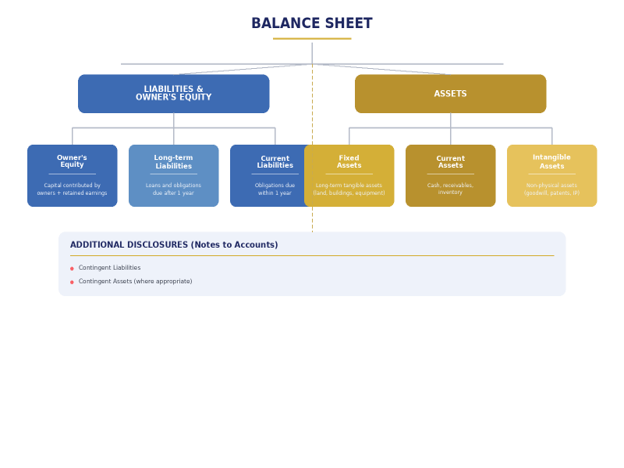
The journey of accounting does not end with calculating profit. After preparing the Trading Account and the Profit & Loss Account, the next step is to understand what the business owns, what it owes, and what belongs to the owner. This information is presented in the Balance Sheet, one of the most important financial statements.
Unlike the Trading Account and Profit & Loss Account, which measure performance during a period, the Balance Sheet presents the financial position of the business on a particular date.
For an unincorporated business such as a sole proprietorship or partnership, the Balance Sheet provides a clear picture of the business resources, obligations and owner’s investment. It also helps assess the business’s liquidity, solvency and overall financial health.
In this discussion, we shall understand the classification of Fixed Assets, Current Assets, Owner’s Equity, Long-term Liabilities and Current Liabilities and explore how these elements help in determining the working capital and financial strength of the business.
Professor: We have already prepared the Trading Account and the Profit & Loss Account.
Now tell me…
After calculating the Net Profit, where do all the balances finally appear?
Student A: In the Balance Sheet, Sir.
Professor: Exactly.
But is the Balance Sheet prepared for finding profit?
Students: No, Sir.
Professor: Then what does it tell us?
Student B: It shows the financial position of the business.
Professor: Excellent!
Professor: Suppose I ask you two simple questions.
- What does the business own?
- What does the business owe?
Can anyone answer?
Student C: What the business owns are Assets.
Student D: What the business owes are Liabilities.
Professor: Perfect!
And after paying all liabilities, whatever remains belongs to whom?
Students: The Owner.
Professor: Correct.
That is called Owner’s Equity (Capital).
Every Balance Sheet answers three important questions:
| Question | Answer |
| What does the business own? | Assets |
| What does the business owe? | Liabilities |
| What belongs to the owner? | Owner’s Equity |
Let’s talk about Assets of the business
- Fixed Assets
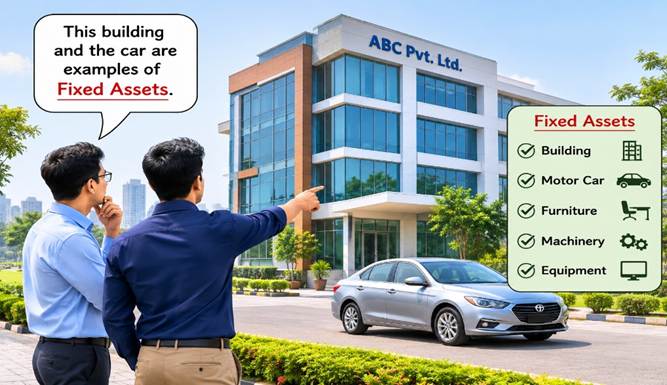
Assets used for a long-term period.
- Current Assets
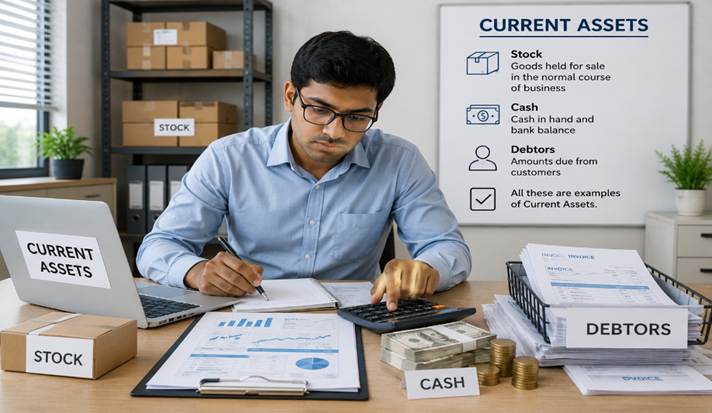
Assets expected to be converted into cash, sold or consumed during the normal operating cycle.
- Intangible Assets
Although we cannot touch or see them like machinery or furniture, they have economic value and help the business earn future benefits.
Professor: Can you see or touch the brand name of Coca-Cola or Apple?
Students: No, Sir.
Professor: Yet are they valuable?
Students: Yes, Sir.
Professor: That is why accounting recognizes certain identifiable intangible assets, while some internally generated items may not be recognized depending on the applicable accounting standards.
| Type of Asset | Meaning | Examples |
| Fixed (Non-Current) Assets | Assets held for long-term use in the business | Land, Building, Machinery, Furniture, Vehicles |
| Current Assets | Assets expected to be realized, sold or consumed during the operating cycle or within one year | Cash, Bank, Inventory, Trade Receivables, Bills Receivable |
| Intangible Assets | Non-physical assets that provide future economic benefits | Goodwill, Patent, Trademark, Copyright, Software Licence, Brand Name |
Classification of Assets
Now, let’s focus on liabilities
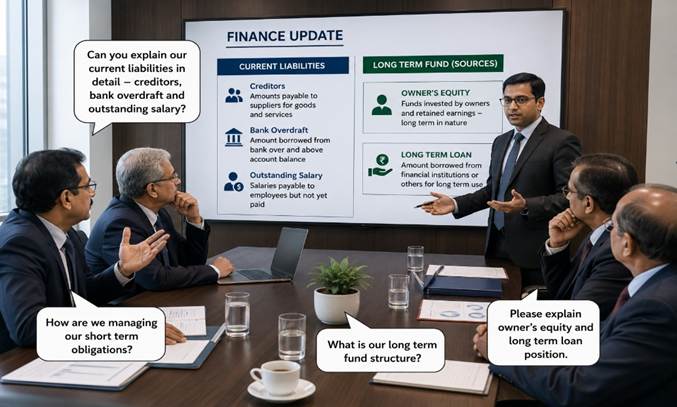
- Long-term Liabilities: Obligations payable after one year.
- Current Liabilities: Obligations payable during the normal operating cycle or within one year.
- Owner’s Equity is the owner’s residual interest in the assets of the business after deducting all liabilities. In simple terms, it represents the amount that belongs to the owner after all external obligations have been settled.
Professor: Suppose your business owns assets worth Rs. 50 lakh and owes Rs.20 lakh to outsiders. Who owns the remaining Rs.30 lakh?
Students: The owner, Sir.
Professor: Exactly. That remaining amount is called Owner’s Equity or Capital. It represents the owner’s claim on the business.
Classification of Liabilities
| Type | Examples |
| Owner’s Equity | Capital, Retained Profit, Less: Drawings |
| Long-term Liabilities | Bank Loan, Mortgage Loan, Long-term Borrowings |
| Current Liabilities | Trade Payables, Bills Payable, Outstanding Expenses, Bank Overdraft, Short-term Borrowings |
Professor: Suppose a customer files a lawsuit against your business claiming damages of Rs.10 lakh.
The court has not yet decided the case.
Should we record it as a liability?
Student: Sir, we don’t know whether we will have to pay.
Professor: Exactly! Such items are called Contingent Liabilities.
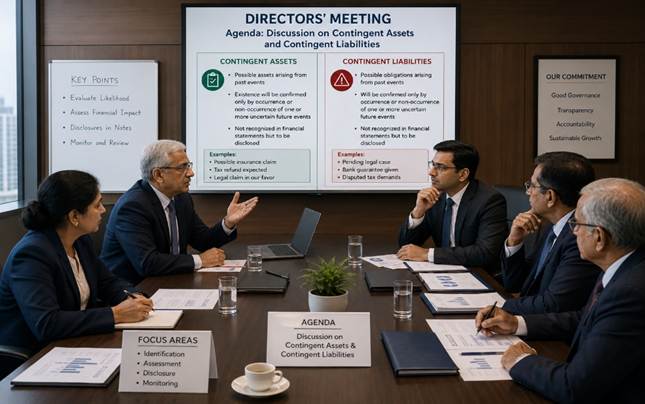
Contingent Liability
A Contingent Liability is a possible obligation arising from past events whose existence will be confirmed only by the occurrence or non-occurrence of uncertain future events that are not wholly within the control of the business.
Examples
| Pending court cases |
| Bank guarantees |
| Corporate guarantees |
| Claims under dispute |
| Bills discounted but not yet matured |
Professor: Now suppose your business has filed a legal case against another company for ₹20 lakh.
Can you immediately recognize this amount as an asset?
Students: No, Sir.
Professor: Correct.
Until the receipt of money becomes virtually certain, it is called a Contingent Asset.
Contingent Asset
A Contingent Asset is a possible asset arising from past events whose existence depends upon uncertain future events.
Examples
| Insurance claims under litigation |
| Compensation claims |
| Court cases filed in favour of the business |
| Refund claims under dispute |
How Are They Reported?
| Item | Recognized in Balance Sheet? | Disclosure |
| Fixed Assets | ✔ Yes | Balance Sheet |
| Current Assets | ✔ Yes | Balance Sheet |
| Intangible Assets | ✔ Yes (if recognition criteria are met) | Balance Sheet |
| Contingent Liability | ✘ Usually not recognized | Disclosed in the Notes to Accounts unless the possibility of outflow is remote |
| Contingent Asset | ✘ Not recognized | Disclosed only when an inflow of economic benefits is probable; recognized only when realization is virtually certain |
Relevant Accounting Standards
| Topic | Accounting Standards (AS) | Ind AS |
| Property, Plant and Equipment | AS 10 | Ind AS 16 |
| Intangible Assets | AS 26 | Ind AS 38 |
| Provisions & Contingencies | AS 29 | Ind AS 37 |
Thanks a lot sir, for making the important concepts interesting.
Thank You sir, for making the important concepts interesting
Understanding balance sheet is very important for a finance person.
This blog make this concept very clear.
Thank you for this effort sir.
The concept of BS must be clear to every finance person or it becomes the liability for them who don’t understand this properly, but sir your blogs are our assets. Thank You Sir.