
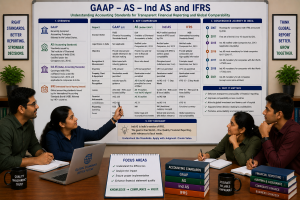
In the modern business environment, financial statements are not prepared merely to calculate profit; they are prepared to communicate financial information in a structured, reliable and globally understandable manner. While studying accounting and corporate reporting, students frequently encounter terms such as GAAP, Accounting Standards (AS), Ind AS and IFRS, which often create conceptual confusion because these frameworks are closely interconnected.
Traditionally, Indian companies prepared financial statements mainly under Indian GAAP and Accounting Standards based largely on the historical cost concept. However, with globalization, international investment and growing need for comparability of financial statements across countries, India gradually moved towards Ind AS, which are substantially converged with IFRS. This transition also put greater emphasis on concepts such as fair value accounting and market-oriented financial reporting.
Therefore, to understand modern financial statements meaningfully, students must first understand the relationship between GAAP, AS, Ind AS and IFRS along with the evolving shift from historical cost accounting towards fair value-based reporting.
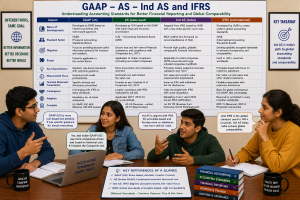
Why do students often get confused?
Students frequently hear terms like:
- GAAP
- Accounting Standards (AS)
- Ind AS
- IFRS
and assume they are completely different systems. These concepts are closely connected. Imagine accounting as a language of business. If every company prepares accounts in its own style, comparison becomes impossible.
Therefore, accounting needs:
- rules,
- principles,
- consistency,
- comparability.
That is where GAAP, AS, Ind AS and IFRS come into the picture.
What is GAAP?
GAAP stands for Generally Accepted Accounting Principles. The purpose of GAAP is to ensure that there is a defined set of rules and procedures that need to be followed to prepare financial statements, which are consistent with the industry standards. It enables external users of the financial statements to easily interpret and understand the accounts of a company.
It is a broad framework consisting of:
- accounting concepts,
- conventions,
- principles,
- standards,
When a company is said to follow the Indian GAAP, it’s assumed that they’re complying with the Indian GAAP to portray the true and fair view of their financial affairs.
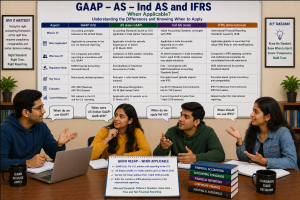
Example of GAAP
- Suppose Liston Limited purchases machinery.
GAAP says:
- show true and fair view,
- match cost with revenue,
- follow consistency.
Then a specific Accounting Standard explains:
- how depreciation should be calculated,
- how machinery should be disclosed,
- how impairment should be treated.
What are Accounting Standards (AS)?
Accounting Standards (AS) are specific accounting rules issued in India. They were mainly issued by the Institute of Chartered Accountants of India (ICAI) for non-listed companies and smaller organizations, and the Indian Accounting Standards (Ind AS) which are converged with International Financial Reporting Standards (IFRS) and apply to listed companies and larger organizations.
These standards guide:
- recognition,
- measurement,
- presentation,
- disclosure.
Examples of AS
| Standard | Topic |
| AS 2 | Valuation of Inventory |
| AS 3 | Cash Flow Statement |
| AS 10 | Property, Plant & Equipment |
| AS 15 | Employee Benefits |
| AS 22 | Accounting for Taxes on Income |
Example
Suppose Axis Retail Pvt. Ltd. has closing inventory.
AS 2 tells:
- inventory should be valued at:
- cost or
- net realizable value,
whichever is lower.
Thus, AS gives detailed practical guidance.
What is Ind AS?
Ind AS = Indian Accounting Standards
India later decided to align accounting with global standards. Ind AS aims to provide a uniform framework for preparing, presenting, and interpreting financial statements, making it easier for stakeholders like investors, regulators, and creditors to assess a company’s financial health.
Why were Ind AS introduced?
Because investors now compare companies globally.
For example:
- an investor comparing:
- Infosys,
- Tata Consultancy Services,
- Apple
- Microsoft
needs more comparable financial reporting.
Example
Under older AS:
- some financial instruments had limited fair value treatment.
Under Ind AS:
- Fair value accounting has become more important.
Thus, financial statements became closer to international reporting practices, fostering confidence among international investors and stakeholders.
What is IFRS?
IFRS = International Financial Reporting Standards
These are global accounting standards issued by:
International Accounting Standards Board (IASB) to ensure consistency, transparency and comparability in financial reporting across countries.
Companies influenced by IFRS globally
Examples:
- Nestlé
- Toyota Motor Corporation
- Samsung Electronics
Many countries follow IFRS directly.
Simple relationship diagram
| Term | Meaning |
| GAAP | Overall accounting framework |
| AS | Traditional Indian Accounting Standards |
| Ind AS | IFRS-converged Indian standards |
| IFRS | International accounting standards |
Important practical difference
| Area | AS | Ind AS / IFRS |
| Focus | Historical Cost | Fair Value + Global Reporting |
| Complexity | Simpler | More detailed |
| International Comparability | Limited | High |
| Financial Instruments | Limited guidance | Extensive guidance |

very easy to understand . Thanks sir for clearly explaining the concepts
Thank you sir for uploading this.