
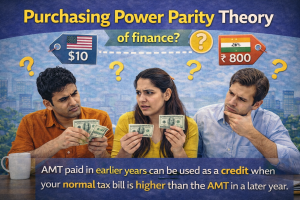
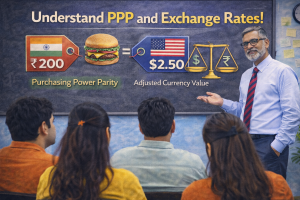
Purchasing power parity (PPP) is an economic theory of exchange rate determination. It states that the price levels between two countries should be equal.
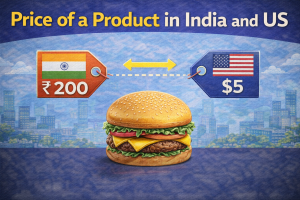
Example:
- In India, Rs.100 may buy a basket of goods.
- In the USA, the same basket may cost Rs.2.
If markets are efficient and trade is possible, exchange rates should reflect the purchasing power of currencies.
This idea leads to the Purchasing Power Parity (PPP) Theory.
In simple words:
If prices rise faster in one country than another, its currency should depreciate.
Suppose:
| Country | Price of same product |
| India | Rs.800 |
| USA | Rs.10 |
Then equilibrium exchange rate should be:
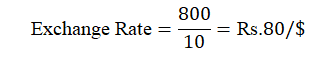
So according to PPP:
$1 = Rs.80
Relative PPP (Inflation-Based
Exchange rate changes according to the inflation differential between two countries.
Example:
| Country | Inflation |
| India | 8% |
| USA | 3% |
Difference = 5%
Therefore, INR should depreciate by about 5% against USD.
Forward Exchange Rates
In international finance, PPP helps explain future expected exchange rates.
Forward exchange rates reflect:
- Expected inflation difference
- Interest rate difference
- Market expectations
If Indian inflation > US inflation
➡ INR likely to depreciate
➡ Forward rate of USD becomes higher (premium)
Example:
Spot Rate = Rs.80 / $
Expected depreciation = 5%
Forward Rate ≈ Rs.84 / $
PP in International Financial Transactions
PPP becomes important in:
| Forward Contracts: importers/exporters use forward contracts to protect against currency depreciation or appreciation. |
| Foreign Investment Decisions: investors compare real purchasing power of currencies. |
| Multinational Pricing: MNCs adjust prices according to currency purchasing power. |
| Long-Term Exchange Rate Forecasting: PPP is widely used to estimate long-run equilibrium exchange rates. |
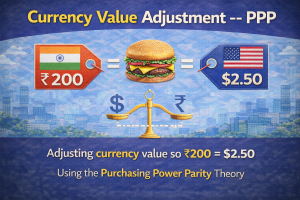
An Indian importer must pay $100,000 after one year.
Current rate = Rs.80/$
Inflation:
- India = 6%
- USA = 2%
Difference = 4%
Expected rate: 80×(1.04) =Rs.83.20
Expected future rate ≈ Rs.83.20 per $
The importer may book a forward contract around this rate.
Example: Product price in two countries
Suppose the same quality football is sold in two countries:
| Country | Price of Football |
| India | Rs.800 |
| USA | Rs.20 |
If the exchange rate is: 1$ = Rs.80.
Then the US price in INR is: 20×80=Rs.1600.
So, the football costs:
- Rs.800 in India
- Rs.1600 in USA ————— the football is cheaper in India.
Trade Opportunity
Because the football is cheaper in India:
- Traders in the US may import footballs from India
- Demand for Indian football exports increases
To buy footballs from India, US buyers must: convert USD into INR
Therefore:
- Demand for INR increases
- Demand for Indian goods increases
Impact on Exchange Rate
When demand for INR increases:
- INR appreciates
- USD depreciates
Suppose exchange rate moves from: 1$=Rs. 80→1$=Rs. 70
Now, let’s check the price again
New Equilibrium
US football price converted into INR: 20×70=Rs.1400.
The price gap is now smaller.
As trade continues:
- Currency values adjust
- Prices become closer
- The increase in demand for football in India would make them more expensive.
- Thus, the prices in the US and India would start moving towards an equilibrium.
Eventually the exchange rate moves toward a level where the same football has roughly similar purchasing power in both countries. This situation is called Purchasing Power Parity (PPP)
One of the most beautiful explanation for understanding the core logic behind the theory. Thank You Sir.
thank you!