
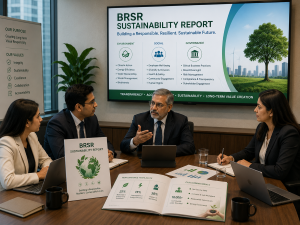
Sustainability is no longer viewed merely as a voluntary corporate initiative; it has become a key governance and compliance priority. With increasing regulatory scrutiny and investors focus on responsible business practices, companies are embedding ESG metrics into their operational and strategic frameworks to drive sustainable growth and strengthen stakeholder trust. Indian companies are increasingly moving toward measurable ESG (Environmental, Social, and Governance) reporting frameworks.
BRSR provides a structured framework for reporting Environmental, Social, and Governance (ESG) performance, making sustainability disclosures more consistent, comparable, and decision useful.

ESG Snapshot
| Pillar | Represents | Focus |
| E | Planet | Environmental Stewardship |
| S | People | Social Responsibility |
| G | Principles | Ethical Governance |
Business Responsibility and Sustainability Reporting (BRSR), introduced by the Securities and Exchange Board of India (SEBI), represents a significant shift in India’s corporate disclosure landscape. Stakeholders increasingly seek transparency regarding a company’s environmental impact, social responsibility, and governance practices. To address this evolving expectation and align with global sustainability trends, SEBI introduced BRSR as a standardized ESG reporting framework for listed companies.
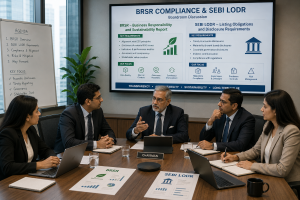
BRSR Compliance
According to the requirements of Securities and Exchange Board of India, Business Responsibility and Sustainability Reporting (BRSR) is mandatory for the top 1,000 listed companies by market capitalization on Indian stock exchanges. These companies must include BRSR disclosures as part of their annual reporting requirements.
Key points:
- Mandatory: Top 1,000 listed entities by market capitalization.
- Voluntary: Other listed companies that are not part of the top 1,000 may adopt BRSR voluntarily.
- BRSR Core: SEBI has also introduced BRSR Core, a subset of key ESG indicators that are subject to assurance requirements. The assurance requirements have been phased in overtime, beginning with the largest listed companies and gradually extending to more entities.
- Value Chain Disclosures: Larger listed entities are also expected to report certain ESG metrics relating to their significant value chain partners under the phased implementation roadmap.
From a compliance perspective, this means that while every listed company is not yet legally required to submit BRSR, ESG reporting expectations are steadily expanding, and many organizations outside the mandatory threshold are adopting BRSR voluntarily to meet investor, lender, customer, and supply-chain requirements.

ESG Framework under BRSR
| ESG pillar | Core focus | Guiding question | Key areas covered | Typical BRSR disclosures |
| E – Environmental (Planet) | Managing the organization’s impact on the environment | How responsibly does the company use natural resources and protect the environment? | Energy management, carbon emissions, water conservation, waste management, pollution control, renewable energy, biodiversity | Energy consumption, GHG emissions, water usage, waste generated and recycled, renewable energy initiatives |
| S – Social (Peo ple) | Creating value for employees, customers, suppliers, and communities | How does the company treat people and contribute to society? | Employee welfare, health & safety, diversity & inclusion, human rights, customer satisfaction, community development, responsible supply chain | Workforce diversity, employee training, safety incidents, community initiatives, customer complaints and resolutions |
| G – Governance (Principles) | Ensuring ethical, transparent, and accountable management | How effectively is the company governed? | Board effectiveness, ethics, compliance, risk management, transparency, anti-corruption measures, stakeholder engagement | Board composition, whistle-blower mechanism, code of conduct, regulatory compliance, grievance redressal systems |
Where is BRSR Reported?
BRSR is typically included as a dedicated section of a company’s Annual Report. Along with the financial statements, Board’s Report, Corporate Governance Report, and Management Discussion & Analysis, the Annual Report contains the Business Responsibility and Sustainability Report (BRSR), providing stakeholders with information on the company’s ESG performance.
Thus, BRSR complements traditional financial reporting by presenting non-financial information relating to environmental, social, and governance matters in a standardized format.
Practical Note
- The Top 1,000 listed companies by market capitalization are required by SEBI to provide BRSR disclosures as part of their Annual Report.
Many companies also upload the BRSR section separately on their websites for easier access by investors, analysts, and ESG rating agencies, but the primary reporting is through the Annual Report.
It helped me a lot for preparing the project , thank you sir for such a rich content 🙏
Need more contents like this. Thank you sir for keeping us updated.