

U.S. Federal Individual Income Tax — Tax Year 2025
One of the most important decisions while preparing a U.S. federal income tax return is choosing between the Standard Deduction and Itemized Deductions. Both reduce your taxable income, thereby lowering the amount of tax you owe. The Standard Deduction is a fixed amount prescribed by the IRS based on your filing status, whereas Itemized Deductions allow taxpayers to claim eligible actual expenses such as mortgage interest, state and local taxes, charitable contributions, and certain medical expenses. Taxpayers generally choose the option that provides the greater tax benefit.
1. Standard Deduction — Tax Year 2025
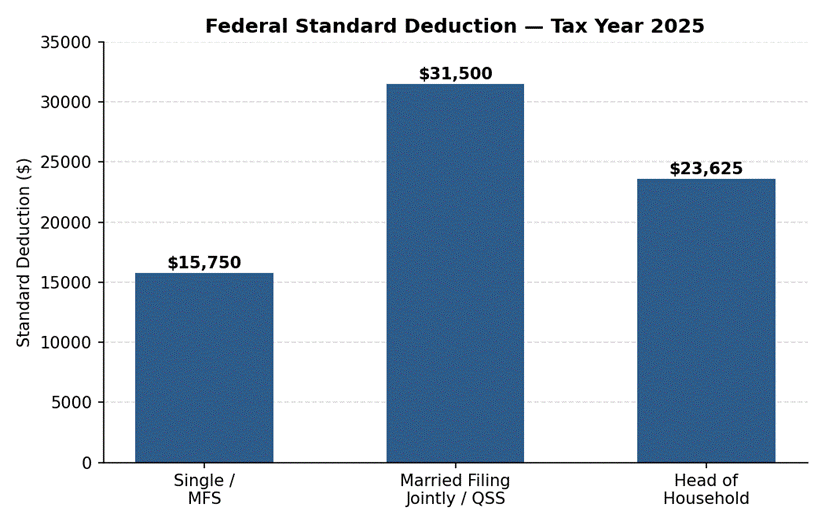
The standard deduction is a fixed dollar amount that reduces taxable income and requires no documentation. Amounts for 2025 were raised by the One Big Beautiful Bill (OBBB) Act, signed July 4, 2025, above the levels originally scheduled under inflation indexing.
| Filing Status | Standard Deduction — TY2025 | Change vs. TY2024 |
| Single / Married Filing Separately | $15,750 | +$1,150 |
| Married Filing Jointly / Qualifying Surviving Spouse | $31,500 | +$2,300 |
| Head of Household | $23,625 | +$1,725 |
Taxpayers who are 65 or older, and/or blind, receive an additional amount on top of the base standard deduction. TY2025 also introduces a new temporary “senior deduction” of up to $6,000 per qualifying person under the OBBB Act, separate from the regular additional amount.
| Additional Standard Deduction | Amount |
| Age 65+ or Blind — Single / Head of Household (per condition) | $2,000 |
| Age 65+ or Blind — Married (per spouse, per condition) | $1,600 |
| New “Senior Deduction” (OBBBA) — Age 65+, TY2025–2028; phases out above $75,000 (Single) / $150,000 (MFJ) MAGI | Up to $6,000 per person |
2. Itemized Deductions — Schedule A (Form 1040)
Itemizing lets a taxpayer deduct actual qualifying expenses instead of the flat standard amount. It only makes sense when total qualifying expenses exceed the applicable standard deduction. Key categories and limits for TY2025:
| Schedule A Category | What Qualifies | Key Limit (TY2025) |
| Medical & Dental Expenses | Unreimbursed medical/dental costs paid out of pocket (prescriptions, doctors, hospital care, etc.) | Deductible only above 7.5% of AGI |
| State & Local Taxes (SALT) | Property tax + choice of state/local income tax or sales tax | Capped at $10,000 (raised by OBBB for eligible filers) |
| Home Mortgage Interest | Interest on acquisition debt for a main or second home (Form 1098) | Debt capped at $750,000 ($375,000 if MFS) |
| Investment Interest | Interest paid to carry property held for investment | Limited to net investment income; excess carries forward |
| Charitable Contributions | Cash/property gifts to IRS-qualified charities | Generally capped at 60% of AGI (30%/20% for certain property/orgs) |
| Casualty & Theft Losses | Personal-use property losses (federally declared disasters only), Form 4684 | Reduce by $100/event, then by 10% of AGI |
3. Standard vs. Itemized — Comparison
The core decision rule: choose whichever is larger — the standard deduction for your filing status, or your total eligible expenses on Schedule A. A taxpayer with a mortgage, high state/local taxes, and significant medical or charitable expenses often benefits more from itemizing.

Nonresident Aliens (NRAs)
In general, Nonresident Aliens (NRAs) are not eligible to claim the Standard Deduction and must instead claim only allowable Itemized Deductions, if applicable. However, certain exceptions exist under U.S. tax law or applicable tax treaties (for example, eligible students and business apprentices from India may claim the Standard Deduction under the U.S.–India Income Tax Treaty). Always verify eligibility before filing.
4. Case Study: Rahul Mehra — Single Filer, AGI $95,000
Rahul is a single, salaried taxpayer with a home mortgage and typical itemizable expenses for TY2025. His adjusted gross income (AGI) is $95,000.
| Itemized Deduction Item | Amount |
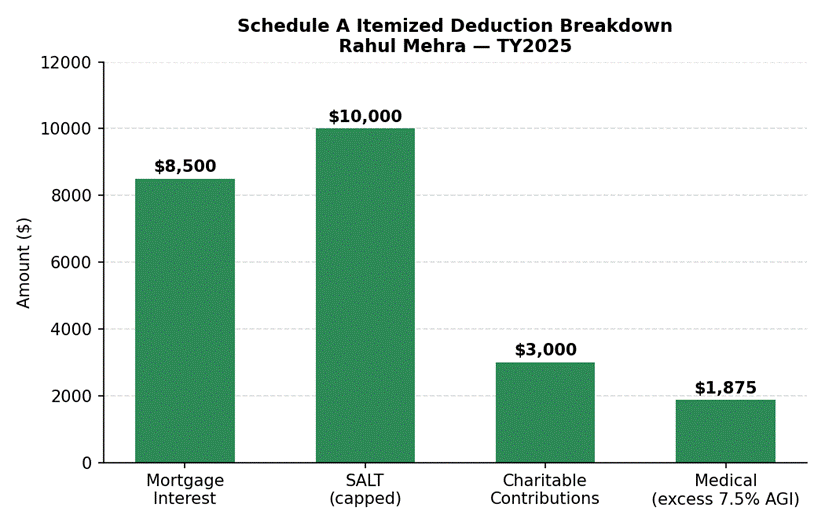
| Home mortgage interest (Form 1098) | $8,500 |
| State & local taxes — property tax $6,200 + state income tax $6,300, capped at $10,000 | $10,000 |
| Charitable contributions (cash, to qualified public charity) | $3,000 |
| Medical expenses: $9,000 paid − 7.5% × $95,000 AGI ($7,125) floor | $1,875 |
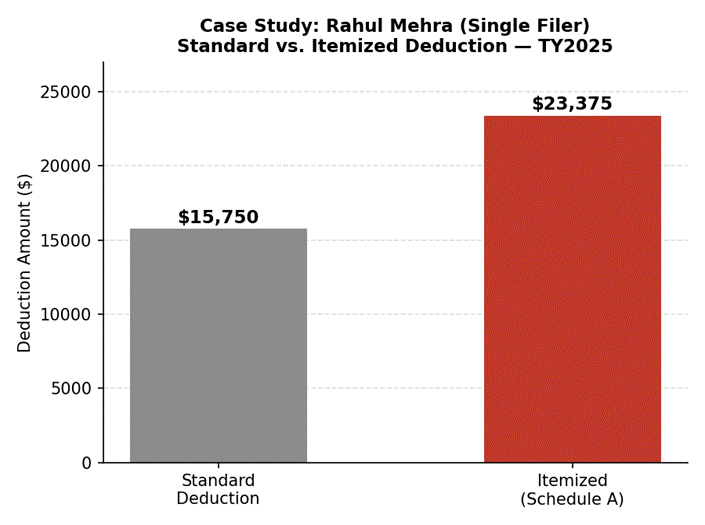
| Total Itemized Deduction (Schedule A) | $23,375 |
| Standard Deduction (Single, TY2025) | $15,750 |
| Additional Taxable-Income Reduction by Itemizing | $7,625 |
Breakdown of Rahul’s itemized deductions by category:
5. Conclusion
Because Rahul’s Schedule A total ($23,375) exceeds his standard deduction ($15,750) by $7,625, he should itemize. This additional deduction lowers his taxable income further and, at a 22% marginal federal bracket, saves him roughly $1,678 in federal tax versus taking the standard deduction (before considering the OBBB’s new limitation on itemized-deduction tax benefit for top-bracket taxpayers, which does not apply to Rahul).
General rule of thumb: itemizing tends to pay off for homeowners with sizable mortgage interest and SALT payments near the $10,000 cap, or taxpayers with large charitable gifts or high unreimbursed medical costs. Renters with modest deductible expenses are almost always better off with the standard deduction.
Disclaimer:
This blog has been prepared solely for educational and learning purposes to provide students with a high-level understanding of the fundamentals of the U.S. federal tax system. The content is intended to explain key concepts in a simplified manner and should not be construed as tax, legal, or professional advice. As U.S. tax laws, IRS regulations, forms, and filing requirements are subject to change and may vary depending on individual circumstances, students are encouraged to refer to the latest IRS publications, instructions, forms, and official guidance for detailed provisions and authoritative interpretation.
Very easily explained sir thanks for such an insightful concept