

Introduction: From Income Sources to ITR Filing
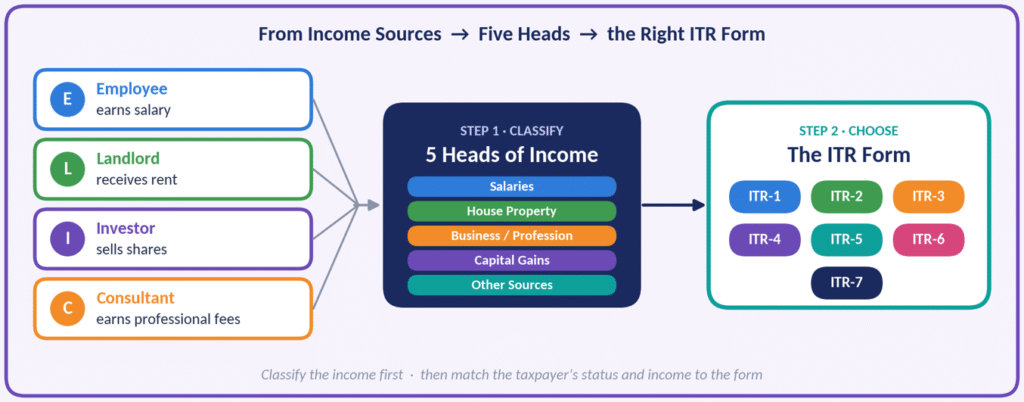
An employee earns salary, a landlord receives rent, an investor sells shares, and a consultant earns professional fees. How are these different income sources classified and reported in an Income Tax Return (ITR)?
The first step is to classify income correctly. The next is to determine the appropriate ITR form based on the taxpayer’s status, income sources and applicable eligibility conditions.
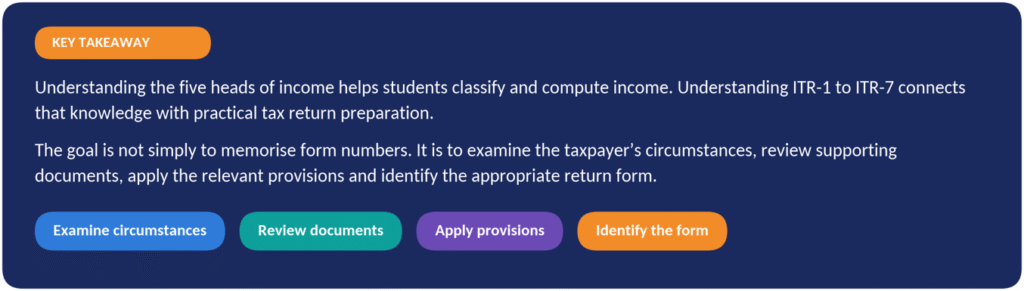
This blog connects the five heads of income and ITR forms in India through practical examples, helping students understand the fundamentals of tax return preparation.
1. Understanding the Heads of Income
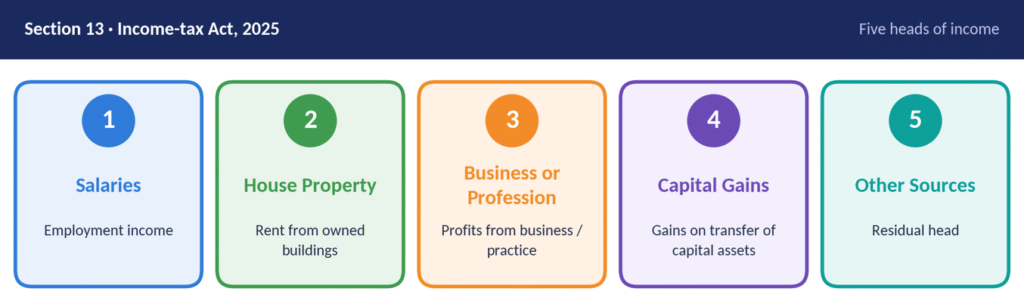
Under Section 13 of the Income-tax Act, 2025, income is classified under five heads, subject to the applicable provisions.
Income from Salaries
This generally covers taxable employment income where the required employer–employee relationship exists.

Income from House Property
This generally concerns income from ownership of a building or land appurtenant to a building, subject to statutory conditions.

Profits and Gains of Business or Profession
This generally covers taxable profits from business or professional activities.

Capital Gains
Capital gains may arise when a capital asset is transferred and a taxable gain results under the applicable provisions.

Income from Other Sources
This is generally the residual head for taxable income not chargeable under the other four heads, subject to specific provisions.

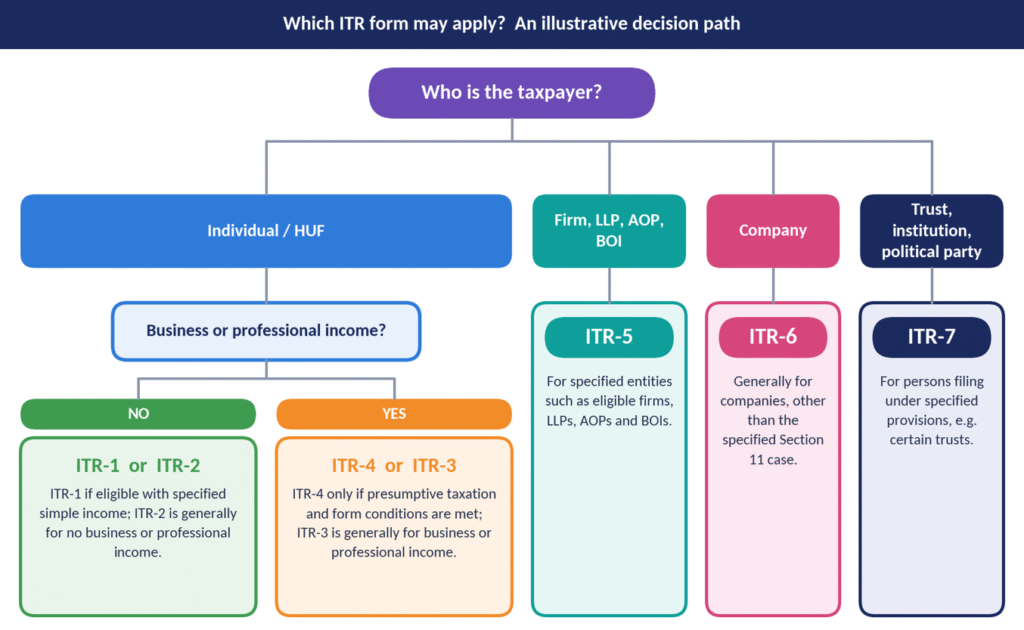
2. ITR-1 to ITR-7: Which Form May Apply?
The appropriate form depends on the taxpayer’s circumstances and the official eligibility conditions.

These are introductory descriptions. The correct form must be confirmed against the applicable year’s official instructions.
3. Mini Case Study: The Sharma Family’s Tax Return
Consider a fictional family with three different taxpayers
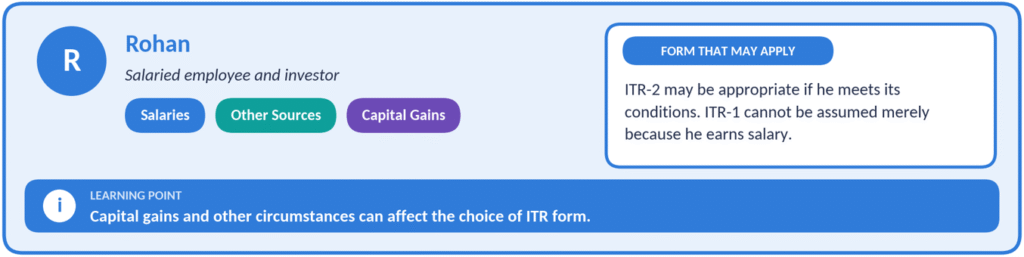
Rohan — Salaried Employee and Investor
Rohan earns salary from his employer, receives bank interest and sells shares, resulting in capital gains. He has no business or professional income.
His salary, interest and share transactions must be classified and computed under the relevant provisions. ITR-2 may be appropriate if he meets its conditions; ITR-1 cannot be assumed to be available merely because he earns salary.
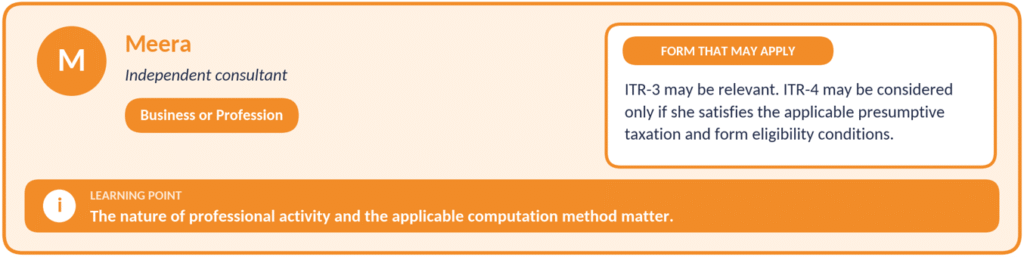
Meera — Independent Consultant
Meera earns professional fees from clients and maintains records of her receipts and expenses.
Her income may fall under Profits and Gains of Business or Profession. ITR-3 may be relevant. ITR-4 may be considered only if she satisfies the applicable presumptive taxation and form eligibility conditions.
The Family’s Partnership Firm
The family also operates a partnership firm that earns business profits.
The firm’s income and legal status must be considered separately from the individual family members’ returns. ITR-5 is generally relevant to a partnership firm, subject to the applicable rules.

This case demonstrates why family members and a business entity cannot automatically use the same return form.

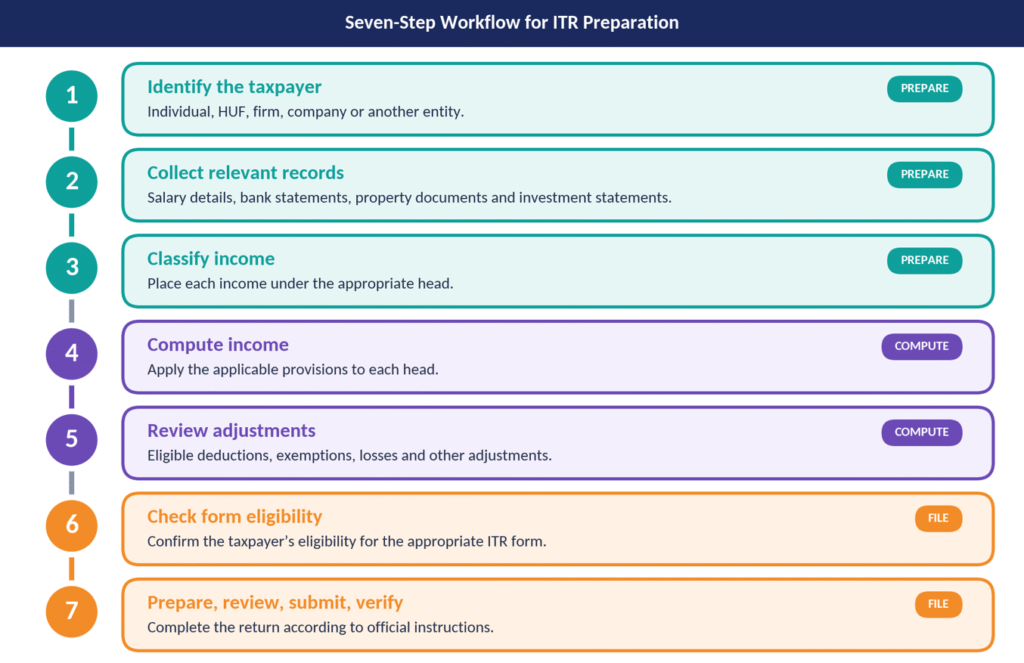
4. Practical Workflow for ITR Preparation
Students can follow this sequence:


Official References
- Income-tax Act, 2025 — Section 13, Heads of Income.
- Income Tax Department: https://www.incometax.gov.in/
- Official forms and downloads: https://www.incometaxindia.gov.in/
