
Fundamentals, Tax Impact and the Role of M-1 and M-3 Adjustments
Student: Professor, I understand that corporations are separate legal entities, but I still get confused when interviewers ask me to distinguish between a C corporation and an S corporation. Where should I begin?
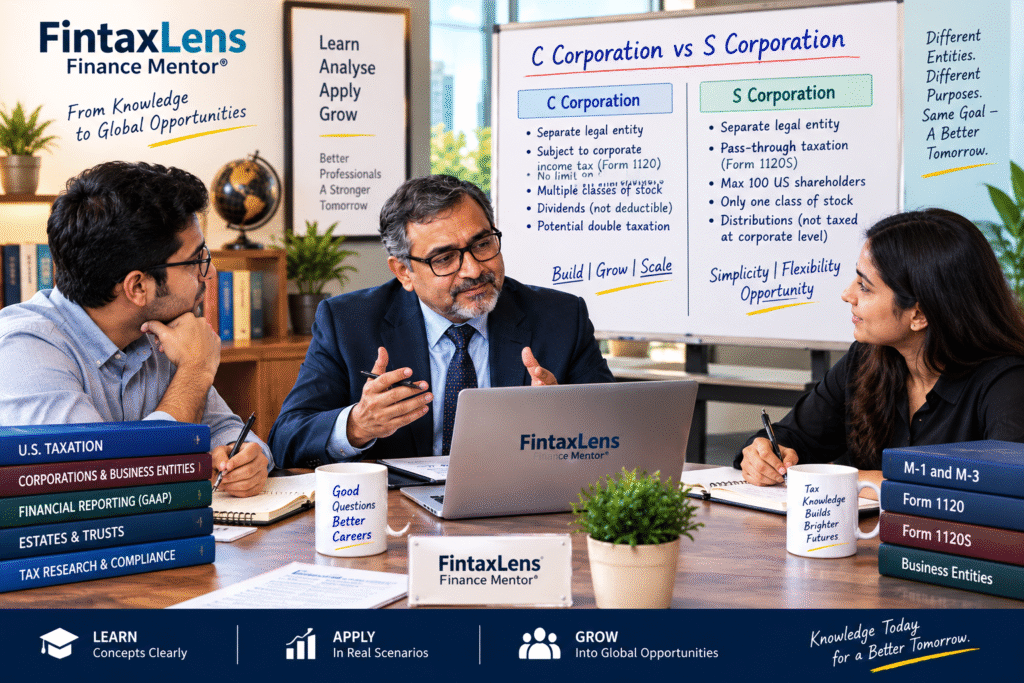
Professor: Begin with one fundamental idea: both are incorporated business entities, but their federal income-tax treatment is different. A C corporation is generally subject to corporate income tax, while an S corporation is generally a pass-through entity in which income or loss flows through to shareholders. Once this distinction is clear, the forms, shareholder rules, distributions and book-to-tax adjustments become much easier to understand.
1 The Fundamental Difference
Student: So, the first interview question may simply be: what is the difference between a C corporation and an S corporation?
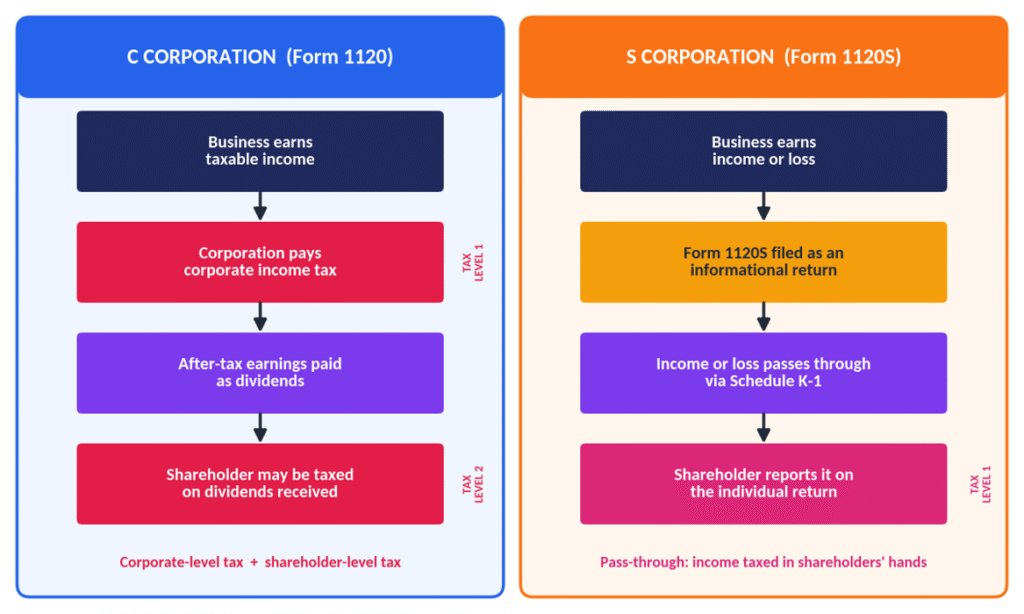
Professor: Exactly. Think of the distinction in terms of where the federal income tax is imposed. A C corporation reports its taxable income on Form 1120 and is subject to corporate income tax. An S corporation generally files Form 1120S as an informational return, and its income or loss passes through to shareholders, who report their respective amounts on their individual returns through Schedule K-1.
2 C Corporation vs S Corporation — At a Glance
| Feature | C Corporation | S Corporation |
| Legal status | Separate legal entity | Separate legal entity |
| Federal taxation | Subject to corporate income tax; Form 1120 | Pass-through taxation; Form 1120S |
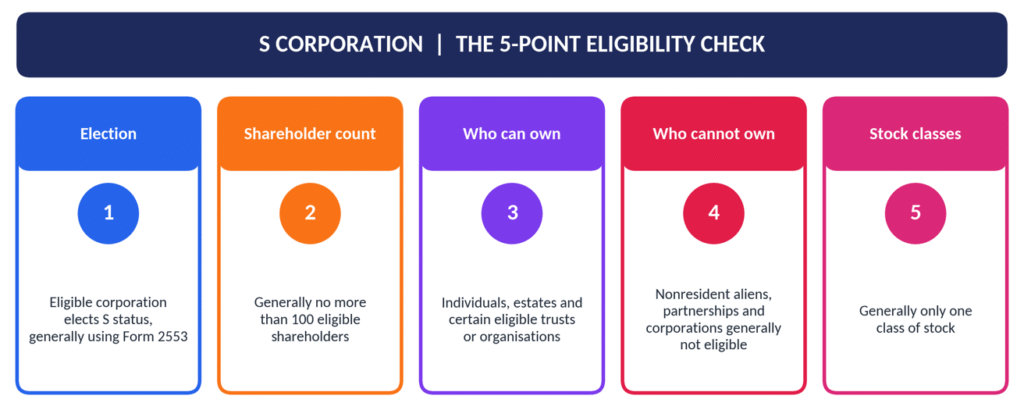
| Shareholders | No general federal limit on number of shareholders | Generally, no more than 100 eligible shareholders |
| Shareholder eligibility | Broad eligibility | Individuals, estates and certain eligible trusts/organizations; nonresident aliens, partnerships and corporations are generally not eligible |
| Classes of stock | Multiple classes may be permitted | Generally, only one class of stock |
| Election | No S election required | Eligible corporation must elect S status, generally using Form 2553 |
| Distributions | Dividends are not deductible by the corporation | Distributions generally do not create a second corporate-level tax in the same way as C-corporation dividends |
3 How C Corporation Taxation Works
Student: Why do people often describe C corporation taxation as double taxation?
Professor: Because the corporation and the shareholder can be taxed at different stages. The corporation first calculates and pays corporate income tax on its taxable income. If the corporation subsequently distributes after-tax earnings as dividends, the shareholder may also have income-tax consequences on those dividends. That is why an interview answer should connect the words corporate-level tax and shareholder-level tax.
- C corporation return: Form 1120.
- Corporate taxable income is determined at the entity level.
- After-tax earnings may be retained in the corporation or distributed to shareholders.
- Dividends are not deductible expenses of the corporation.
4 How S Corporation Taxation Works
Student: And what makes an S corporation different?
Professor: The key is pass-through taxation. The S corporation generally does not pay federal income tax at the corporate level on ordinary operating income in the same manner as a C corporation. Instead, the corporation files Form 1120S and reports the shareholders’ distributive amounts, generally through Schedule K-1, which the shareholders report on their own returns.
- S corporation return: Form 1120S.
- Income and loss generally pass through to shareholders.
- Schedule K-1 communicates each shareholder’s share of relevant tax items.
- S corporations have specific eligibility requirements and election rules.
- An S corporation generally must have only one class of stock.
5 When the Structure Matters
| Aspect | C Corporation | S Corporation |
| Typical fit in the source material | Larger businesses, capital raising and multinational operations | Small to medium businesses with limited shareholders |
| Corporate tax treatment | Corporate income tax applies | Pass-through treatment |
| Retained earnings | Can be retained for business growth, subject to applicable tax rules | Items generally flow through to shareholders |
| Self-employment / payroll point | Dividends are not treated as self-employment income | Active shareholder-employees must consider reasonable compensation and applicable payroll taxes |
| Compliance | More complex corporate compliance and reporting | Simpler in some respects, but strict eligibility rules apply |
6 The Interview Bridge: From Financial Statements to Tax Returns
Student: Where do M-1 and M-3 come into this discussion?
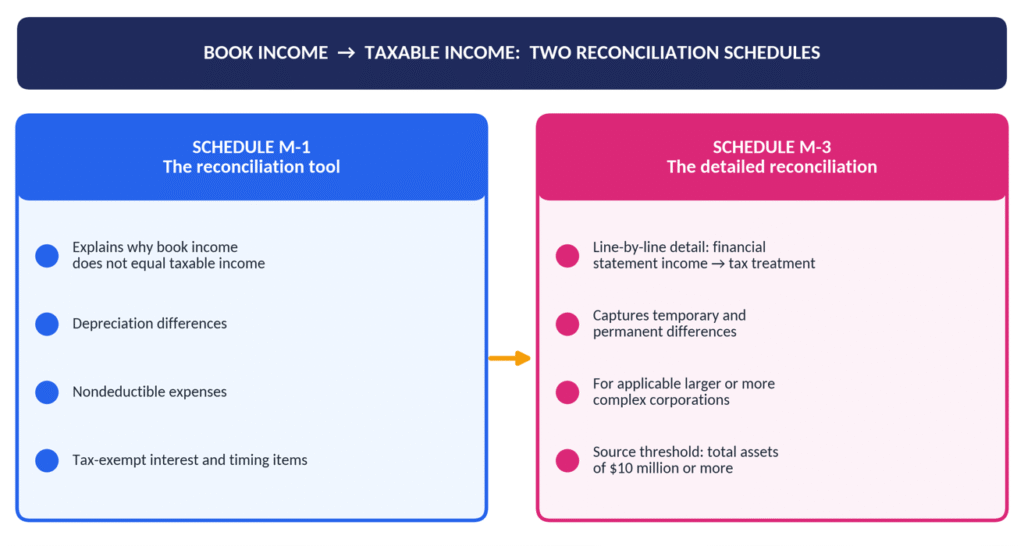
Professor: This is where a basic corporation question becomes a practical tax interview question. Financial statements are prepared using accounting principles, while taxable income is determined under tax rules. Therefore, book income and taxable income may differ. Schedule M-1 and, where applicable, Schedule M-3 provide reconciliation between financial statement income and taxable income.
7 Schedule M-1 Adjustments
Student: What should I remember about M-1?
Professor: Remember M-1 as a reconciliation tool. It helps explain why income reported for financial accounting purposes does not necessarily equal taxable income. For example, if tax-exempt interest is included in book income but excluded from taxable income, that amount is deducted in the reconciliation.
- Items may be added to book income because they are taxable but are not included in book income in the same manner.
- Items may be added back because an expense is recorded for book purposes but is not deductible for tax purposes, such as certain nondeductible expenses.
- Differences may arise from book depreciation and tax depreciation.
- Timing differences can arise from items such as deferred revenue or other book-tax differences.
- Items may be deducted from book income where tax treatment permits a deduction that differs from book treatment.
8 Schedule M-3 — A More Detailed Reconciliation
Student: Then why do we need M-3?
Professor: M-3 provides a more detailed reconciliation of financial statement income to taxable income for corporations that meet the applicable requirements. It provides more line-by-line detail than M-1 and is particularly relevant for larger or more complex corporations. In the material used for this discussion, the threshold is presented as total assets of $10 million or more.
- M-3 provides a more detailed reconciliation.
- It maps financial statement income and expenses to tax treatment in greater detail.
- It captures temporary and permanent differences.
- It can be viewed as an expanded and more transparent version of the M-1 reconciliation for applicable corporations.
9 Illustration — From Book Income to Taxable Income
Student: Can we connect M-1 and M-3 to numbers?
Professor: Yes. Consider a simplified C corporation example. Start with book income and then examine the book-tax differences.
| Particulars | Amount (USD) | Effect on Taxable Income | M-1 / M-3 Treatment |
| Book income (GAAP) | $1,000,000 | Starting point | Starting point |
| Book depreciation | $200,000 | Add back book depreciation | M-1 / M-3 |
| Tax depreciation | $300,000 | Deduct tax depreciation | M-1 / M-3 |
| Meals — nondeductible portion | $20,000 | Add back nondeductible | M-1 / M-3 |
| Tax-exempt interest | $10,000 | Deduct from book income if included in book income | M-1 / M-3 |
| Illustrative taxable income | $910,000 | Book income + book depreciation − tax depreciation + nondeductible meals − tax-exempt interest | Reconciled result |
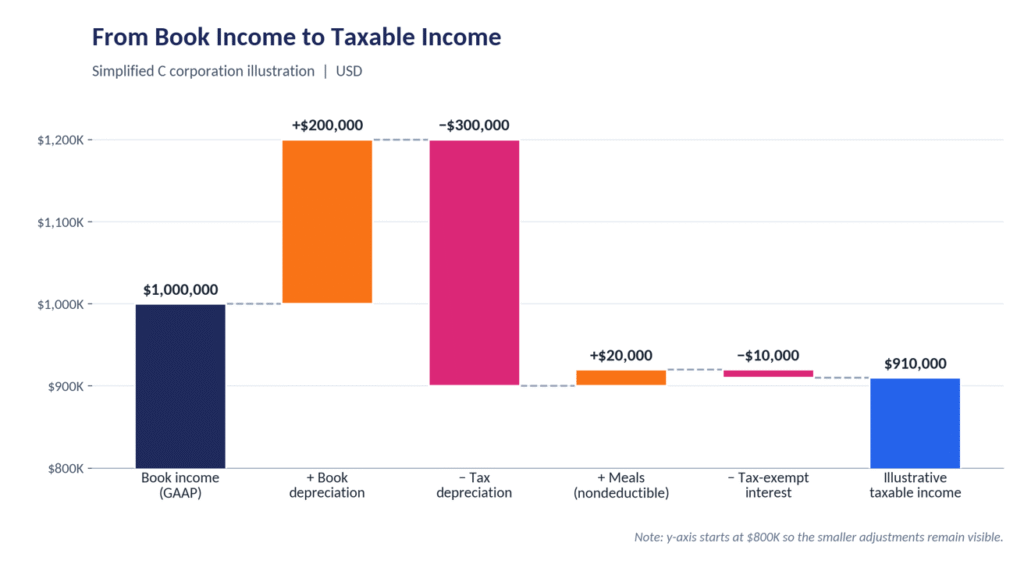
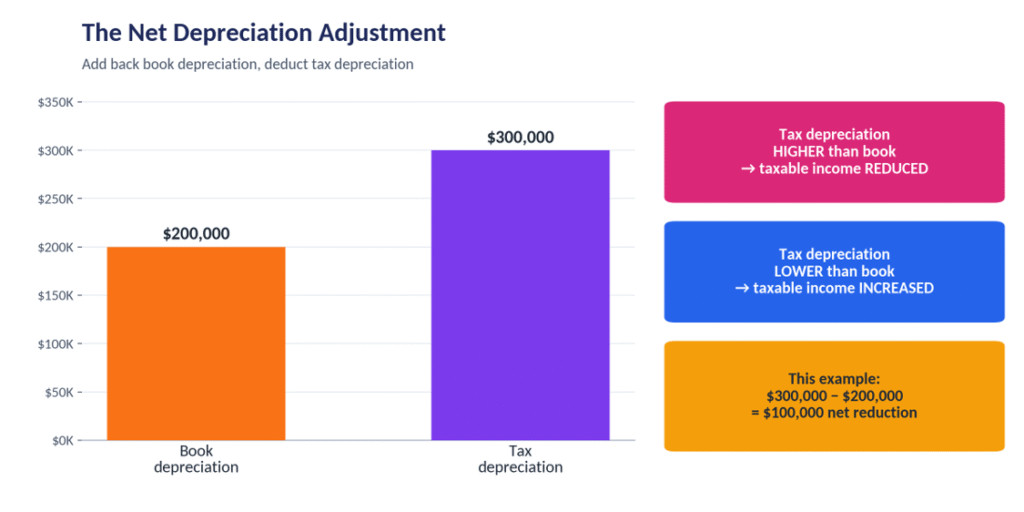
Professor: The important interview point is not memorising the final number. For depreciation, add back book depreciation and deduct tax depreciation. The difference between the two produces the net depreciation adjustment. If tax depreciation is higher than book depreciation, the net adjustment reduces taxable income; if tax depreciation is lower, it increases taxable income. Similarly, if tax-exempt interest has been included in book income, it is deducted in the book-to-tax reconciliation because it is not included in taxable income. The other book-tax differences are then considered separately.
10 A Strong Interview Answer in One Minute
Student: If an interviewer asks me to explain C corporation versus S corporation in one minute, what should I say?
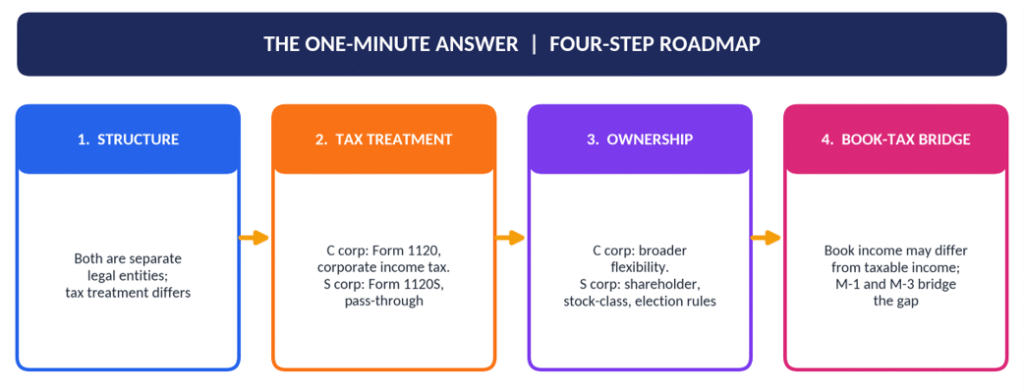
Professor: Say it in a structured way: both are separate legal entities, but their federal income-tax treatment differs. A C corporation files Form 1120 and is subject to corporate income tax, while an eligible S corporation files Form 1120S and generally passes income and loss through to shareholders. C corporations generally have broader ownership flexibility, whereas S corporations have specific shareholder, stock-class and election requirements. Finally, remember that for a C corporation, book income may differ from taxable income, so M-1 and M-3 reconciliations help bridge financial reporting and tax reporting.
11 Interview Takeaways
| 1 Understand the structural and tax differences between C and S corporations. |
| 2 Know the purpose of Form 1120 and Form 1120S. |
| 3 Understand the role of Schedule K-1 in S corporation pass-through taxation. |
| 4 Remember the major S corporation eligibility requirements. |
| 5 Understand why book income and taxable income can differ. |
| 6 Know the purpose of Schedule M-1 and the more detailed role of Schedule M-3. |
| 7 Be prepared to explain common book-tax differences such as depreciation and nondeductible expenses. |
| 8 Connect financial reporting, tax compliance and business decisions rather than treating them as separate topics. |