

The SmartSteel Ltd- Case Study
One Business, Three Questions
Every business, big or small, is really answering three fundamental questions at all times:
- Did we make a profit?
- What do we own, and what do we owe?
- Where did our cash come from, and where did it go?
Each question is answered by one financial statement — and together, the three statements tell the complete financial story of a business.
A Simple Memory Framework
| Statement | Think of it as… | Because… |
| Income Statement | A Movie | It covers a period of time |
| Balance Sheet | A Photograph | It shows position at one date |
| Cash Flow Statement | A Cash Journey | It tracks how cash moved |
| Remember: Profit ≠ Cash. The three statements are not independent — they are deeply connected, and one transaction can move through all three. |
SmartSteel Ltd. — A Manufacturing Company’s Financial Story
Let’s follow one company through one year of transactions, stage by stage.
Stage 1 — SmartSteel Starts Business
The owners invest ₹10,00,000 as capital.
| Balance Sheet | Impact |
| Cash | ↑ ₹10,00,000 |
| Share Capital | ↑ ₹10,00,000 |
| Lesson: Capital introduced is not income. There is no revenue, no profit yet. |
Stage 2 — SmartSteel Takes a Bank Loan
₹5,00,000 is borrowed from the bank.
| Statement | Impact |
| Balance Sheet: Cash | ↑ ₹5,00,000 |
| Balance Sheet: Loan Liability | ↑ ₹5,00,000 |
| Cash Flow: Financing Inflow | ↑ ₹5,00,000 |
| Socratic check — “Has SmartSteel earned ₹5,00,000?” Answer: No. Borrowing creates a liability, not income. |
Stage 3 — SmartSteel Buys Machinery
₹6,00,000 worth of machinery is purchased.
| Statement | Impact |
| Balance Sheet: Machinery | ↑ ₹6,00,000 |
| Balance Sheet: Cash | ↓ ₹6,00,000 |
| Cash Flow: Investing Outflow | ₹6,00,000 |
| Income Statement | No immediate expense |
| Lesson: A cash outflow does not necessarily mean an expense. |
Stage 4 — SmartSteel Manufactures Goods
Now costing enters the picture: raw materials, direct labour, factory overheads and work-in-progress combine to give Finished Goods.
Cost of Production → Cost of Goods Sold (COGS) → Gross Profit.
Stage 5 — SmartSteel Makes Sales
Total sales of ₹10,00,000 are made, split deliberately into two kinds:
| Sale Type | Amount | Cash Received Now? |
| Sale A — Cash Sale | ₹4,00,000 | Yes |
| Sale B — Credit Sale | ₹6,00,000 | No — becomes Trade Receivables |
| The key insight: the Income Statement shows Revenue of ₹10,00,000, but the Cash Flow Statement shows only ₹4,00,000 actually received. The remaining ₹6,00,000 sits on the Balance Sheet as Trade Receivables. |
Stage 6 — Profit Appears
| Income Statement | Amount |
| Revenue | ₹10,00,000 |
| Expenses | ₹8,00,000 |
| Net Profit | ₹2,00,000 |
Net Profit of ₹2,00,000 flows into Retained Earnings on the Balance Sheet — but we still don’t know how much actual cash the company has.
Stage 7 — Enter the Cash Flow Statement
Starting from Net Profit, we adjust for non-cash items and working-capital movements to find the real cash generated:
| Item | Amount | Reason |
| Net Profit | ₹2,00,000 | Starting point |
| Add: Depreciation | ₹50,000 | Non-cash expense |
| Less: Increase in Receivables | (₹70,000) | Sales recognised, cash not yet collected |
| Less: Increase in Inventory | (₹80,000) | Cash tied up in stock |
| Cash from Operations | ₹1,00,000 | Total |
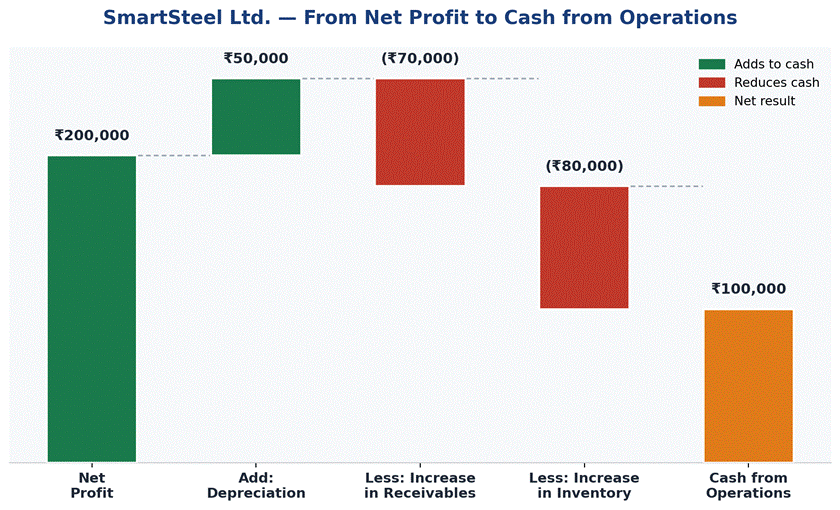
| Why can a profitable company still have a cash problem? Because profit and cash are not the same thing — money can be tied up in receivables and inventory even while the Income Statement shows a healthy profit. |
Stage 8 — The Three Statements Finally Come Together
| Statement | What It Tells Us |
| Income Statement | Performance — did we make a profit? |
| Balance Sheet | Position — what do we own and owe? |
| Cash Flow Statement | Cash Movement — where did the cash go? |
| KEY TAKEAWAY One transaction can impact all three financial statements at once. Profit ≠ Cash — and understanding the bridge between them is the single most important skill in reading a company’s financial story. |
Your blogs are life savior for us. Thank you sir.