
Suppose the government wants to encourage taxpayers to save for retirement, pursue higher education, or pay for medical expenses. Instead of giving cash directly, it often provides tax benefits in the form of deductions. But what exactly is a deduction, and why are some deductions called ‘above-the-line’ while others are ‘below-the-line’? Let’s understand this step by step.
What Is a Tax Deduction?
A tax deduction is an amount that the IRS allows a taxpayer to subtract from income before calculating federal income tax.
| In simple words: A deduction reduces the income on which federal income tax is calculated. Higher Deduction → Lower Taxable Income → Lower Federal Income Tax |
Classification of Deductions
There are two broad categories of deductions.
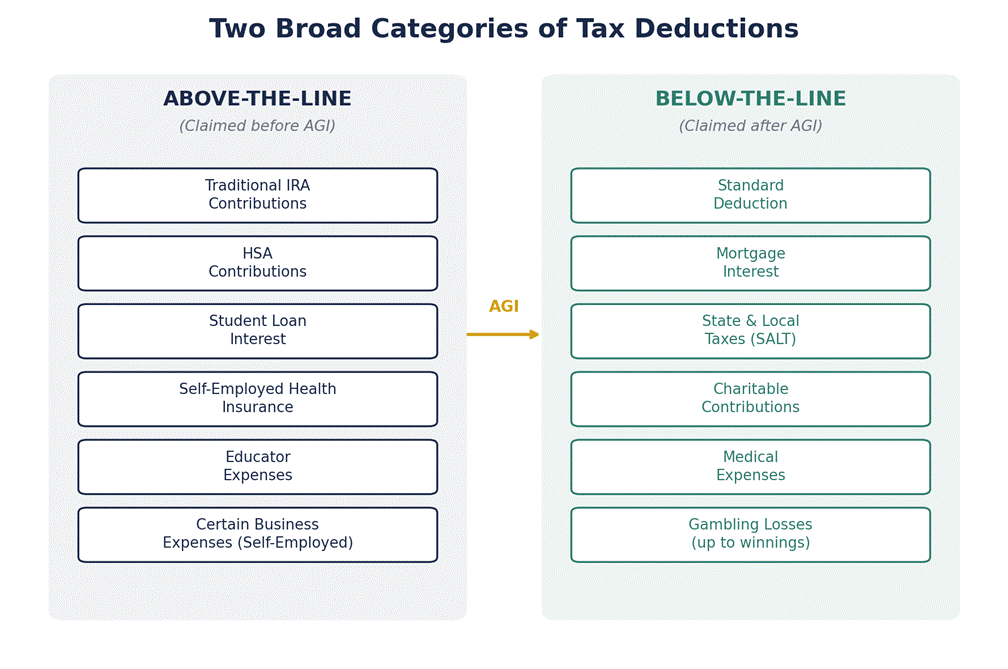
Chart 1 — Above-the-line vs. below-the-line deductions at a glance
A. Above-the-Line Deductions (ALD)
These deductions are claimed before arriving at Adjusted Gross Income (AGI) and are generally available whether or not the taxpayer itemizes deductions.
| Deduction | Purpose |
| Traditional IRA Contributions | Retirement savings |
| Health Savings Account (HSA) Contributions | Medical savings |
| Student Loan Interest | Higher education |
| Self-Employed Health Insurance | Self-employed taxpayers |
| Certain Business Expenses of Self-Employed Persons | Business deductions |
| Educator Expenses | Qualified classroom expenses |
| Alimony Paid * | Subject to applicable tax law |
| Moving Expenses * | Limited eligibility (primarily certain members of the Armed Forces under current law) |
A Note on Alimony
Before the Tax Cuts and Jobs Act (TCJA):
- Alimony paid was generally deductible by the payer.
- The recipient generally included it in taxable income.
For most divorce or separation agreements executed after 31 December 2018, the TCJA generally eliminated the deduction for alimony payments and excluded those payments from the recipient’s taxable income. Older agreements may continue to follow the prior rules unless modified to adopt the TCJA treatment.
A Note on Moving Expenses
The TCJA generally suspended the moving expense deduction for most taxpayers through 2025.
Currently, this deduction is generally available only to eligible active-duty members of the U.S. Armed Forces who move pursuant to military orders.
B. Below-the-Line Deductions (BLD)
After calculating AGI, taxpayers claim either the Standard Deduction or Itemized Deductions — whichever provides the greater benefit.
| Itemized Deduction | Remarks |
| Mortgage Interest | Subject to IRS rules |
| State and Local Taxes (SALT) | Subject to statutory limitation |
| Charitable Contributions | Qualified organizations |
| Medical Expenses | Subject to AGI threshold |
| Gambling Losses | Deductible only up to the amount of gambling winnings and generally only if the taxpayer itemizes deductions; adequate records are required |
Key Tax Law Updates Affecting Deductions
| Deduction | Before TCJA | Current High-Level Position |
| Alimony | Generally deductible | Generally not deductible for most post-2018 agreements |
| Moving Expenses | Generally deductible if requirements met | Generally suspended except for eligible military personnel |
| Gambling Losses | Deductible up to gambling winnings | Same general principle continues, subject to current IRS rules |
| Standard Deduction | Lower | Significantly increased by TCJA (amounts adjusted periodically for inflation) |
Case Study: Understanding Deductions in Action
Background
Emma is a marketing executive working in New York. During the 2025 tax year, she earned a salary of $100,000. She wants to determine how deductions reduce her taxable income before calculating her federal income tax.
Assume the following figures (assumed for classroom learning):
| Particulars | Amount ($) |
| Gross Salary | 100,000 |
| Traditional IRA Contribution | 4,000 |
| Student Loan Interest | 1,000 |
| HSA Contribution | 2,000 |
| Standard Deduction | 15,000 |
Step 1: Calculate Above-the-Line Deductions
| Particulars | Amount ($) |
| Traditional IRA Contribution | 4,000 |
| Student Loan Interest | 1,000 |
| HSA Contribution | 2,000 |
| Total Above-the-Line Deductions | 7,000 |
Step 2: Calculate Adjusted Gross Income (AGI)
| Particulars | Amount ($) |
| Gross Income | 100,000 |
| Less: Above-the-Line Deductions | (7,000) |
| Adjusted Gross Income (AGI) | 93,000 |
Step 3: Claim Standard Deduction
| Particulars | Amount ($) |
| Adjusted Gross Income | 93,000 |
| Less: Standard Deduction | (15,000) |
| Taxable Income | 78,000 |
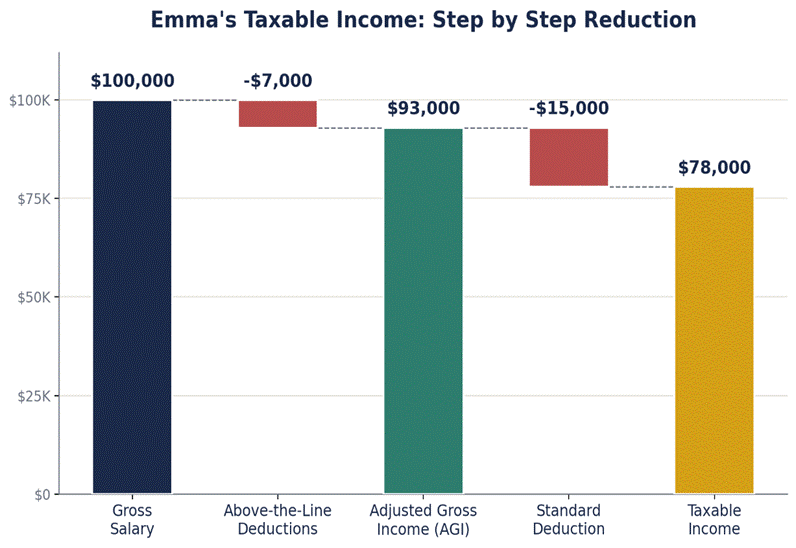
Chart 2 — Emma’s taxable income, step by step
Learning Outcome
Without deductions, Emma’s taxable income would have been $100,000. Because of the deductions:
- Above-the-Line Deductions = $7,000
- Standard Deduction = $15,000
Her taxable income is reduced to $78,000.
| Tax savings arise because federal income tax is calculated on $78,000 instead of $100,000. |
Q&A
Professor: Did the deductions reduce Emma’s tax directly?
Students: No.
Professor: Then what did they reduce?
Students: They reduced her taxable income.
Professor: Excellent! The tax will now be calculated at $78,000 rather than $100,000. The actual tax saving depends on Emma’s applicable federal income tax bracket.
Memory Sheet
| Concept | Effect |
| Above-the-Line Deduction | Reduces Gross Income to arrive at AGI |
| Below-the-Line Deduction | Reduces AGI to arrive at Taxable Income |
| Tax Deduction | Reduces Taxable Income |
| Tax Credit | Reduces Federal Income Tax Liability |
| Tax Withholding | Advance payment of tax |
| Estimated Tax Payment | Advance payment of tax |
Takeaway
| Think of deductions as reducing the amount of income that is taxed. They come before the tax is calculated. Tax credits come later and reduce the tax itself. |
Thank You sir , for explaining the concept so easily …
The case study makes it very easier to understand the deductions properly.
Thank u sir for explaining to clearly and in easy way
specially the memory sheet is very usefull thanks again sir, the best teacher & guide i have ever seen.
Very well explained Sir ! The simple language and the case study analysis made the topic easy to understand.Thank you Sir.
That’s great to hear!! stay tuned.
Very nicely explained. Thank You sir for putting so much effort for us.