
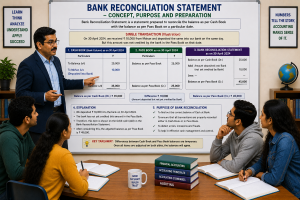
Cash and bank balances represent the most liquid resources of a business. Their accurate recording is essential because they not only affect day-to-day operations but also influence the Balance Sheet and the Cash Flow Statement. To ensure proper control over these balances, accountants maintain a Cash Book and periodically prepare a Bank Reconciliation Statement (BRS).
However, students are often confused by terms such as Cash Book, Bank Statement, Bank Reconciliation Statement (BRS), Balance Sheet and Cash Flow Statement. Questions such as “which bank balance is correct?” and “how are all these records connected?” are quite common among beginners.
What is a Cash Book?
Professor: Students, suppose you start a small business today. What type of transactions are likely to occur first?
Student A: We may receive cash from customers and pay cash for various expenses.
Professor: Correct. To record such transactions, accountants maintain a Cash Book.
Definition
A Cash Book is a special accounting book used to record all cash receipts, cash payments and bank transactions of a business.

What is a Double Column Cash Book?
Student B: Sir, where do we record bank transactions?
Professor: Excellent question. In practice, many businesses maintain a Double Column Cash Book.
Definition
A Double Column Cash Book contains two columns:
- Cash Column
- Bank Column
The Cash Column records cash transactions, while the Bank Column records transactions relating to the bank account.
Thus, one book simultaneously tracks:
- Cash in Hand
- Bank Balance
Professor: The closing balance of the Bank Column represents the Bank Balance as per the Cash Book.
Then why does the Bank send a statement?
Student C: If we already know our bank balance from the Cash Book, why does the bank send a statement?
Professor: Because the bank maintains its own records.
The bank statement contains:
- Deposits received
- Cheques cleared
- Online transfers
- Bank charges
- Interest credits
- Standing instructions executed by the bank
The balance shown by the bank is called the Bank Balance as per the Bank Statement.
Why are the two balances different?
Student D: Shouldn’t both balances always be the same?
Professor: Ideally yes, but in practice they often differ.
Consider this example:
On 31 March, the business issued a cheque of Rs.10,000 to a supplier.
The business immediately records:
Bank A/c Cr. Rs.10,000
However, the supplier presents the cheque to the bank on 5 April.
As a result:
- The Cash Book records the payment on 31 March.
- The Bank records the payment on 5 April.
Therefore, the two balances become temporarily different.
What is a Bank Reconciliation Statement (BRS)?
Definition
A Bank Reconciliation Statement (BRS) is a statement prepared to reconcile the difference between:
- Bank Balance as per the Cash Book, and
- Bank Balance as per the Bank Statement.
Why do differences arise?
Professor: Let us classify the differences into two categories.
Category 1: Timing differences
Examples:
- Cheques issued but not yet presented.
- Cheques deposited but not yet collected.
- Electronic transfers are still under processing.
In these cases:
- The Cash Book is correct.
- The Bank Statement is temporarily different.
No accounting adjustment is required.
The BRS simply explains the difference.
Category 2: Unrecorded items
Examples:
- Bank charges debited by the bank.
- Interest credited by the bank.
- Direct deposits by customers.
- Standing instructions executed by the bank.
In these cases:
- The Bank Statement contains information.
- The Cash Book has not yet recorded it.
Therefore, adjustment entries must be passed in the books.
Why is BRS important?
Student A: Sir, why do Accountants spend so much time preparing for BRS?
Professor: Because it serves several important purposes.
A BRS helps to:
- Verify the accuracy of cash and bank records.
- Detect omissions and errors.
- Identify unauthorized transactions.
- Strengthen internal control over cash.
- Improve the reliability of financial statements.
For this reason, BRS is considered one of the most important control tools in accounting.
Which balance appears in the Balance Sheet?
Student B: Sir, after preparing a BRS, which balance finally appears in the Balance Sheet?
Professor: This is the most important question.
Many students mistakenly believe that the balance shown by the bank statement must appear in the Balance Sheet.
This is not always true.
Important Rule
If the difference arises due to timing differences:
- No accounting entry is required.
- The Cash Book balance remains correct.
- Accounting entry is required for unrecorded items and in that case the revised Cash Book balance becomes the correct balance.
| Type of difference | Accounting entry required? | Effect on Cash Book |
| Timing Difference | No | No change |
| Unrecorded Entry | Yes | Cash Book revised |
Therefore:
The Balance Sheet reports the correct bank balance as per the books after recording all necessary adjustments, while the BRS explains any remaining timing differences.
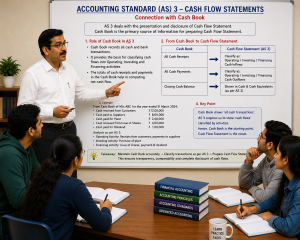
How does this connect with the Cash Flow Statement (AS 3)?
Student C: Sir, where does the Cash Flow Statement come into the picture?
Professor: Excellent question.
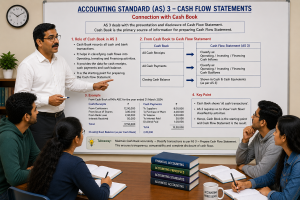
The Cash Flow Statement under AS 3 begins with an opening cash balance and ends with a closing cash balance.
The closing balance of:
- Cash in Hand, and
- Bank Balance
shown in the Balance Sheet should agree with the closing Cash and Cash Equivalents reported in the Cash Flow Statement.
Thus, all these records are interconnected.
Takeaway
The Cash Book records cash and bank transactions, the Bank Statement provides the bank’s perspective, and the BRS acts as a bridge between the two. After necessary adjustments are recorded, the resulting cash and bank balances appear in the Balance Sheet and ultimately form part of the Cash Flow Statement under AS 3.
Very very conceptually explained sir . Thanks a lot
Hello https://fintaxlens.com/,
I hope you’re doing well. I came across your business online and thought you might be interested in improving your visibility and traffic on search engines.
We specialize in helping businesses strengthen their online presence through effective SEO strategies.
Once you share your target keywords and target market, I’ll send a full proposal.
Warm regards,
Asif
Let me check.. Thank you.
Well explanation with clear examples
Thank you sir, it helped me a lot.