

Accounting is the language of business but often introduced as a subject of rules, formats, and calculations. But it is built on a set of fundamental concepts that give meaning and consistency to every number recorded.
If students understand these concepts clearly, they don’t need to “memorize accounting”—they can reason out answers, even in interviews or practical situations.
What are Accounting Concepts?
Accounting concepts are the fundamental assumptions or basic ideas upon which accounting is built.
Examples of Accounting Concepts
- Business Entity Concept
- Going Concern Concept
- Money Measurement Concept
- Accounting Period Concept
- Dual Aspect Concept
- Accrual Concept
- Cost concept

Why are Accounting Concepts important?
- They provide a logical foundation for recording transactions
- They ensure uniformity and comparability in financial statements
- They connect practical accounting with Accounting Standards (AS) and GAAP (Generally Accepted Accounting Principles)
- They help students think like accountants, not just solve problems
Concepts are the why behind accounting. Without them, accounting becomes mechanical.
Connection with AS and GAAP
All Accounting Standards and GAAP are built on these basic concepts.
- When companies follow standards, they apply these concepts in a structured way
- Concepts ensure that financial statements are:
- Reliable
- Consistent
- Comparable
What are Accounting Conventions?
Accounting conventions are customs, practices, or guidelines that have been developed over time to make accounting information more useful and reliable.
They answer the question: how should accountants apply accounting concepts in practice?
Examples of Accounting Conventions
- Convention of Conservatism (Prudence)
- Convention of Consistency
- Convention of Materiality
- Convention of Full Disclosure
Example
Suppose inventory costs are Rs.1,00,000 and its market value falls to Rs.90,000.
Under the Convention of Conservatism, inventory is reported at Rs.90,000 because anticipated losses are recognized, while anticipated profits are not.
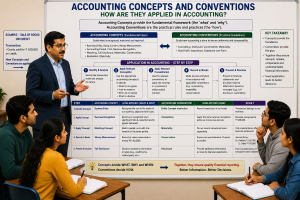
Difference between Accounting Concepts and Conventions
| Basis | Accounting Concepts | Accounting Conventions |
| Meaning | Fundamental assumptions of accounting | Established practices and customs |
| Purpose | Provide theoretical foundation | Guide practical application |
| Nature | Basic accounting ideas | Accepted accounting practices |
| Origin | Derived from accounting theory | Developed through experience |
| Example | Going Concern Concept | Conservatism Convention |
Are Accounting Principles and Concepts the same?
Not exactly, although they are closely related.
Example
Accrual Concept
States that:
- revenues and expenses should be recognized when earned or incurred, not necessarily when cash is received or paid.
Accounting Principle derived
Revenue and expense recognition follow the accrual basis of accounting.
Thus:
- Concept = underlying idea
- Principle = accounting rule arising from that idea
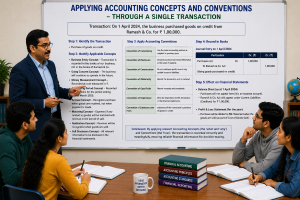
One Transaction – Application of multiple concepts and conventions
Selva Company purchased machinery worth Rs.5,00,000 on credit from a supplier.
| Concept / Convention | Application in the transaction | Explanation |
| Business Entity concept | Machinery is purchased by the business | The business is treated as separate from its owner. Therefore, the machinery becomes a business asset and not the personal property of the owner. |
| Dual Aspect concept | Machinery increases and Creditors increases by Rs.5,00,000 | Every transaction has two aspects. Here, one asset is acquired, and a corresponding liability is created. |
| Money Measurement concept | Transaction recorded at Rs.5,00,000 | Only transactions that can be expressed in monetary terms are recorded in accounting records. |
| Going Concern concept | Machinery is treated as a fixed asset | Since the business is expected to continue in the foreseeable future, the machinery will be used to generate future economic benefits rather than being immediately sold. |
| Cost concept | Machinery recorded at purchase cost of Rs.5,00,000 (Historical Cost) | Assets are initially recorded at the actual amount paid or payable at the time of acquisition, irrespective of future market value changes. |
| Accrual concept | Creditor is recognized immediately although payment has not yet been made | Transactions are recorded when they occur and not necessarily when cash is paid or received. |
| Convention of Conservatism (Prudence) | No anticipated gain is recognized if machinery value rises later | Accountants recognize expected losses but generally do not recognize unrealized gains. |
| Convention of Consistency | Same depreciation method should be followed year after year | Consistent accounting policies improve comparability of financial statements over different accounting periods. |
| Convention of Full Disclosure | Significant information relating to the machinery may be disclosed in notes to accounts | Users of financial statements should receive all material information necessary for informed decision-making. |
Key Takeaway for Students Every business transaction tells a story. Debit and Credit help us record that story, accounting concepts explain why it is recorded in a particular manner, and accounting conventions ensure that the information is presented consistently and prudently. Together, they form the foundation of modern accounting and financial reporting.
Thanks a Lot Sir, helped me a lot
Helped in understanding the concepts in depth .Thank you sir.
Thank you!
Sir, these concepts not only improved my accounting knowledge, but also helped me to understand the importance of the use of these actual concepts of accounting rather than just solving sums.
The table helped me for understanding it easily. Thank You Sir.