

In today’s competitive business environment, companies frequently rely on external financing to support expansion, manage working capital, or undertake capital-intensive projects. Financial institutions, however, do not extend credit based solely on growth prospects—they closely evaluate a company’s financial stability and repayment capacity before making lending decisions.
Two of the most critical metrics in this evaluation are the Debt–Equity Ratio and the Interest Coverage Ratio (ICR). While the Debt–Equity Ratio reflects the long-term solvency and capital structure risk, the Interest Coverage Ratio measures the company’s ability to service interest obligations from its operating profits.
For businesses, regularly monitoring these ratios is not merely a routine financial check but a strategic necessity. A well-balanced ratio can improve creditworthiness, whereas unfavorable levels may restrict access to funding or increase borrowing costs.
In this blog, we will explore how these ratios are calculated, the key components involved, and how they are interpreted from a lender’s perspective, helping you connect financial theory with practical decision-making.
The Debt-to-Equity (D/E) ratio compares a company’s total debt to its shareholders’ equity and indicates financial leverage.
- A higher ratio indicates a higher level of debt relative to equity, suggesting that the company is more leveraged and could be at greater risk of financial distress.
- A lower ratio indicates that the company is less reliant on debt to finance its operations.
- Maintaining a balanced D/E ratio helps in reducing financial risk, and keeping track allows you to see how changes in debt or equity impact your financial health over time.
Total Liabilities ÷ Total Shareholder Equity = Debt-to-Equity Ratio
The interest coverage ratio (ICR) is an essential metric for evaluating a company’s financial health and debt-servicing ability. In simple words, the interest coverage ratio is a metric that enables us to determine how efficiently a firm can pay off its share of interest expenses on debt.
- Interest Coverage Ratio (ICR) measures how easily a company pays interest on outstanding debt.
- A higher ICR indicates a greater ability to meet interest obligations, which is favorable for attracting investors and pleasing creditors.
- A low ICR can signal potential trouble. When the ratio dips below 1.00, your company might struggle to meet interest payments and increase the risk of default.
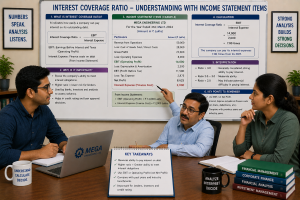
Interest Coverage Ratio Formula (ICR)
EBIT ÷ Interest Expenses → It shows how many times a company can cover its interest cost from operating profits.
Case study
Zedix Ltd is a mid-sized infrastructure support company seeking a term loan for expansion of operations. The bank evaluates both:
- Solvency position (Debt–Equity Ratio)
- Interest servicing ability (ICR)
to assess overall creditworthiness.
Financial data (Projected year)
| Particulars | Amount (Rs.) |
| Total Debt | 6,00,00,000 |
| Shareholders’ Equity | 2,00,00,000 |
| EBIT | 1,20,00,000 |
| Interest Expense | 40,00,000 |
Key ratios computed
| Ratio | Formula | Calculation | Result |
| Debt–Equity Ratio | Debt / Equity | 6,00,00,000 / 2,00,00,000 | 3: 1 |
| Interest Coverage Ratio (ICR) | EBIT / Interest | 1,20,00,000 / 40,00,000 | 3 times |
Interpretation from Bank’s Perspective
1. Solvency Position (Debt–Equity Ratio =3: 1)
- Indicates high leverage
- Company is heavily dependent on borrowed funds
- Higher long-term financial risk
Bank’s Concern: Capital structure is aggressive

Interest Payment Capacity (ICR = 3 times)
- EBIT is 3 times the interest obligation
- Reasonable ability to service interest
- Provides a moderate safety shield
Bank’s Comfort: Current earnings can support interest payments.
Integrated credit view
| Aspect | Observation | Risk level |
| Capital Structure | Highly leveraged | High risk |
| Interest Coverage | Adequate | Moderate comfort |
| Overall Position | Risky but manageable | Cautious approval |
Bank’s Likely Decision
- This loan may be approved but with conditions, such as:
- Additional collateral
- Restriction on further borrowing
- Monitoring cash flows
Key learning for students
- A good ICR cannot fully offset high leverage risk
- Banks always look at both solvency and servicing ability together
- Credit decisions are based on balanced judgment, not a single ratio
What Ind AS 23 Covers
- Deals with accounting treatment of borrowing costs (interest, finance charges, etc.)
- Specifications regarding when borrowing costs should be:
- Capitalized (added to cost of asset), or
- Expensed (charged to Profit & Loss)
Capitalization vs Expense
- If loan is used for a qualifying asset (e.g., plant under construction):
→ Interest is capitalized (not immediately affecting EBIT) - If loan is for working capital or general purposes:
→ Interest is expense (reduces profit and affects ICR)
For Zedix Ltd
Scenario 1: Borrowing for Expansion (Capital Project)
- Interest during construction phase → Capitalized
- EBIT remains higher (since interest not charged to P&L initially)
- ICR may appear stronger
→ Insight: Financials may look comfortable in early years
Scenario 2: Borrowing for Working Capital
- Interest → Expensed immediately
- EBIT reduces
- ICR becomes lower
→ Insight: Immediate pressure on profitability and coverage ratios
Why This Matters for Bankers
- Banks don’t rely only on reported EBIT
- They often look at:
- Cash flows
- Actual interest obligations
- True Performance Ratios
→ Because capitalization can temporarily improve ratios without improving cash reality.