

Suppose the Government wants to provide you with a tax benefit. Should it reduce your income first, or should it reduce your tax directly? The answer leads us to two of the most important concepts in U.S. taxation—deductions and tax credits.
Although both reduce the overall tax burden, they work at different stages of the tax computation.
Step 1: Deductions Reduce Taxable Income
A deduction is an amount that is subtracted from your income before the federal income tax is calculated.
Therefore,
Deduction reduces Taxable Income, not tax directly.
High-Level Classification of Deductions
| Type of Deduction | Purpose | Examples |
| Above-the-Line Deductions | Reduce Gross Income to arrive at Adjusted Gross Income (AGI) | Traditional IRA contributions, Health Savings Account (HSA) contributions, Student loan interest (subject to eligibility), Self-employed health insurance deduction |
| Below-the-Line Deductions | Reduce AGI to arrive at Taxable Income | Standard Deduction or Itemized Deductions (e.g., mortgage interest, state and local taxes subject to limits, charitable contributions, certain medical expenses subject to thresholds) |
Learning Point
Above-the-line deductions reduce AGI, whereas below-the-line deductions reduce Taxable Income. Both reduce the income on which federal income tax is calculated.
Step 2: Tax Credits Reduce Tax Liability
Unlike deductions, tax credits are applied after the federal income tax has been computed.
Therefore,
Tax Credits reduce the amount of tax payable, dollar for dollar.

Types of Tax Credits
| Type | Meaning | Example |
| Non-Refundable Tax Credit | Can reduce federal income tax to zero but generally cannot create a refund by itself | Child and Dependent Care Credit (subject to current law), Lifetime Learning Credit (subject to eligibility) |
| Refundable Tax Credit | Can reduce tax below zero and may generate a refund if eligibility requirements are met | Earned Income Tax Credit (EITC), Additional Child Tax Credit (subject to eligibility) |
Step 3: Tax Payments
Many students confuse tax credits with tax payments.
They are not the same.
Examples of tax payments include:
- Federal income tax withheld from salary
- Estimated tax payments
These are advance payments of tax already made to the IRS during the year.
One-Page Memory Chart
| Step | What is Reduced? | Examples |
| Above-the-Line Deductions | Gross Income | IRA Contribution, HSA Contribution, Student Loan Interest |
| Below-the-Line Deductions | AGI | Standard Deduction or Itemized Deductions |
| Non-Refundable Tax Credits | Federal Income Tax | Lifetime Learning Credit, Foreign Tax Credit (subject to rules) |
| Additional Federal Taxes | Added to Net Federal Income Tax | SECA, AMT, NIIT, Additional Medicare Tax |
| Refundable Tax Credits | Total Federal Tax Liability | Earned Income Tax Credit (EITC), Additional Child Tax Credit (subject to eligibility) |
| Tax Payments | Balance Payable | Federal Tax Withholding, Estimated Tax Payments |
Flow chart
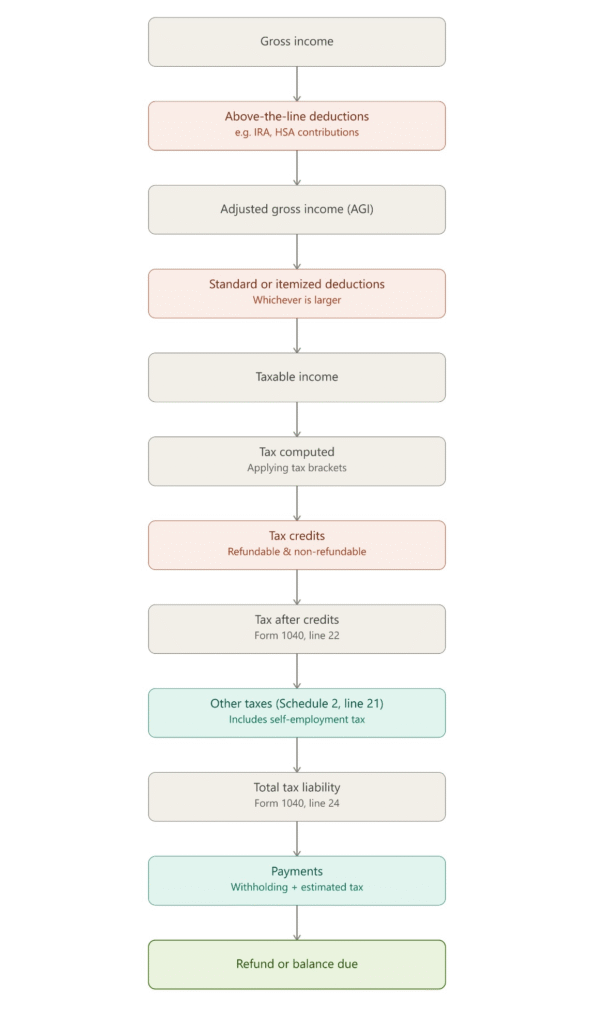

This Flow chart is very helpful & easy to remember.
This Flow chart is very helpful & easy to remember.
Very easily explained sir . Thank you
Thank you sir , for explaining with the memory chart it helped me a lot
Thank you sir, for explaining with the memory chart.
Thanks a lot sir for providing us with this flow chart it’s really helpful
Good…study