
Before we discuss tax forms such as Form 1065, Form 1120, or Form 1120S, we must first understand how businesses are legally organized. The legal structure determines who owns the business, who manages it, who bears the liability, and ultimately how the business is taxed.
Partnerships, S corporations, and C corporations are three common business types, and each is taxed differently under federal law.
Partnership
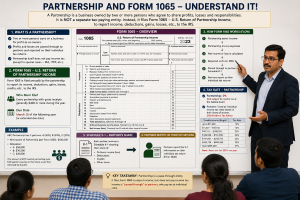
A partnership is formed when two or more persons carry on a business together with the objective of earning profit.
Generally, partnerships are pass-through entities, meaning the partnership itself generally does not pay federal income tax. Instead, profits and losses flow through to the partners, who report them on their individual tax returns.
The partnership files Form 1065 (U.S. Return of Partnership Income) with the IRS, and each partner receives a Schedule K-1, showing his or her share of income, deductions, and credits.
S Corporation
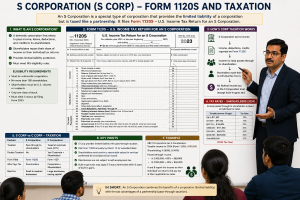
An S corporation generally doesn’t pay federal income tax at the business level. Like partnerships, S corporations are pass‑through entities.
Unlike a C Corporation, it generally does not pay federal income tax at the corporate level. S corporations file Form 1120S, which generates a Schedule K1 for each shareholder. The shareholders then report the information from their Schedule K1 on their personal tax returns.
C Corporation
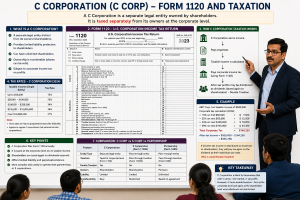
A C Corporation is a separate legal entity from its owners.
Unlike partnerships and S corporations, the corporation itself pays federal income tax on its taxable income. If profits are later distributed to shareholders as dividends, the shareholders also pay tax on those dividends. This is known as double taxation.
Schedule K‑1 is a tax reporting document that shows a business owner’s share of certain income, losses, deductions, and credits from a partnership or S corporation.
An LLC is not itself a separate federal tax classification. Instead, for federal tax purposes, it may choose to be treated as:
| Particulars | Partnership | LLC (Limited Liability Company) | S Corporation | C Corporation |
| Legal Structure | Partnership | Hybrid legal entity | Corporation electing S status | Corporation |
| Separate Legal Entity | Generally, No | Yes | Yes | Yes |
| Limited Liability | GP – No LP – Limited Partner Yes | Yes | Yes | Yes |
| Owners | Partners | Members | Shareholders | Shareholders |
| Maximum No. of Owners | No federal limit | No federal limit | 100 shareholders | No limit |
| Foreign Owners Allowed | Yes | Yes | No (generally only U.S. citizens/resident individuals and certain eligible trusts/estates) | Yes |
| Corporate Shareholder Allowed | Yes | Yes | No | Yes |
| Classes of Ownership | Flexible | Flexible | Only one class of stock (voting rights may differ) | Multiple classes permitted |
| Federal Taxation | Pass-through | Depends on tax election | Pass-through | Entity-level taxation |
| Double Taxation | No | Depends on election | No | Yes |
| Federal Tax Return | Form 1065 | Depends on election | Form 1120-S | Form 1120 |
| Information to Owners | Schedule K-1 | Depends on election | Schedule K-1 | Dividend reporting (if distributed) |
| Federal Tax Rate | Not taxed at entity level | Depends on election | Generally, no federal income tax at entity level | Flat 21% corporate tax rate |
| Who Pays Income Tax? | Partners | Depends on election | Shareholders | Corporation itself |
- a Sole Proprietorship (single-member LLC),
- a Partnership (multi-member LLC),
- an S Corporation (if eligible and an election is made), or
- a C Corporation (if an election is made).
- Therefore, the federal tax return depends on the tax classification selected.
Comparison of U.S. Business Structures and Federal Tax Filing
Key Federal Tax Forms and Deadlines
| Form | Purpose | Due Date | Extension |
| Form 1040 + Schedule C | Single-Member LLC reporting | April 15 | Form 4868 extends filing to October 15 |
| Form 1065 | Partnership return | March 15 | Form 7004 extends to September 15 |
| Form 1120-S | S Corporation return | March 15 | Form 7004 extends to September 15 |
| Form 1120 | C Corporation return | April 15 (calendar year) | Form 7004 extends to October 15 |
| Form 2553 | Election of S Corporation status | Generally within 2 months and 15 days after beginning of tax year | Late election relief may be available |
| Form 8832 | Entity Classification Election | As filed; effective date generally cannot be more than 75 days before filing or more than 12 months after filing | IRS provides limited late election relief |

Disclaimer:
This blog has been prepared solely for educational and learning purposes to provide students with a high-level understanding of the fundamentals of the U.S. federal tax system. The content is intended to explain key concepts in a simplified manner and should not be construed as tax, legal, or professional advice. As U.S. tax laws, IRS regulations, forms, and filing requirements are subject to change and may vary depending on individual circumstances, students are encouraged to refer to the latest IRS publications, instructions, forms, and official guidance for detailed provisions and authoritative interpretation.
Very easily explained sir , helping me a lot .
Good.. keep yourself updated…
Got more info about 1065, 1120 & 1120s .
Short & easy to catch.
Thank you sir
THANK U SIR FOR MAKING THIS EASY TO UNDERSTAND
The blogs make complex topics very easy to understand. Thank you sir.
It’s a pleasure that it’s helping you!
Thankyou sir for making easy to understand.
Good.. Keep you updated.
good… keep yourself updated..
It helps me to understand the difference between C corporation & S corporation as well as this blog gives a fair view on double taxation.
Good to hear!! Keep following..
Good.. keep studying..
You always make learning easy for us. Thank You sir.
Thank you. Keep yourself updated..
Very Easy to Understand . Thank You SIr
Happy to know that you have undersood!
Very insightful and informative blog on U.S business structures.
Thank you.. keep yourself updated..