
Finance

Asset side of the balance sheet

Debt–Equity & Interest Coverage Ratio: Linking Lending Decisions with Ind AS 23

In today’s competitive business environment, companies frequently rely on external financing to support expansion, manage working capital, or undertake capital-intensive projects. Financial institutions, however, do not extend credit based solely on growth prospects—they closely evaluate a company’s financial stability and repayment capacity before making lending decisions. Two of the most critical metrics in this evaluation

Debt–Equity & Interest Coverage Ratio: Linking Lending Decisions with Ind AS 23 Read More »

Understanding Debt Service Coverage Ratio (DSCR) from a Lending Perspective

Lending institutions use this ratio as a key measure of a company’s ability to pay off the principal and interest on a loan. Before granting a loan, the bank will calculate your company’s debt service coverage ratio. If it’s good, the bank will consider that you should be able to meet your repayment obligations. If

Understanding Debt Service Coverage Ratio (DSCR) from a Lending Perspective Read More »

NPV and IRR

NPV and IRR in Capital Investment and Financing Decisions

Net Present Value (NPV) and Internal Rate of Return (IRR) are two fundamental tools used to evaluate a project’s profitability. NPV is an absolute measure of the difference between the present value of cash inflows and the present value of cash outflows over a specific period of time. It considers the time value of money, which

NPV and IRR in Capital Investment and Financing Decisions Read More »

Discounted Cash Flow and Present Value in Investment Decisions

Present Value (PV) and Discounted Cash Flow (DCF) are terms we frequently hear in the financial world. They are widely used in corporate finance, banking, valuation, and even personal investment planning. But why are they so important? Let us begin with a very simple question. Suppose you invest in an LIC policy today and receive

Discounted Cash Flow and Present Value in Investment Decisions Read More »

Understanding CAPM in the World of Returns and Wealth Building

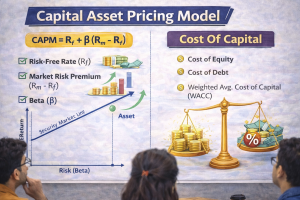
The Capital Asset Pricing Model (CAPM) is an equation that describes the relationship between the expected return of an investment and its risk. CAPM quantifies investment risk through beta, allowing investors to compare the volatility of an asset to the market. If you need to clear your concept of CAPM, let’s go through this classroom

Understanding CAPM in the World of Returns and Wealth Building Read More »

Cost of capital and EVA

Cost of Capital and EVA: Tools for Strategic Financial Decisions

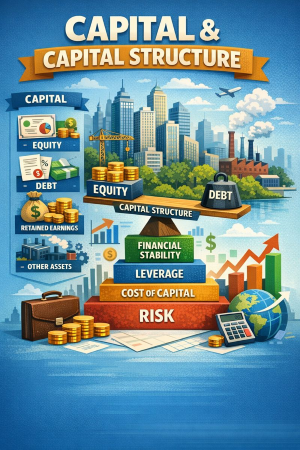
Cost of Capital is the minimum rate of return or profit a company must earn.  It is extremely important to investors and analysts. It’s the cost of obtaining funds, whether through equity or debt and includes the returns expected by shareholders and the interest expenses on debt. Companies look for the optimal mix of financing that provides adequate funding and minimizes the

Cost of Capital and EVA: Tools for Strategic Financial Decisions Read More »

Equity or Debt? Understanding Financial Breakeven and Indifference Point

The students were settling into the Corporate Finance class, some eagerly taking the front seats while many quietly occupied the back benches. The room buzzed with low conversations as notebooks and laptops came out. The professor stood calmly in front of the smart board, glanced around the classroom, and smiled. He wrote a few key

Equity or Debt? Understanding Financial Breakeven and Indifference Point Read More »

Risk–Return Dynamics: A Case Study Discussion

The professor looks at the students and says, Students, case studies are excellent for understanding concepts in real life.But in corporate finance, true clarity comes only when concepts are tested with numbers. He pauses, scans the classroom, and continues, Stories help you visualize a situation, but figures help you understand the logic behind decisions. Then

Risk–Return Dynamics: A Case Study Discussion Read More »

Don`t copy text!