

STUDENT: Professor, whenever I hear the words Australian Taxation, I feel there are too many terms to remember. Where should I start?
PROFESSOR: Don’t start by memorising terms. Start by asking a simple question: Why does a government need taxes?
STUDENT: To collect revenue?
PROFESSOR Exactly. Governments need revenue to provide public services such as healthcare, education, infrastructure, defense and social security. But taxation is not simply about collecting money. It is also about who has the legal power to tax, what is taxed, and who administers the system.
STUDENT So, before learning tax rates and tax returns, I should understand the foundation of the Australian tax system?
PROFESSOR: Precisely. Let’s build that foundation step by step.
1. How Did Australian Taxation Begin?
STUDENT: Was there an Australian tax system before modern Australia?
PROFESSOR: Before Federation in 1901, Australia’s separate colonies each managed their own governments and taxes. Federation changed this by uniting them into the Commonwealth of Australia, with the Australian Constitution establishing a new framework to divide powers between the national government and the states.
STUDENT: And taxation became part of that constitutional arrangement?
PROFESSOR Exactly. That is why understanding the Constitution helps us understand Australian taxation.
2. Who Has the Power to Tax?
| STUDENT Professor, who actually has the power to impose taxes in Australia? |
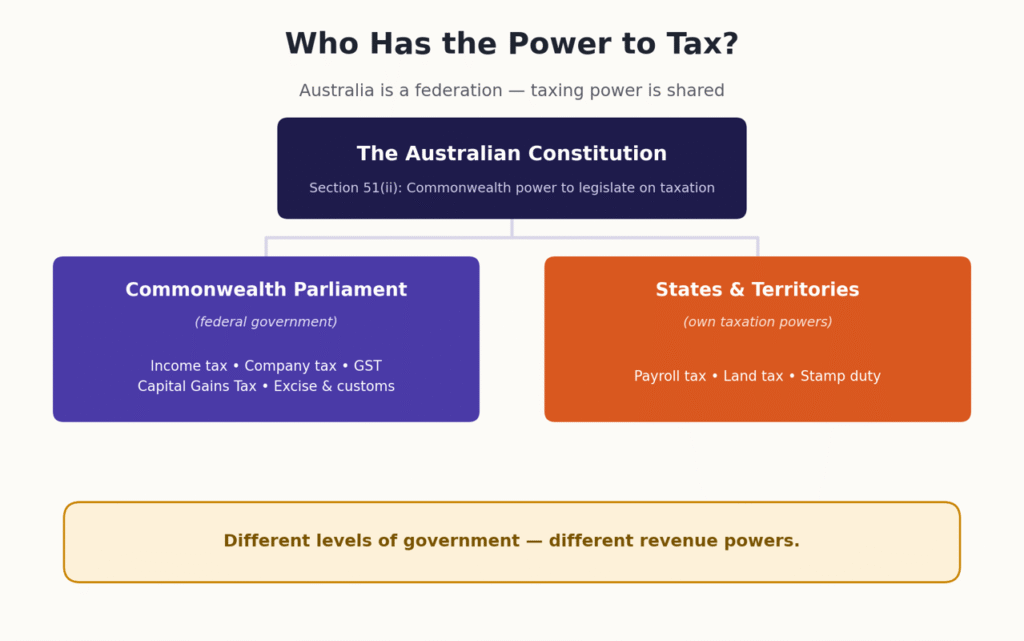
PROFESSOR: The Australian Constitution provides the foundation for Commonwealth taxation powers. For example, Section 51(ii) gives the Commonwealth Parliament power to make laws with respect to taxation, subject to constitutional limitations.
| STUDENT Does that mean only the Commonwealth can impose taxes? |
PROFESSOR: No. Australia is a federation. The States and Territories also have taxation powers.
STUDENT What kind of taxes do they impose?
PROFESSOR Depending on the jurisdiction, examples include payroll tax, land tax and stamp duty.
STUDENT: So Australian taxation is not controlled by one single level of government?
PROFESSOR: Correct. Think of it as a system in which different levels of government have different revenue powers.
3. What Does the Australian Tax Structure Look Like?
STUDENT: What are the major categories of Australian taxes?
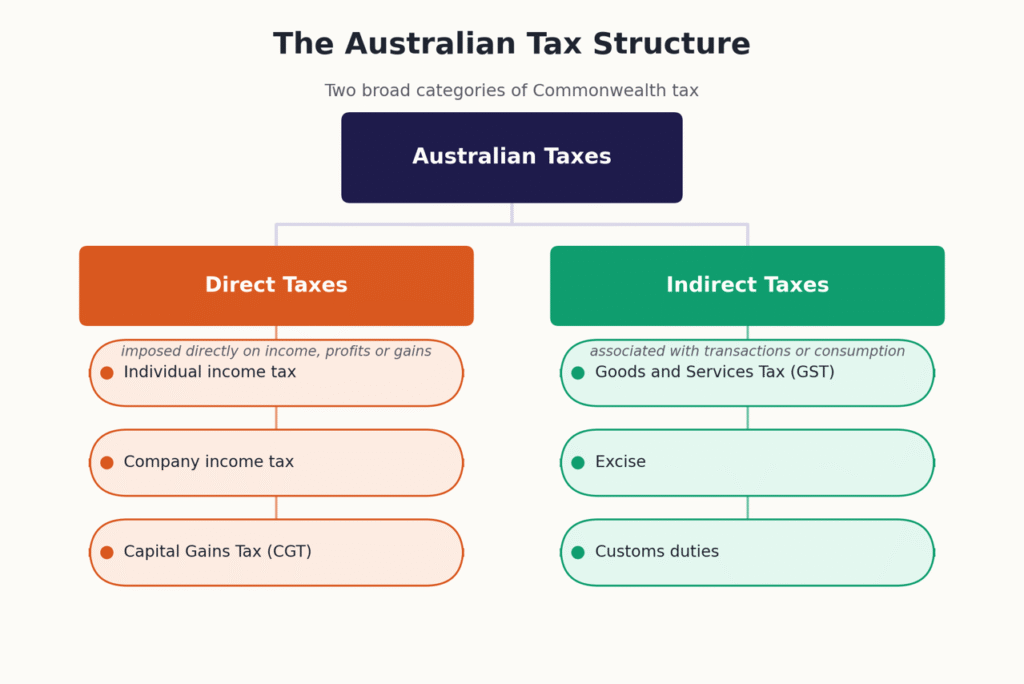
PROFESSOR: Broadly, we can think about direct and indirect taxes.
STUDENT: What’s the difference?
PROFESSOR: A direct tax is generally imposed directly on income, profits or certain gains
For example:
● Individual income tax
● Company income tax
● Capital Gains Tax (CGT)
STUDENT: And indirect taxes?
PROFESSOR These are generally associated with transactions or consumption.
For example:
● Goods and Services Tax (GST)
● Excise
● Customs duties
STUDENT: So, if I earn income, income tax may apply; if I purchase taxable goods or services, GST may apply.
PROFESSOR: Exactly. Now you are beginning to see the structure rather than memorising individual tax names.
4. Who Administers Federal Taxation?
STUDENT: Professor, who makes sure taxpayers actually comply with these tax laws?
PROFESSOR Now we come to one of the most important institutions in Australian taxation — the Australian Taxation Office, or ATO.
STUDENT Is the ATO the government department that collects all Australian taxes?
PROFESSOR: Be careful with the word all. The ATO administers Australia’s federal tax and superannuation systems, while various State and Territory authorities administer their own taxes.
STUDENT What does the ATO actually do?
PROFESSOR: The ATO helps taxpayers understand their obligations, processes tax returns, collects taxes, administers tax and superannuation laws, and undertakes compliance activities.
STUDENT: So, the ATO is mainly concerned with tax administration?
PROFESSOR: Exactly.
REMEMBER: ATO → Federal tax administration
5. I Want to Start a Business — What Is an ABN?
STUDENT: Professor, suppose I want to start a business in Australia. What identity does my business need?
PROFESSOR :You will soon encounter the Australian Business Number, or ABN.
STUDENT: What exactly is an ABN?
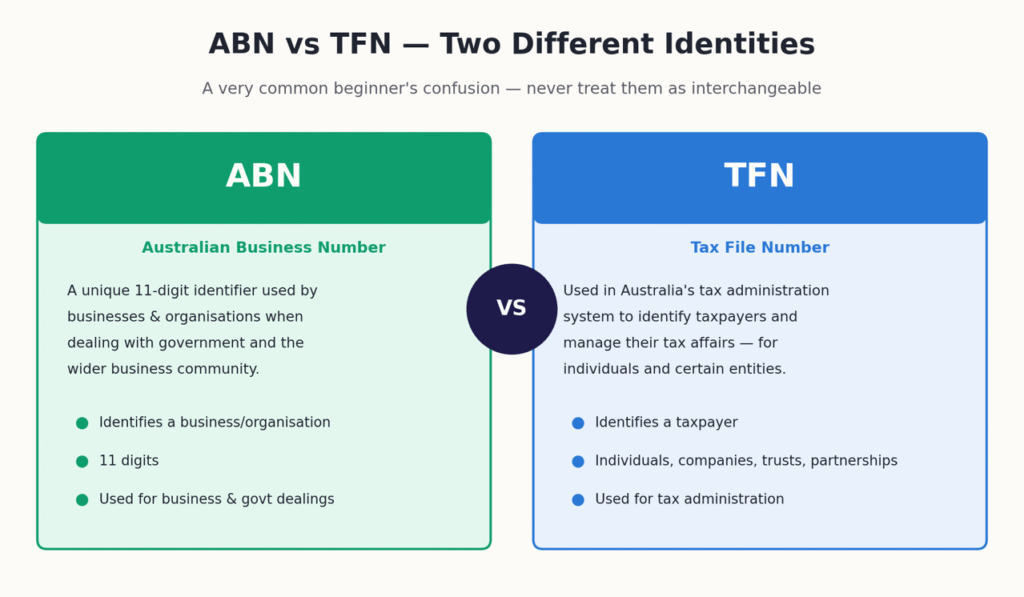
PROFESSOR: An ABN is a unique 11-digit identifier used by businesses and organisations when dealing with government and the wider business community.
| STUDENT: Is an ABN the same as a Tax File Number? |
PROFESSOR: No. That is a very common beginner’s confusion.
STUDENT: Then what is the difference?
PROFESSOR: Think of it this way:
● ABN → identifies a business or organisation for business and government dealings.
● TFN → identifies a taxpayer for tax administration purposes.
STUDENT So, ABN and TFN serve different purposes.
PROFESSOR Exactly. Never treat them as interchangeable.
6. Then What Is a TFN?
PROFESSOR: Tax File Number.
STUDENT: Is it only for individuals?
PROFESSOR: No. Individuals and certain entities such as companies, partnerships and trusts can have TFNs, depending on their circumstances.
STUDENT: And why is it important?
PROFESSOR: It is used in Australia’s tax administration system to identify taxpayers and manage their tax affairs.
STUDENT: So, if ABN is mainly connected with business identity, TFN is connected with tax identity.
PROFESSOR That’s a useful way to remember the distinction.
7. Where Does ASIC Come In?
STUDENT :I have heard another name — ASIC. Is ASIC another tax authority?
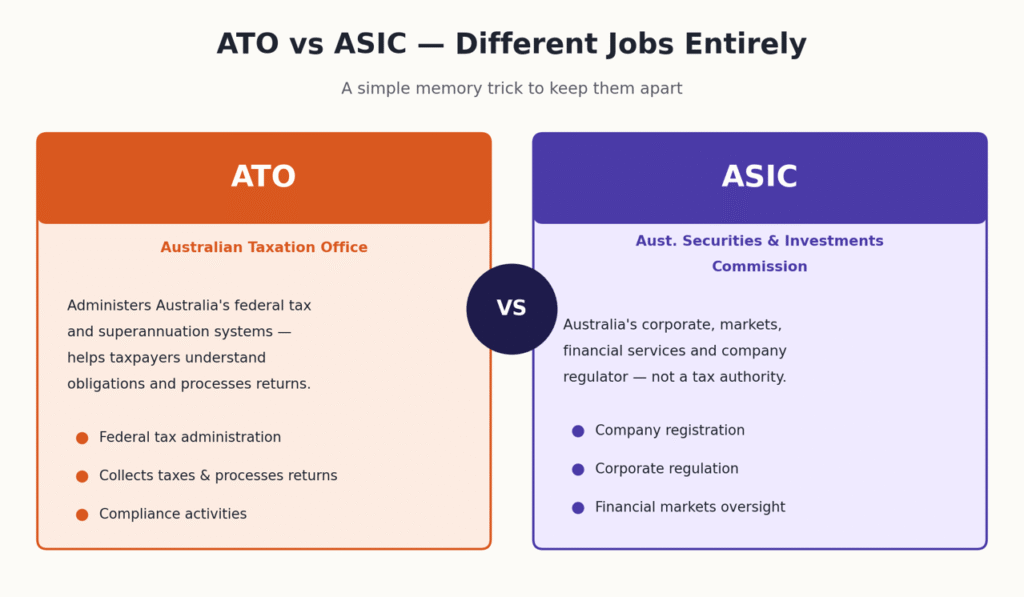
PROFESSOR No. This distinction is extremely important. ASIC stands for the Australian Securities and Investments Commission.
STUDENT: Then what does ASIC do?
PROFESSOR: ASIC is Australia’s corporate, markets, financial services and company regulator. It has an important role in areas such as company registration, corporate regulation and financial markets regulation.
STUDENT So, ATO and ASIC have different responsibilities?
PROFESSOR: Precisely.
A simple memory trick:
● ATO → Tax
● ASIC → Companies, corporations and financial regulation
STUDENT: That makes the distinction much easier.
8. Finally, What Is the ABR?
STUDENT: Professor, one last term — ABR. What is it?
PROFESSOR ABR stands for the Australian Business Register.
STUDENT: Is it connected with the ABN?
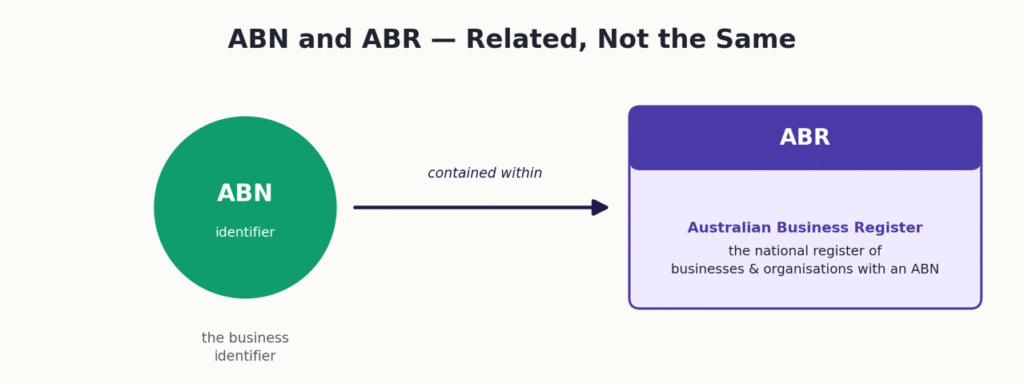
PROFESSOR Very closely. The ABR is the national register containing information about businesses and organisations that have an ABN.
STUDENT So, ABN and ABR are related, but they are not the same thing?
PROFESSOR: Exactly.
Think of it like this:
● ABN = the business identifier
● ABR = the register containing business information associated with ABNs
STUDENT Professor, now the terms don’t seem like eight separate topics.
PROFESSOR That’s the purpose of learning through understanding. You should be able to see the relationship between them.
PROFESSOR That’s the purpose of learning through understanding. You should be able to see the relationship between them. Don’t memorise Australian taxation as a list of terms — follow the journey below
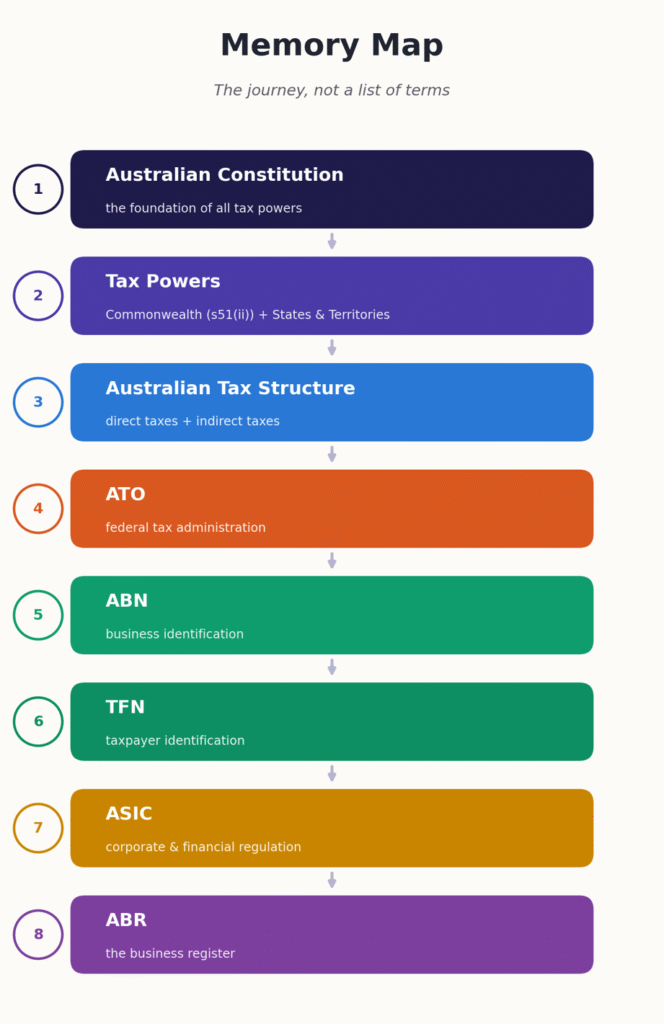
Takeaway
“Don’t memorise Australian taxation as a list of terms. Understand the journey — from constitutional tax powers to tax administration, and from taxpayer identity to business and corporate regulation.”
STUDENT: Professor, I think I am ready for the next topic.
PROFESSOR: Good. Then let’s ask the next important question: Who is considered an Australian tax resident?
Disclaimer: For educational purposes only. This content provides a high-level overview of Australian tax fundamentals and is not professional, legal, or tax advice. Always check current ATO guidance and legislation for your specific situation.