
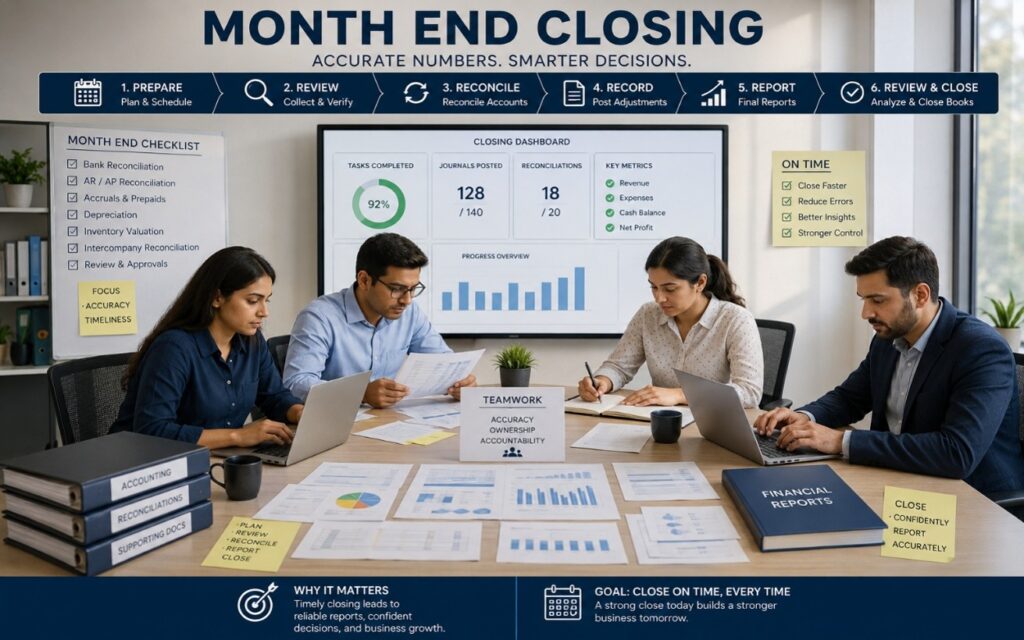
Close Better · Report Smarter · Decide Faster
Can management trust the numbers we are about to report?
The answer depends on the quality of the month-end closing process.
01 What Is Month-End Closing?
Month-end closing is the systematic process of completing and reviewing all accounting activities for a month before the financial statements are finalized. It turns raw transactions into information management can trust.
The Closing Flow
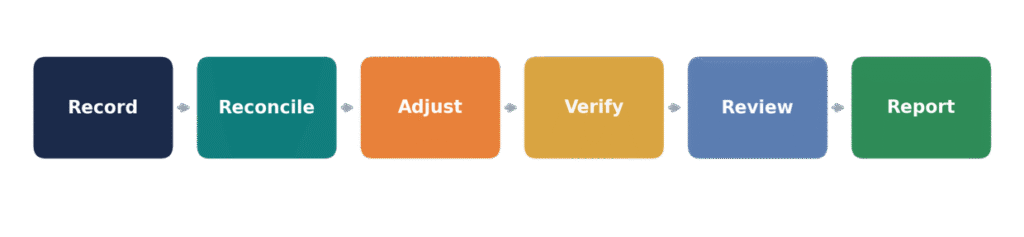
Trial Balance is not the finish line — it is a checkpoint before the financial statements are reviewed.
02 The 10-Step Closing Checklist
| # | Closing Activity | What to Check |
| 1 | Record all transactions | Sales, purchases, receipts, payments, expenses |
| 2 | Bank reconciliation | Books vs. bank statement; unidentified items; charges |
| 3 | AP review | Vendor invoices, outstanding balances, debit/credit notes |
| 4 | AR review | Customer balances, overdue amounts, doubtful debts |
| 5 | Accruals & prepayments | Outstanding expenses, prepaid expenses, accrued income |
| 6 | Depreciation | Monthly depreciation, asset additions/disposals |
| 7 | Inventory verification | Physical stock, adjustments, valuation |
| 8 | Tax verification | GST/indirect tax, TDS, tax liabilities |
| 9 | General Ledger review | Unusual balances, duplicate entries, wrong postings |
03 Case Study — MoonLight Manufacturing Ltd
MoonLight closes its books for 31 March. At first glance the books look complete — but the closing team’s review uncovers several adjustments before the Profit & Loss Account can be trusted.
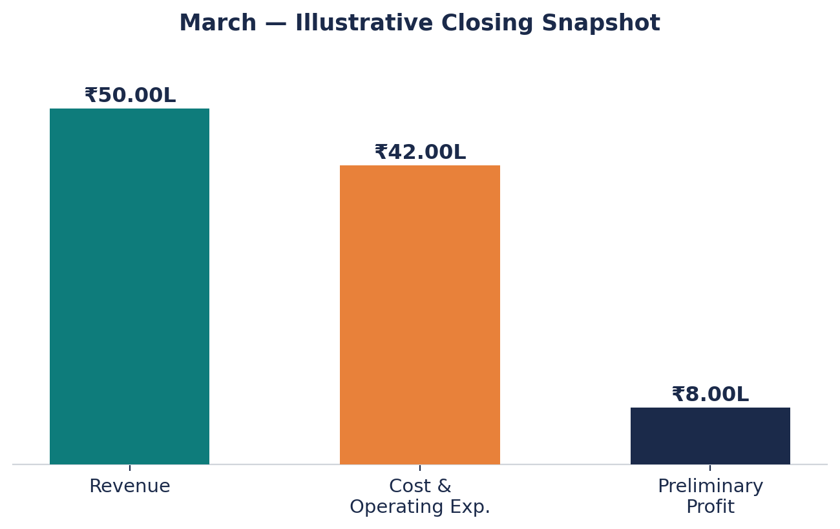
Adjustments discovered during review
● Electricity bill of ₹20,000 for March not yet received.
● Annual insurance of ₹1,20,000 paid in advance — only ₹10,000 relates to March.
● Depreciation of ₹1,20,000 needs to be posted.
● Bank charges of ₹5,000 missing from the books.
● Physical inventory ₹8,00,000 vs. ledger ₹8,40,000.● A customer balance of ₹50,000 needs review — recovery is doubtful
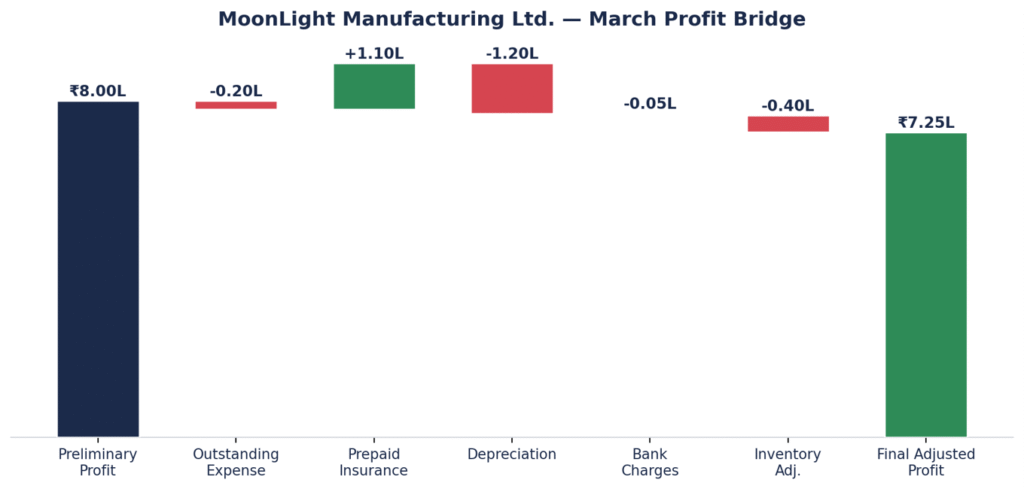
The difference of ₹75,000 is not an accounting technicality — it changes the information available to management.
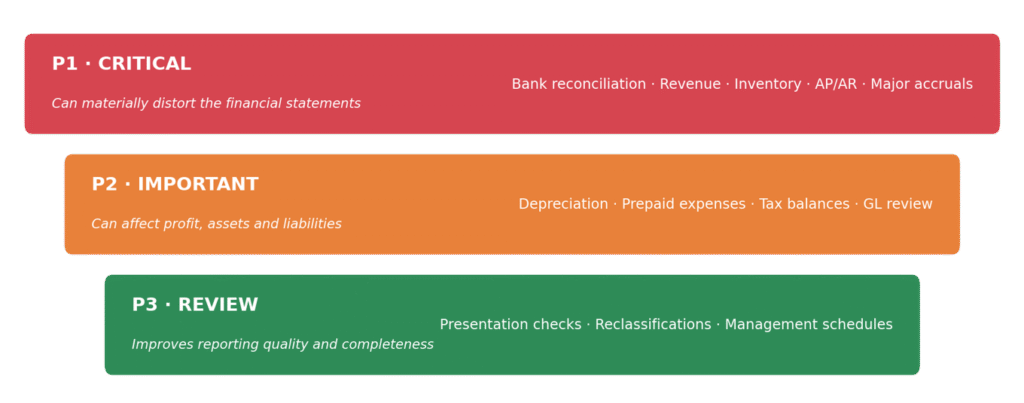
04 Priority Whistle — What Must Close First?
Not every closing task carries the same risk. Never close the books merely because every box is ticked — if a high-value item remains unresolved, the close is still at risk.
05 The Five Golden Reconciliations
| 1 · Bank | Books ≠ Bank balance — check outstanding cheques, deposits in transit, charges, interest, unidentified items. |
| 2 · Receivable | Can we collect what customers owe? Review ageing, overdue balances, disputes, credit notes, doubtful debts. |
| 3 · Payable | Have we recorded everything we owe? Look for unrecorded invoices, goods received not invoiced, duplicates. |
| 4 · Inventory | Compare physical quantity → records → valuation. Watch for errors, wastage, damage, theft, obsolescence. |
| 5 · General Ledger | Look for unusual debit balances in expenses, credit balances in assets, round-number or duplicate entries. |
06 A Simple Closing Calendar
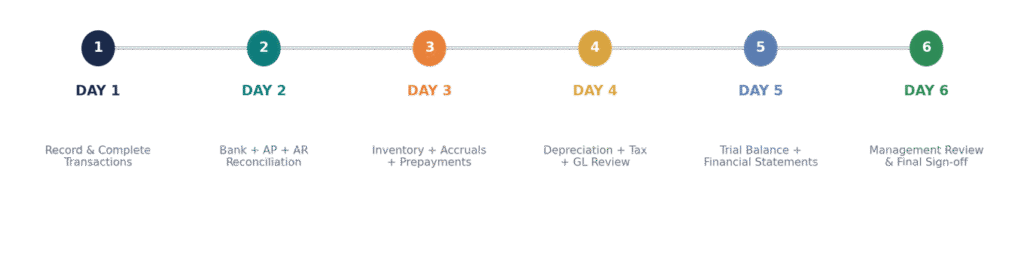
Actual timelines vary by company size, ERP system, industry and reporting requirements.
07 From Accounting Close to Management Decision
A good close does not just produce numbers — it produces questions management should answer.
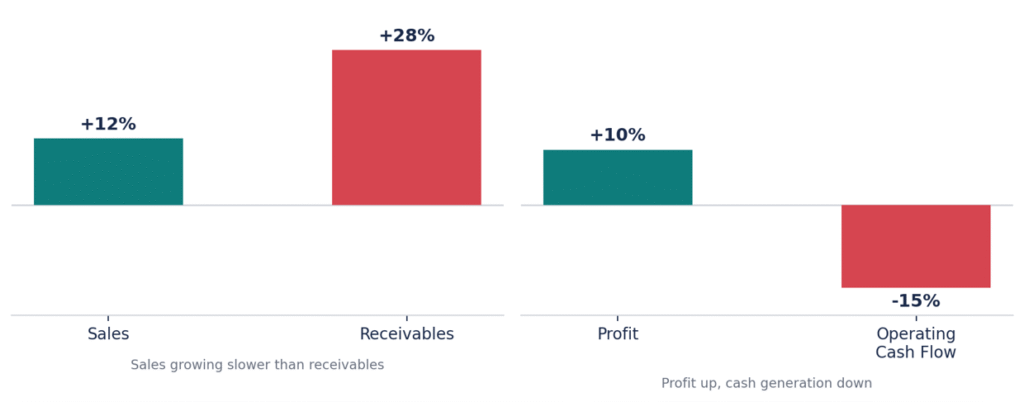
Are sales growing faster than the company’s ability to collect cash? Is reported profit converting into real cash?
08 What Comes After Closing?
| Statement | Main Question |
| Profit & Loss | Did the company make a profit? → Performance |
| Balance Sheet | What does the company own and owe? → Position |
| Cash Flow | Where did cash come from and go? → Liquidity |
09 Month-End Closing Dashboard
| Closing Area | Status | Priority |
| Transaction posting | Completed | P3 |
| Bank reconciliation | Completed | P1 |
| Accounts receivable | Review required | P1 |
| Accounts payable | Completed | P1 |
| Accruals | Completed | P2 |
| Depreciation | Completed | P2 |
| Inventory | Variance identified | P1 |
| Tax balances | Completed | P2 |
| General Ledger | Under review | P2 |
| Trial Balance | Pending final adjustments | — |
Very Enriched Content sir
Thanks a lot sir for such an insightful blog
Its very informative blog sir Thank you for sharing.