

1. Backdrop
Good morning, everyone.
Professor: Today I don’t want you to write any formula , just a simple story about school bags.
Student 1: Sir, no formula? That’s unusual for Costing!
Professor: Exactly! Today, I want you to think like a business owner. Suppose you manufacture 1,000 school bags. You spend ₹2,00,000 manufacturing them. Now tell me — have you incurred a cost of ₹2,00,000?
Student 2: Yes, sir. That’s the manufacturing cost.
Professor: Good. Now suppose you sell only 800 bags during the year. What happened to the remaining 200?
Student 3: They are still in our warehouse.
Professor: Excellent. So, should the cost of all 1,000 bags be treated as the cost of goods sold?
Students: No, sir. Only 800 bags sold.
Professor: Exactly! And that is where COGS begins.
| COGS = Cost of Finished Goods Actually Sold |
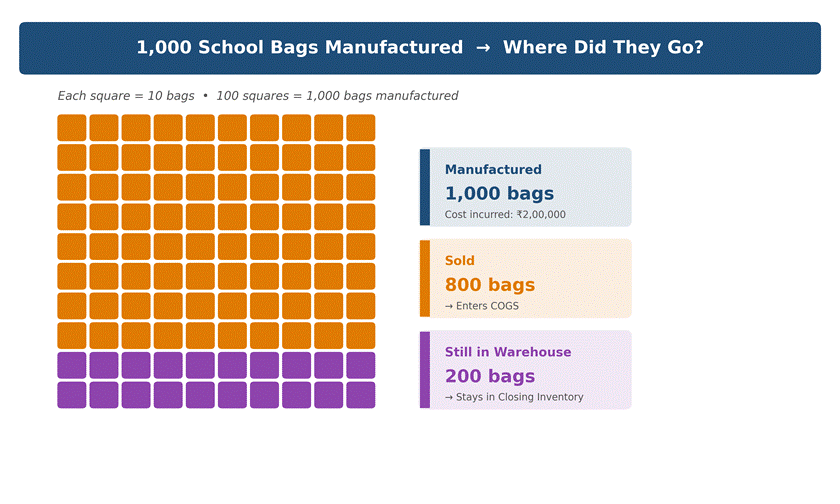
Fig. 1 — Of the 1,000 bags manufactured, only the 800 sold flow into COGS; the 200 unsold stay in inventory.
2. Does ‘Manufactured’ Mean ‘Sold’?
Professor: So let me ask you something. If we manufactured goods worth ₹31,000, can I immediately say COGS is ₹31,000?
Student 1: Not necessarily, sir. Some of those goods may still be unsold.
Professor: Very good.
Student 2: So we need to look at finished goods inventory.
Professor: Correct.
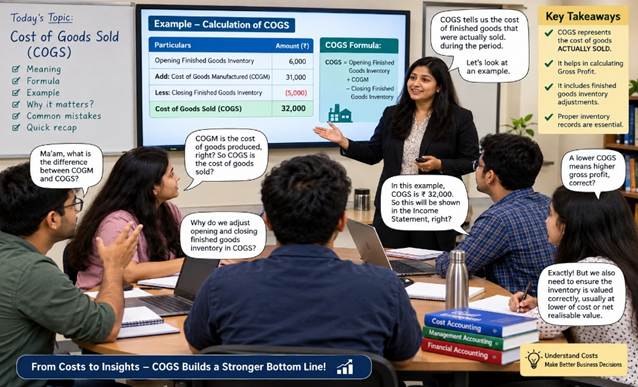
3. Let’s Solve a Business Problem
Professor: Imagine our company starts the year with finished goods inventory of ₹6,000. During the year, we manufacture goods costing ₹31,000. At year-end, we still have finished goods worth ₹5,000 in the warehouse. Now, how much did we actually sell?
Student 3: Sir, ₹31,000?
Professor: Are you sure?
Student 3: Hmm… because ₹5,000 is still unsold.
Professor: Exactly. But remember — we also had ₹6,000 of finished goods at the beginning of the year. So let’s think about it.
| On the Board | |
| Opening Finished Goods | ₹6,000 |
| Add: Goods Manufactured | ₹31,000 |
| Less: Goods Still Unsold | (₹5,000) |
| COGS | ₹32,000 |
Students: ₹6,000 + ₹31,000 − ₹5,000 = ₹32,000
Professor: Excellent! COGS = ₹32,000
4. Wait — That Doesn’t Add Up… Or Does It?
Student 4: Sir, something is confusing me.
Professor: Good! Confusion is often the beginning of learning. Ask.
Student 4: If we manufactured goods worth ₹31,000, how can COGS become ₹32,000?
Professor: Excellent question. Who wants to answer?
Student 2: Because we had ₹6,000 of finished goods already available at the beginning.
Professor: Exactly!
Student 2: So we had goods available for sale of ₹37,000.
Professor: Perfect!
| Goods Available for Sale = Opening Finished Goods + COGM = ₹6,000 + ₹31,000 = ₹37,000 Goods Available for Sale − Closing Finished Goods = ₹37,000 − ₹5,000 = ₹32,000 COGS |
5. Connecting COGS with Gross Profit
Professor: One final question. Suppose our company sold these goods for ₹50,000. What is our gross profit?
Student 1: ₹50,000 − ₹32,000 = ₹18,000.
Professor: Exactly!
| Particulars | ₹ |
| Sales | 50,000 |
| Less: COGS | (32,000) |
| Gross Profit | 18,000 |
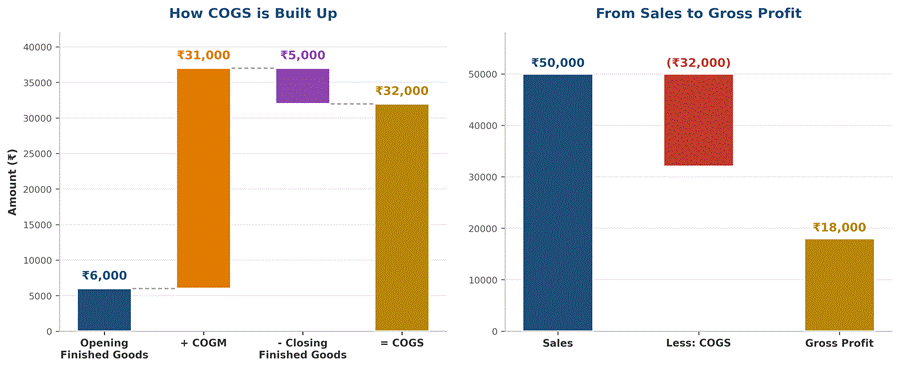
Fig. 2 — How Opening Stock, COGM and Closing Stock combine into COGS, and how COGS drives Gross Profit.
Professor: Now you understand why COGS is important.
Student 3: Because if we calculate COGS incorrectly, gross profit will also be wrong.
Professor: Absolutely!
6. Can We ‘Manage’ Profit by Inflating Inventory?
Professor: Now suppose closing finished goods inventory increases from ₹5,000 to ₹10,000. What happens to COGS?
Student 4: COGS will decrease.
Professor: And what happens to gross profit, assuming sales remain unchanged?
Students: Gross profit will increase!
Professor: Good. But should we simply increase inventory to show higher profit?
Students: No, sir!
Professor: Why?
Student 2: Because inventory must be properly counted and valued. We cannot manipulate closing stock just to increase profit.
Professor: So what does accounting require?
| Ind AS 2 — Inventories Inventories are generally measured at: Lower of Cost and Net Realisable Value (NRV). AS 2 — Valuation of Inventories Inventory is generally valued at: Lower of Cost and Net Realisable Value. |
Student: Sir, so we cannot deliberately increase inventory just because we want higher profit?
Professor: Exactly. The inventory must be properly measured according to the applicable accounting framework.
Professor: Exactly. Now you are thinking like accountants — and managers.
7. The Key Distinction — COGM vs. COGS
| COGM “What did we complete?” | COGS “What did we sell?” |
| Memory Formula COGS = Opening Finished Goods + COGM − Closing Finished Goods |
Very informative and great leaning blogs!!!
Very well explained sir thnk you soo much 🙏🏻