

In business, credit sales are common, and customers (debtors) become an important asset of the organization. However, not every amount due from customers may be collected in full. Some customers may fail to pay, resulting in Bad Debts.
Accounting follows the principles of prudence and accrual, which require businesses to recognize possible losses relating to credit sales in the period in which they arise. Therefore, apart from actual bad debts, businesses also estimate possible future losses by creating a Provision for Bad Debts.
While Bad Debt represents an actual loss already identified, Provision for Bad Debts represents an estimated loss created to reflect the expected recoverability of receivables.
In business, credit sales are common, and customers (debtors) become an important asset of the organization. However, not every amount due from customers may be collected in full. Some customers may fail to pay, resulting in Bad Debts.
Accounting follows the principles of prudence and accrual, which require businesses to recognize possible losses relating to credit sales in the period in which they arise. Therefore, apart from actual bad debts, businesses also estimate possible future losses by creating a Provision for Bad Debts.
While Bad Debt represents an actual loss already identified, Provision for Bad Debts represents an estimated loss created to reflect the expected recoverability of receivables.
Bad Debts
Meaning
Bad debts represent the amount owed by customers that has become irrecoverable. The business no longer expects to receive the money.
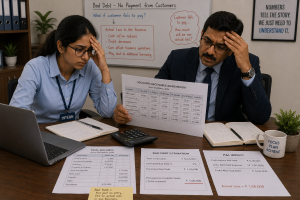
Provision for Bad Debts (PBD)
Meaning
- Provision for Bad Debts is an estimate of future losses that may arise from existing debtors.
- The business does not know exactly who will default but expects that some customers may fail to pay.
- Bad Debt = Known loss (customer will not pay)
- Doubtful Debt = Possible future loss (customer may not pay)
Modern Financial Reporting Perspective
Under current accounting frameworks (e.g., Ind AS / IFRS), the traditional term Provision for Doubtful Debts is often replaced by:
Allowance for Expected Credit Losses (ECL)
Expected Credit Losses (ECL): One of the most important changes introduced by Ind AS 109 is the Expected Credit Loss (ECL) impairment model. Instead of recognizing losses only after a credit event occurs, entities must estimate and recognize expected losses using forward-looking information.
Provision for Doubtful Debts is the traditional accounting concept, whereas Expected Credit Loss (ECL) under Ind AS 109 is its modern, forward-looking version. Both aim to ensure that receivables are not overstated.
Example
Step 1
| Suppose at the beginning of the year: |
| Total Debtors = Rs.1,00,000 |
| Existing Provision for Bad Debts = Rs.5,000 |
This means we already expected that about Rs.5,000 of debtors may not pay.
Therefore, Balance Sheet shows:
| Particulars | Amount (Rs.) |
| Debtors | 1,00,000 |
| Less: Provision for Bad Debts | (5,000) |
| Net Realizable Value | 95,000 |
Step 2: One Customer Fails
Suppose customer Mr. Raj owes Rs.2,000.
Management now confirms that Raj will never pay.
This is an actual loss, not merely an estimate.

Entry
Provision for Bad Debts A/c Dr Rs.2,000
To Debtors A/c Rs.2,000
Why?
Because we had already created a provision of Rs.5,000 in earlier years.
Therefore, we utilize the provision.
No additional expense is charged to P&L now.
Step 3: Position after writing off Raj
| Debtors become: |
| Rs.1,00,000 – Rs.2,000 = Rs.98,000 |
| Provision balance becomes: |
| Rs.5,000 – Rs.2,000 = Rs.3,000 |
Step 4: Re-estimate Closing Provision
At year end management decides:
Let’s keep provision 5% of remaining debtors.
Remaining debtors = Rs.98,000
Required provision = 5% i.e. = Rs.4,900
Current provision balance = Rs.3,000
Required provision = Rs.4,900
Additional provision needed = Rs.1,900
Adjustment Entry
Profit & Loss A/c Dr Rs.1,900
To Provision for Bad Debts A/c Rs.1,900
Therefore:
P&L Expense = Rs.1,900 only
Provision for Bad Debt Account
| Dr. | Amount | Cr. | Amount |
| Bad Debt (Raj) | 2,000 | Opening Balance | 5,000 |
| Balance c/d | 4,900 | P&L Adjustment | 1,900 |
| Total | 6,900 | Total | 6,900 |
Golden Rule for Students
If there is NO existing provision
| Bad Debt → P&L |
| Example: |
| Bad Debts A/c Dr |
| To Debtors A/c |
| If Existing Provision Exists |
| Bad Debt → Adjust against Provision |
| Provision A/c Dr |
| To Debtors A/c |
Learning Rule
| Situation | Deduct from Debtors while calculating closing provision? | Reason |
| Bad debt already written off | No | Already removed from Debtors |
| Bad debt to be written off at year end | Yes | Still included in Debtors |
| New provision required | Based on final adjusted Debtors | Represents expected future loss |

Thank you so much ,Sir for sharing such insightful blogs.. They really help us to build our concept in depth..
Very Very Conceptual Explanation, Thank you sir.
Very knowledgeable. Thank you sir
Very conceptual .Thank you sir
Thank you sir for such a conceptual blog.
Thank you very much, sir; it is truly helpful.
Mind blowing blog, learned new thing. Thank you so much sir.