
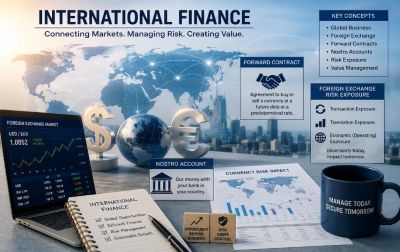
Case: Edific Engineering Ltd. (India)
Edific Engineering Ltd., an Indian multinational company, exports industrial machinery to customers across the USA, Europe, and Asia. As the company expands globally, it encounters various aspects of international business. International finance encompasses a wide range of interconnected concepts that are best understood through a logical sequence of business events rather than as isolated topics. The following integrated learning roadmap traces the journey of an imaginary multinational company, demonstrating how an international business transaction progresses from export and banking operations to foreign exchange management, hedging, global financing, and financial reporting. This roadmap will serve as a guide for connecting theoretical concepts with practical business applications.
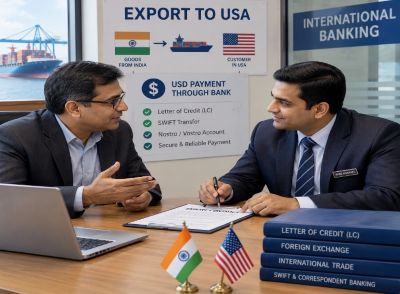
Integrated Learning Roadmap
| Phase | Business Activity | International Finance Concept | Student Learning |
| 1 | Export order received from USA | International Trade | Cross-border transaction |
| 2 | Buyer requests Letter of Credit | International Banking | LC, SWIFT, Correspondent Banking |
| 3 | Bank receives payment | Nostro, Vostro & Loro Accounts | International fund transfer |
| 4 | USD converted into INR | Foreign Exchange Market | Spot & Forward Rates |
| 5 | Exchange rate changes | Forex Risk | Transaction Exposure |
| 6 | Company books Forward Contract | Hedging | Forward, Futures, Options & Swap |
| 7 | Overseas subsidiary prepares accounts | Translation Exposure | Ind AS 21 & OCI/FCTR |
| 8 | Currency appreciation affects exports | Operating (Economic) Exposure | Long-term business risk |
| 9 | Company needs overseas funds | International Debt Market | ECB, Eurobond, FCCB |
| 10 | Company issues ADR/GDR | International Equity Market | Global capital raising |
| 11 | Treasury monitors positions | Treasury Management | Exchange Position & Nostro Balance |
| 12 | Global economic changes | International Finance Environment | PPP, IRP, BOP & Country Risk |
Background: Every international business transaction ultimately finds its place in a company’s financial statements. Depending on the nature of the foreign exchange risk, the impact may appear in the Income Statement, Balance Sheet, Cash Flow Statement, or Equity. The following table summarizes how different foreign exchange exposures are reflected in the financial statements under the applicable accounting treatment, enabling students to connect business events with financial reporting.
Financial Statement Impact
| Situation | Income Statement | Balance Sheet | Cash Flow Statement |
| Export Receivable | Revenue recognised | Foreign Debtor | No cash yet |
| Exchange loss on collection | Forex Loss (P&L) | Debtor revalued | Lower cash inflow |
| Translation of foreign subsidiary | No impact on P&L | OCI → FCTR (Equity) | No cash effect |
| Operating Exposure | Lower Sales & Profit | Lower Retained Earnings | Reduced Operating Cash Flow |
Background: International trade cannot be completed without an efficient banking system. Unlike domestic transactions, cross-border payments involve multiple banks, international payment networks, foreign currency accounts, and documentary procedures to ensure that both the exporter and importer fulfil their contractual obligations. The following table provides a simplified flow of how an international banking transaction is executed, enabling students to understand the role of banks in facilitating global trade.
| Business Event | International Banking Activity | Key Learning |
| Export order received | Sales contract signed between exporter and importer | Initiation of international trade |
| Letter of Credit (LC) issued | Importer’s bank issues LC in favour of the exporter | Payment assurance to exporter |
| LC advised | Advising bank authenticates and forwards the LC to the exporter | Verification of authenticity |
| Goods shipped | Exporter dispatches goods as per contract | Performance of contractual obligation |
| Shipping documents submitted | Exporters submit invoices, Bill of Lading, insurance, packing list, etc., to the bank | Documentary compliance |
| Documents examined | Bank verifies compliance with LC terms | Ensures secure payment process |
| Payment made | Importer’s bank remits funds through correspondent banks using SWIFT | Cross-border fund transfer |
| Nostro account settlement | Foreign currency is settled through the exporter’s bank’s Nostro account | International fund settlement |
| Currency conversion | USD/EUR, etc., converted into INR | Foreign exchange transaction |
| Export proceeds credited | Exporter’s account credited after conversion | Completion of the international transaction |
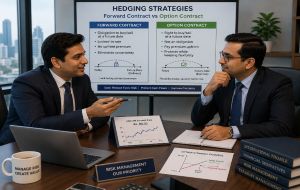
Background: As companies expand beyond domestic markets, they require larger and more diversified sources of finance to support international operations, acquisitions, capacity expansion, and working capital requirements. Depending on their financial needs and capital structure, companies may raise funds either through the international debt market or the international equity market. The following table provides an overview of the major financing options available in global capital markets.
International Financing Options
| Debt Financing | Purpose / Key Feature | Equity Financing | Purpose / Key Feature |
| External Commercial Borrowing (ECB) | Foreign currency loan from overseas lenders | American Depository Receipt (ADR) | Raise equity from investors in the U.S. market |
| Eurobond | Bond issued in a currency different from the country where it is issued | Global Depository Receipt (GDR) | Raise equity from investors in multiple international markets |
| Foreign Currency Convertible Bond (FCCB) | Debt instrument with an option to convert into equity | Indian Depository Receipt (IDR) | Enables a foreign company to raise equity from Indian investors |
| Syndicated Loan | Large loan jointly provided by a group of international banks | Direct Overseas Listing | Listing of shares on a foreign stock exchange to access global investors |
Background: Foreign exchange rates are highly volatile and can significantly affect the profitability and cash flow of companies engaged in international business. To safeguard themselves against adverse currency movements, multinational companies adopt various hedging strategies using financial instruments such as forward contracts, futures, options, and swaps. The following table summarizes the major types of foreign exchange risks and the corresponding hedging techniques commonly used in international finance.
Forex Risk and Hedging
| Type of Forex Risk | Cause | Impact on Business | Common Hedging Tool |
| Transaction Exposure | Exchange rate changes affecting foreign currency receivables or payables | Gain or loss on settlement of foreign currency transactions | Forward Contract, Currency Futures, Currency Options |
| Translation Exposure | Translation of financial statements of foreign subsidiaries into the reporting currency | Accounting gain or loss reported in OCI/Equity (FCTR) under Ind AS 21 | Natural Hedge, Balance Sheet Management |
| Operating (Economic) Exposure | Long-term changes in exchange rates affecting future revenues, costs and competitiveness | Reduction in future cash flows, profitability and firm value | Strategic Hedging, Operational Diversification, Natural Hedge, Currency Swaps (where appropriate) |
Final Learning Outcome
International finance is an interdisciplinary subject that integrates concepts from finance, accounting, banking, economics, and international business. Rather than studying these topics in isolation, students should understand how they interact in real-world business situations. This integrated case study is designed to develop a practical understanding of cross-border financial transactions and their implications for multinational companies.