
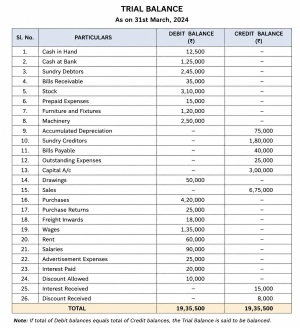
Imagine that a business has recorded hundreds of transactions during a month. These transactions have been entered in the Journal and subsequently posted to various Ledger Accounts such as Cash, Bank, Sales, Purchases, Rent, Capital and Creditors.
At this stage, an important question arises:
How can an accountant verify that the debit and credit entries have been posted correctly to the ledgers?
The answer lies in the preparation of a Trial Balance.
A Trial Balance acts as a bridge between bookkeeping and financial statements. It helps accountants verify the arithmetical accuracy of ledger postings before preparing the Statement of Profit and Loss and the Balance Sheet.
Professor: Students, after recording transactions in the Journal and posting them to various Ledger Accounts, what should an accountant do next?
Student A: Sir, prepare financial statements?
Professor: Not immediately. First, we need to verify whether the books are arithmetically correct.
For this purpose, accountants prepare a Trial Balance.
Definition
A Trial Balance is a statement prepared by listing the balances of all ledger accounts on a particular date to verify the arithmetical accuracy of the books of accounts.
Why is a Trial Balance prepared?
A Trial Balance is prepared to
- Verify the arithmetical accuracy of ledger postings.
- Check whether total debits equal total credits.
- Summarize ledger balances in one statement.
- Provide the basis for preparing financial statements.
- Assist in locating accounting errors.
How Is a Trial Balance Prepared?

Suppose the following ledger balances are available:
| Ledger Account | Balance type | Amount (Rs.) |
| Cash A/c | Debit | 50,000 |
| Bank A/c | Debit | 1,20,000 |
| Purchases A/c | Debit | 80,000 |
| Rent A/c | Debit | 10,000 |
| Furniture A/c | Debit | 40,000 |
| Capital A/c | Credit | 2,00,000 |
| Sales A/c | Credit | 70,000 |
| Creditors A/c | Credit | 30,000 |
List the Balances
| Account Name | Debit (Rs.) | Credit (Rs.) |
| Cash A/c | 50,000 | – |
| Bank A/c | 1,20,000 | – |
| Purchases A/c | 80,000 | – |
| Rent A/c | 10,000 | – |
| Furniture A/c | 40,000 | – |
| Capital A/c | – | 2,00,000 |
| Sales A/c | – | 70,000 |
| Creditors A/c | – | 30,000 |
| Total | 3,00,000 | 3,00,000 |
Student B: Sir, do all ledger accounts appear in the Trial Balance?
Professor: Generally, yes.
Every ledger account having a debit or credit balance should appear in the Trial Balance.
Examples include:
- Assets
- Liabilities
- Capital
- Income
- Expenses
However, accounts that have been completely closed or have a nil balance may not appear.
A Simple Rule: This rule helps understand why accounts appear on a particular side of the Trial Balance.
| Type of Account | Usually appears as |
| Assets | Debit Balance |
| Expenses | Debit Balance |
| Drawings | Debit Balance |
| Liabilities | Credit Balance |
| Capital | Credit Balance |
| Income | Credit Balance |
Student C: Sir, if the Trial Balance agrees, does it mean the accounts are completely correct?
Professor: No.
This is one of the most common misconceptions in accounting.
A Trial Balance can only verify arithmetic accuracy. Certain errors may remain undetected.

Errors not detected by a Trial Balance
1. Error of Omission
Entire transaction omitted from the books.
Example:
Credit purchase of Rs.20,000 is not recorded at all.
Since both debit and credit aspects are missing, the Trial Balance still agrees.
2. Error of Principle
Wrong accounting principle applied.
Example:
Purchase of machinery Rs.50,000 debited to Purchases A/c instead of Machinery A/c.
Debit and credit totals remain equal.
Trial Balance agrees.
3. Error of Commission
Entry made in the wrong personal account.
Example:
Sale made to Raj but recorded in Ravi’s account.
The Trial Balance remains unaffected.
4. Compensating Errors
Two independent errors cancel each other.
Example:
Sales understated Rs.1,000 and Purchases understated Rs.1,000.
The Trial Balance still agrees.
5. Complete Reversal of Entry
Example:
Instead of:
Salary A/c Dr.
To Cash A/c
recorded as:
Cash A/c Dr.
To Salary A/c
Both debit and credit amounts remain equal.
Trial Balance agrees.
Errors detected by a Trial Balance
The following errors generally cause disagreement:
- One-sided posting.
- Wrong amount posted to one account.
- Arithmetic mistakes in ledger balancing.
- Posting to the wrong side of an account.
- Errors in totaling the Trial Balance.
Student D: Sir, what if debit and credit totals are different?
Professor: Then accountants search for the error.
Common checking procedures include:
- Rechecking ledger balances.
- Verifying postings from the Journal.
- Checking additions and totals.
- Confirming debit and credit placements.
Until the error is found, the difference may be temporarily transferred to a Suspense Account.
A Suspense Account is a temporary account opened to make the Trial Balance agree until the errors causing the difference are identified and rectified.
Student: Is Suspense Account a permanent account?
Professor: No.
A Suspense Account is only a temporary arrangement.
As errors are discovered, rectification entries are passed and the balance in the Suspense Account gradually reduces.
Once all errors are rectified:
The Suspense Account should have a nil balance and be closed.
Key Examination Point:
| Question | Answer |
| Does every Trial Balance have a Suspense Account? | No |
| When is the Suspense Account opened? | When the Trial Balance does not agree and the difference cannot be located immediately |
| Is it permanent? | No |
| What should be its final balance? | Nil (after rectification of all errors) |
Takeaway for Students:
Source Documents → Journal → Ledger → Trial Balance → Difference Found (if any) → Suspense Account → Error Detection → Rectification of Errors → Financial Statements

Very meaningful blog for quick revision. Thank you sir.