

Lending institutions use this ratio as a key measure of a company’s ability to pay off the principal and interest on a loan.
Before granting a loan, the bank will calculate your company’s debt service coverage ratio. If it’s good, the bank will consider that you should be able to meet your repayment obligations. If it’s bad, it could be detrimental to applications for financing.
What is Debt Service Coverage Ratio (DSCR)?
The Debt Service Coverage Ratio, or DSCR or DSC ratio, is a credit metric that indicates a company’s ability to cover its annual principal and interest obligations using its operating cash flow. Since the DSCR ratio formula also includes a company’s principal obligations in its denominator, it is an extremely useful metric for reducing term debt.
The debt coverage ratio includes all the existing debt an individual or company is paying and the additional loans they seek. A company’s annual Net Operating Income and Total Debt service are the major components for understanding the DSCR meaning.
Simple Meaning:
DSCR = Income available to repay loan / Loan Installments to be paid
What is a Good DSCR ratio?
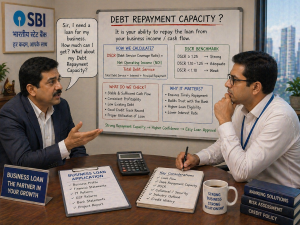
A debt service coverage ratio of 1.5 or higher is an ideal DSCR ratio. A DSCR of 1 indicates that all the EBITDA goes straight to debt. The company has nothing left to pay taxes, reinvest in the business, or pay dividends.
Banks calculate the Debt Service Coverage Ratio (DSCR) by dividing a company’s annual net operating income (typically EBITDA or cash profit) by its total annual debt obligations, including interest and principal repayments, to ensure it can repay a term loan. A healthy ratio is usually
DSCR= NOI or EBITDA/ Total Debt Service (Interest + Principal)
How to calculate EBITDA
Usually, it doesn’t appear on your income statement. It’s a measure that must be calculated by adding up the various data found on your income statement, namely:
- Earnings after tax
- + Interest on short- and long-term debt
- + Income taxes
- + Amortization and depreciation of assets
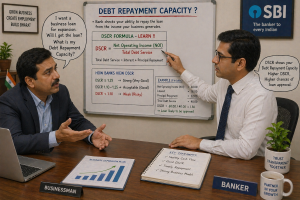
Key Steps in Lender DSCR Analysis:
- Determine Operating Income (Numerator): Banks often use Earnings Before Interest, Taxes, Depreciation, and Amortization (EBITDA) or cash profit (Net Income + Depreciation/Amortization) to represent the actual cash available for debt repayment.
- Calculate Total Debt Service (Denominator): This includes all existing annual interest and principal payments, plus the proposed new loan repayment for the year.
Case Study: Assessing Debt Repayment Capacity through DSCR – A Case of Eltech Manufacturing Company
Background
Eltech Manufacturing Company is a medium-sized engineering goods manufacturer engaged in producing industrial electrical components for infrastructure and construction companies.
The company is planning to expand its production capacity by installing a new automated assembly line. For this purpose, Eltech has approached a bank for a term loan of Rs.2 crore.
Before sanctioning the loan, the bank wants to evaluate the company’s ability to service debt obligations. One of the most important indicators used by the lender is the Debt Service Coverage Ratio (DSCR).
Financial Data of Eltech Manufacturing Company (FY 2025–26)
| Particulars | Amount (Rs.) |
| Revenue from Operations | 8,00,00,000 |
| Operating Expenses (excluding depreciation and interest) | 6,20,00,000 |
| EBITDA | 1,80,00,000 |
| Interest on Existing & Proposed Loan | 30,00,000 |
| Principal Repayment Due During Year | 60,00,000 |
Step 1: Total Debt Service
Total Debt Service = Interest + Principal
= Rs.30,00,000 + Rs. 60,00,000 = Rs.90,00,000
Step 2: DSCR
NOI or EBITDA/ Total Debt Service (Interest + Principal)
1,80,00,000/90,00,000 =2
Interpretation
The DSCR of 2.0 times means that Eltech generates twice the amount required to meet its annual debt obligations.
Practical Meaning
- For every Rs1 of debt obligation, the company generates Rs.2 of operating cash earnings
- The lender may consider this ratio comfortable
- Generally, a DSCR above 1.5 is viewed favorably by banks
Banker’s View
Banks generally prefer:
- DSCR below 1.0 → higher risk of default
- DSCR = 1 → just enough income to cover debt only
- DSCR above 1.0 → favourable for loans
Since Eltech’s DSCR is 2, the bank may consider the company a low-risk borrower.

Great post, Sir! I really appreciated how you simplified the DSCR concept. The straightforward example helped clear up any confusion I had. Thank you for making a complex financial topic so understandable!