
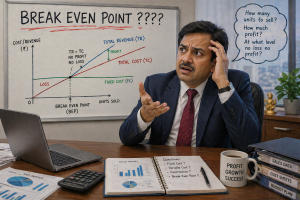
In business, every activity involves a sacrifice of resources—materials, manpower, money and time. This sacrifice, when expressed in monetary terms, is known as cost. Whether a firm is manufacturing a product or providing a service, cost becomes the starting point for all financial decisions.
But understanding cost is not just about knowing “how much” is spent. A more important question is: how does cost behave when the level of activity change?
This behavior of cost is crucial because businesses operate in a dynamic environment where output, sales, and demand are constantly changing. Managers need to predict how costs will react under different situations to make decisions related to pricing, production levels, and profitability.
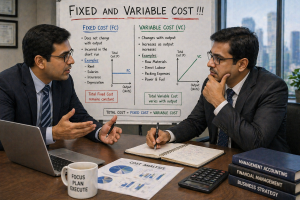
To simplify this analysis, costs are classified based on their behavior into three categories.
- Fixed Cost
- Variable Cost
- Semi-Variable (Mixed) Cost
Understanding this classification helps managers determine contribution, break-even point, and ultimately the pricing strategy.
Suppose a company manufactures electric water pumps and plans to produce 10,000 units per year.
To determine the pricing strategy, the company first analyzes its cost structure.
Fixed Costs (including depreciation)
Fixed costs remain constant in total irrespective of production level.
| Fixed cost component | Annual Amount (Rs.) |
| Factory Rent | 2,40,000 |
| Administrative Salaries | 3,00,000 |
| Insurance | 60,000 |
| Property Tax | 40,000 |
| Depreciation on Machinery | 1,60,000 |
| Total Fixed Cost | 8,00,000 |
Note:
Depreciation is included because machinery loses value over time due to wear and tear.
Variable Costs (Per Unit)
Variable costs change directly with production level.
| Variable cost component | Cost per unit (Rs.) |
| Raw Materials | 900 |
| Direct Labour | 250 |
| Packing | 100 |
| Sales Commission | 50 |
| Total Variable Cost per Unit | 1,300 |
Total variable cost for 10,000 units:
10,000×1,300=1,30,00,000
Semi-Variable Costs
Some costs have both fixed and variable elements.
Example: Electricity
| Component | Amount (Rs.) |
| Fixed electricity charge | 1,00,000 |
| Variable electricity cost | 20 per unit |
Variable electricity cost; 10000*20 = Rs. 2,00,000
Now, we can divide total cost into fixed and variable
Variable = 1,30,00,000 + 2,00,000 = 1,32,00,000
Fixed = 8,00,000+ 1,00,000 = 9,00,000
Total cost calculation
| Cost Component | Amount (Rs.) |
| Fixed Cost | 9,00,000 |
| Variable Cost | 1,32,00,000 |
| Total Cost | 1,41,00,000 |
| Cost per Unit Production = 10,000 units | 1,41,00,000/10,000 = Rs. 1,410 |
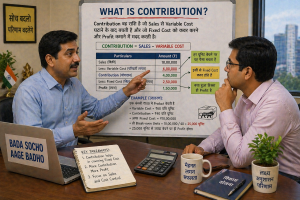
Contribution and Pricing Decision
Suppose the company plans to sell the product at Rs.1,700 per unit.
Contribution per unit: Selling Price – Variable cost
1700- 1,320 = Rs.380
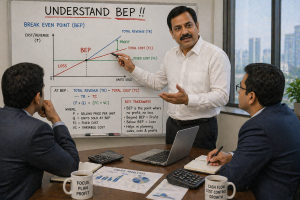
Every company wants to know its Break-Even Point (BEP), because at this level all fixed costs are fully recovered; beyond this point, the contribution from each additional unit directly adds to profit.
Break-Even Analysis
Total fixed cost = Rs. 9,00,000
BEP (units) = Rs. 9,00,000/380 = 2,368 units
This means the company must sell about 2,368 units to cover all costs.
TakeawayAt BEP, there is no profit and no loss; after BEP, each unit sold contributes towards profit.
The blogs are really very helpful, specially when we are reading it before our placements. Thank you so much sir for making things easy for us.