
The classroom was unusually quiet today. Students sat alert, notebooks open, eyes fixed on the smart board.
The professor picked up the marker and wrote one word slowly:
On the smart board, terms like Operating Leverage, Financial Leverage, Fixed Cost, Debt.
“LEVERAGE”
He turned to the class and said:

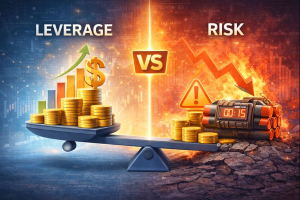
Today, we are not just learning a concept—we are understanding risk.
How companies amplify profits… and how the same strategy can magnify losses.
Leverage is an investment strategy of using borrowed money—specifically, the use of various financial instruments or borrowed capital—to increase the potential return of an investment.
In simple words, using other people’s money to grow the business.
Leverage magnifies:
- profits when business performs well
- losses when business performs poorly
Imaginary Case Study
Case: Hello Electronics Pvt. Ltd.
Hello Electronics wants to expand production.
Option 1: No Leverage
- Investment required: Rs.10 crore
- Entirely funded by equity
- Expected annual EBIT: Rs.2 crore
- Tax 30%
- No interest and PAT are (Rs. 2 crores – 0.60) = 1.4 crores
- ROI= 14%
Return is stable, risk is low.
Option 2: With Leverage
- Equity: Rs. 5 crores
- Debt: Rs.5 crore at 10% interest
- Interest: ₹0.5 crore
- EBIT: Rs. 2 crores
Now the company earns:
- EBIT: Rs.2 crore
- Less Interest: Rs. 0.5 crore
- Profit before tax: Rs. 1.5 crores
- ROI = (1.5/5) = 30%
Shareholders invested only Rs.5 crores and the ROI is 30% while investment of Rs. 10 crores fetch ROI 14%.
Note to Students:
This increase in return due to the use of debt is called financial leverage.
The professor looked at the class and said:
Imagine a company that invests heavily in machines, technology, and fixed salaries.
- High fixed operating costs
- Low variable cost per unit
The professor continued:
- If sales increase, profits rise sharply.
But if sales fall, losses increase just as sharply.
This sensitivity of operating profit to sales is called Operating Leverage and therisk involved is Operating Risk.
Story Example:
A manufacturing company buys expensive automated machines.
- Sales rise → huge profits
- Sales fall → heavy losses
The students nodded.
Then the professor said:
Now imagine the same company borrows money.
Interest must be paid whether profits are earned or not
He explained:
Debt increases returns to shareholders when business is good,
but increases pressure when profits fall.
This use of debt is Financial Leverage and theassociated risk is Financial Risk.
Story Example:
A company takes a large loan to expand.
- High profits → shareholders earn more
- Low profits → interest burden becomes painful
Combined Leverage – Total Business Risk
The professor smiled and said:
Now combine both.
- High fixed operating costs and
- High fixed financial costs
He looked at the class and concluded:
This is the most powerful—and dangerous—position.
Combined Leverage = Operating Leverage + Financial Leverage
Risk involved = Total Risk (Business + Financial Risk)
Case Study: How Tata Motors Used Leverage to Acquire Jaguar Land Rover (JLR)
Background
In 2008, Tata Motors wanted to buy Jaguar Land Rover from Ford. But the acquisition price was huge — around $2.3 billion. Tata Motors did not have that much cash sitting idle.
So, what did they do?

Use of Leverage
Tata Motors borrowed a significant portion of the money through loans and bridge financing.
This borrowing allowed them to buy JLR without using only their own equity.
This is leverage — using debt to finance a major investment with the expectation that future profits will exceed the cost of borrowing.
Why This is a Perfect Example of Leverage
- Debt financed a large acquisition
Tata Motors used borrowed funds to expand its business dramatically. - High risk, high reward
In 2008, the global economy crashed, and many doubted whether Tata Motors could repay its debt. - Outcome
JLR turned profitable within a few years.
The acquisition became a huge success, and the returns far exceeded the cost of debt.
As the class drew to a close, discussions did not stop.
Students were deeply engaged, debating the Tata Motors case study, connecting leverage decisions with operating and financial risks faced by real companies.
The professor glanced at the clock, smiled quietly, and gathered his notes.
As he walked out for his next finance class, the room remained alive—with conversations, questions, and curiosity still unfolding.

Tata Motor case study source:
https://www.motozite.com/blog/how-tata-motors-turned-jaguar-land-rover-into-a-global-success/https://norma.ncirl.ie/5819/1/nikunjgupta.pdf
A very sharp, concise and insightful take on leverage. The cases and examples are really so helpful that actually make the concept easily understandable, thank you Sir.
My pleasure. Keep going steadily.
Good Sudeshna and keep learning.