
Direct tax is something that every earning individual faces in life. Even if you are not from a finance background, understanding the basics of direct tax helps you become a responsible taxpayer. In today’s session, let us navigate through the fundamentals of direct taxation to gain a clear, high-level understanding of the subject.
Samit is a final-year student of MBA who gets his first job in a Big4 firm in April 2024.
His annual salary is Rs. 10,00,000.
Before joining the job, the company asks for PAN
Samit applies for PAN, because it is important for the following
- Salary
- Bank account
- Income tax return
- PF account
Know: PAN becomes Samit’s lifelong tax identity.
Samit has started earning
Samit earns salary every month.
So, his income falls under: Head: Income from Salary

HR asks Samit:
Old tax regime or new tax regime?
Samit learns:
- Old regime — deductions & exemptions
- New regime — lower slab rates, fewer deductions
Since Samit has no investments, he selects:
New Tax Regime (default)
Tax is Calculated
Employer calculates tax based on:
- Salary
- Slab rates
- Standard deduction
- Rebate if applicable
Some tax is deducted every month as:
TDS (Tax Deducted at Source)
Samit is paying tax without even filing a return yet.
Financial Year ends on 31 March 2025.
Now Samit must:
File Income Tax Return for AY 2025–26
Why?
- Government wants Samit needs to declare total income to Income Tax
- TDS alone is not enough
Samit selects:
ITR-1 (Sahaj)
Self-Assessment Tax (If needed)
After calculation, Samit finds:
- Actual tax = Rs. X
- TDS paid = Rs. Y
If X > Y, Samit pays:
Filing & Verification
Samit:
- Files ITR online
- E-verifies using Aadhaar OTP
Now his job is done.
Assessment by Income Tax Department
After a few days:
- Samit receives Intimation under Section 143(1)
It says:
- Return accepted
- Or refund due
- Or small demand
This process is called Assessment.
Remember:
Earn → Identify income → Choose regime → Pay tax → File return → Government checks
Flow Chart
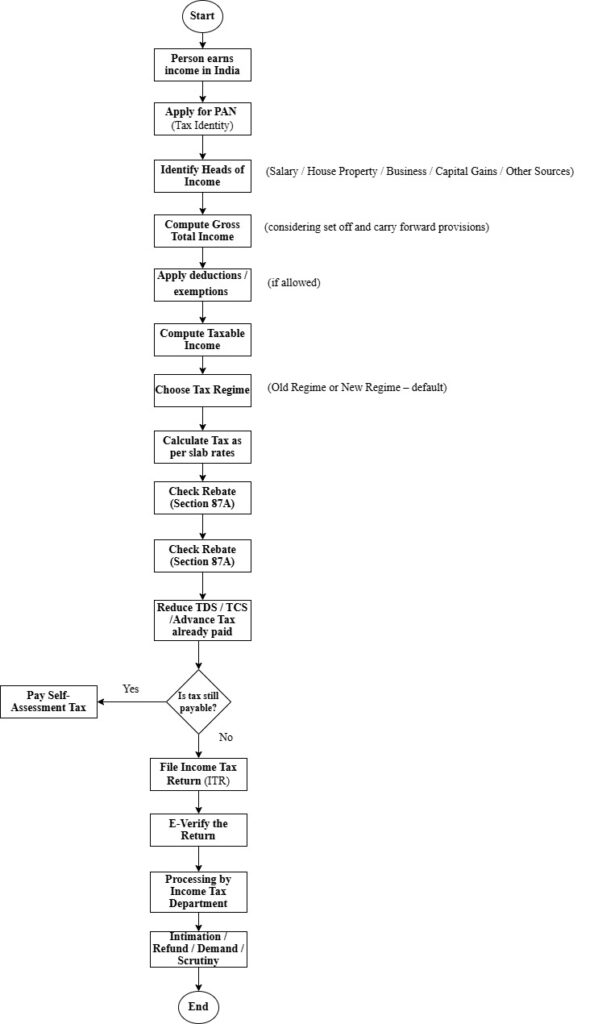
Students, let’s now look at some important questionsfor Interview and concept clarity based on this discussion
Explain income tax in one sentence
Answer:
Income tax is a statutory levy on income, paid through self-assessment and regulatory compliance.
What is the first step in income tax compliance for an individual?
Answer:
Obtaining a PAN, as it is the basic tax identification number
Why is income classified under different heads?
Answer:
To compute income correctly and apply specific tax rules and tax rates based on the nature of income.
What is the difference between Gross Total Income and Total Income?
Answer:
Gross Total Income is income under all heads, whereas Total Income is arrived at after deductions and exemptions.
What is the default tax regime for AY 2025–26?
Answer:
The New Tax Regime is the default, though the taxpayer can opt for the old regime.
What is the purpose of rebate under Section 87A?
Answer:
To reduce the tax liability to zero for taxpayers within the specified income limit.
On what basis should a taxpayer choose between old and new tax regime?
Answer:
Based on the availability of deductions and exemptions, not merely on slab rates.
Is TDS the final tax payment? Why or why not?
Answer:
No. TDS is only a mode of tax collection; final tax liability is determined after calculating taxable income.
What is the role of Income Tax Return (ITR)?
Answer:
ITR is a formal declaration of income and tax liability made by the taxpayer to the government.
Differentiate between Advance Tax and Self-Assessment Tax.
Answer:
Advance tax is paid during the year, whereas self-assessment tax is paid before filing the return to clear balance tax liability.
What is meant by assessment under the Income Tax Act?
Answer:
Assessment is the verification of income and tax declared by the taxpayer to the Income Tax Department.
Does every return undergo scrutiny assessment?
Answer:
No. Most returns are processed automatically; scrutiny applies only to selected cases.
Why is filing ITR important even when tax payable is zero?Answer:
It ensures income disclosure, compliance, record maintenance, and facilitates future financial transactions.