
Why do investors buy shares of a company?
Ans:
- For dividend
- For capital appreciation
- For profit

What determines whether a company is valuable or not?
Ans: The value of a firm is determined by its ability to generate future earnings and cash flows.
A firm is financed by:
- Equity shareholders
- Debt holders
So naturally,

Value of the Firm (Market Value Concept)
Value of the firm = Market value of Equity + Market value of Debt
V=S+D
Where:
S=No. of equity shares × Market Price per Share
D=No. of debentures × Market Price per Debenture
So,

Why Market Value (Not Book Value)?
In finance theory (especially capital structure decisions):
- We use market values
- Because they reflect investors’ expectations
- They capture risk and return perception
- They are relevant for shareholder wealth maximization
Suppose:
- 1,00,000 shares
- MPS = Rs. 50
- 10,000 debentures
- Market price per debenture = Rs. 95
Then:
Market value of equity = 1,00,000 × 50 = Rs. 50,00,000
Market value of debt = 10,000 × 95 = Rs. 9,50,000
Value of Firm+ Rs. 59,50,000
All capital structure theories use market values:
- NI Approach
- NOI Approach
- MM Hypothesis
- Trade-off Theory
Under Net Income (NI) Approach
- More debt → Increases value of firm
- WACC decreases
- Ko =( D/V)kd + (S/V)Ke v= total value of firm
S= value of equity
D= value of debt
Under Net Operating Income (NOI) Approach (MM without tax)
- Value of firm is constant
- Capital structure irrelevant
V= EBIT/Ko
- The value of equity S is found as S = V-D
- Ke = EBIT-I/S
Under MM with Tax
Where:
= Levered firm value
= Unlevered firm value
= Tax shield value

What Trade-Off Theory Says
Trade-Off Theory accepts MM tax shield but adds:
- Expected bankruptcy cost
- Financial distress cost
- Agency cost of debt
So the equation becomes:

Now:
- Initially value increases (tax benefit dominates)
- After some point value decreases (distress dominates)
Under:
- Net Income (NI) Approach → Value changes with leverage
- Net Operating Income (NOI) Approach → Total value remains constant
- MM without tax → Capital structure irrelevant
- MM with tax → Value increases with debt (due to tax shield)
Let us take go trough this comparative table
- NI Approach
- NOI Approach
- MM Approach (without tax)
- MM Approach (with tax)
- Trade -Off theory—- in a comparative table format.
Comparative Table
| Theory | Optimal Structure? | Reason |
| NI | 100% Debt | Debt cheaper |
| NOI | Irrelevant | Market adjusts |
| MM (No Tax) | Irrelevant | Arbitrage |
| MM (With Tax) | 100% Debt | Tax shield |
| Trade-Off | Yes | Balance benefit & cost |
Let us take one common numerical example and compute
Assume
EBIT = Rs. 2,00,000
Total Capital = Rs. 10,00,000
Debt = Rs. 4,00,000
Equity = Rs. 6,00,000
Interest Rate = 10%
Cost of Equity (unlevered) = 12%
Overall Cost of Capital (Ko under NOI/MM) = 12%
Interest = 10% of 4,00,000 = Rs. 40,000
EBT = 2,00,000 – 40,000 = Rs. 1,60,000
Net Income (NI) Approach
Assumptions:
- Cost of equity constant
- Cost of debt constant
- WACC declines with leverage
Step 1: Value of Equity
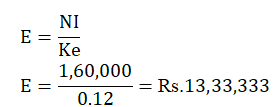
Step 2: Value of Firm

Net Operating Income (NOI) Approach
Assumptions:
- Overall cost (Ko) constant
- Market capitalizes EBIT
- Value independent of capital structure
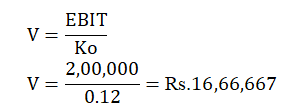
Value of Equity:

MM (without tax) gives same result as NOI:
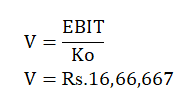
Hence,
Equity Value = Rs. 12,66,667
MM with Corporate Tax
EBIT = Rs. 2,00,000
Debt = Rs. 4,00,000
Interest Rate = 10% → Interest = Rs. 40,000
Tax Rate = 40%
Unlevered Cost of Capital (Ko) = 12%
Step 1: Value of Firm under MM (Without Tax)
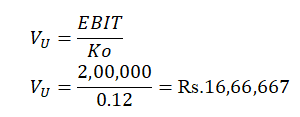
This is value of firm if no debt.
Step 2: Tax Shield Value
Under MM with tax:

Step 3: Levered Firm Value
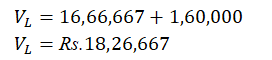
Step 4: Value of Equity
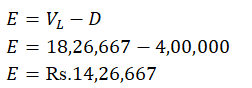
Complete Comparative Table
| Particulars | NI | NOI | MM (No Tax) | MM (With Tax) |
| EBIT | 2,00,000 | 2,00,000 | 2,00,000 | 2,00,000 |
| Interest | 40,000 | 40,000 | 40,000 | 40,000 |
| Tax Rate | 0 | 0 | 0 | 40% |
| Value of Firm | 17,33,333 | 16,66,667 | 16,66,667 | 18,26,667 |
| Behaviour | Value ↑ with Debt | Constant | Constant | Value ↑ due to tax shield |
Why doesn’t Big Company operate with 90% debt?
Ans: Because of
- Credit rating risk
- Bankruptcy risk
- Loss of control
- Agency problems
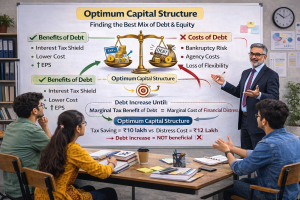
That is Trade-Off Theory in action and Trade-Off Theory leads to an Optimum Capital Structure.