

Good morning, students. This is my second class on TDS, because in our previous session some important questions remained unanswered. Today, we shall clarify them properly.
He looked around the class and paused thoughtfully and asked
Sweta… what is your question
Sweta:
Sir, in a company we make payments to contractors, suppliers, transporters and employees. We know TDS must be deducted, but how do we know the threshold limit? Which section should we refer to?
Professor:
Excellent question, Sweta.
Students must always remember — threshold limit is mentioned in the respective TDS section itself.
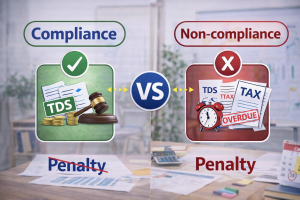
There is no single section for all thresholds. Each section prescribes:
- Nature of payment
- Threshold limit
- Rate of TDS
Let me give you some important sections relevant for a manufacturing company.
Important TDS Sections & Threshold Limits
| Nature of Payment | Section | Threshold l3imit |
| Salary | Section 192 | No fixed limit – Tax deducted if income exceeds basic exemption |
| Contractor Payment | Section 194C | Rs.30,000 single payment / Rs.1,00,000 aggregate |
| Professional Fees | Section 194J | Rs. 50,000 |
| Rent | Section 194I | Rs. 6,00,000 per year |
| Interest (Bank and Post Office) | Section 194A | Rs.50,000 (general cases) |
| Purchase of Goods | Section 194Q | Rs. 50 lakhs (buyer turnover > Rs. 10 crore) |
So, Sweta, whenever you want to check threshold — open the relevant section of the Income Tax Act. That is your primary reference.
Anusmita asked
Sir, can you give us a practical example of TDS on salary in a company
Professor:
Yes, let us take a factory production manager.
Example:
Mr. Anshu works as Production Manager.
Annual Salary Structure:
- Basic + DA: Rs.7,20,000
- HRA: Rs.2,40,000
- Other Allowances: Rs.1,40,000
Gross Salary = Rs.11,00,000
After deductions under:
- Section 80C = Rs.1,50,000
- Standard Deduction = Rs.50,000
Taxable Income = Rs.9,00,000
Since taxable income exceeds basic exemption limit (Rs.2,50,000 under old regime), TDS must be deducted.
How TDS is deducted under Section 192?
Under Section 192:
✔ Employer must estimate total annual income with necessary details from the employee
✔ Compute tax liability as per slab
✔ Deduct tax monthly proportionately
Suppose total annual tax = Rs.72,800
Monthly TDS = Rs.72,800 ÷ 12 = Rs.6,067 (approx.)
Journal Entry in Manufacturing Company Books
At salary booking:
Salary Expense A/c Dr
To TDS Payable A/c
To Salary Payable A/c
At payment to employee:
Salary Payable A/c Dr
To Bank A/c
At TDS deposit:
TDS Payable A/c Dr
To Bank A/c
Professor Concludes:
Remember students, Section 192 is different from other TDS sections because:
- There is no fixed monetary threshold.
- Tax is deducted only if estimated income exceeds exemption limit.
- Employer must compute tax as per slab — not flat rate.
Anusmita: Sir, what happens if a company forgets to deduct TDS?
The Professor replies: Very important question. If a company fails to deduct or deposit TDS, it becomes an assessee in default under Section 201 of the Income-tax Act —Section 201(1) – Assessee in Default.
If tax is:
- Not deducted, or
- Deducted but not deposited
- The company is treated as assessee in default.
Interest under Section 201(1A).
Two Types of Interest:
| Default | Rate of Interest | Period |
| TDS not deducted | 1% per month or part thereof | From date tax was deductible to actual date of deduction |
| TDS deducted but not deposited | 1.5% per month or part thereof | From date of deduction to date of deposit |
The Professor looks at the class and spoke
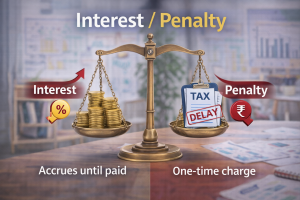
Remember
- Assessee in default – Section 201
- Interest – Section 201(1A)
- Penalty – 271C
- Late fee – 234E
- Prosecution – 276B
For detailed understanding, you must refer directly to Sections 192, 201, 201(1A), 234E, 271C and 276B of the Income-tax Act. Interviews test whether you know the relevant sections applicable to the role you are appearing for.