

We all know one basic rule of finance — higher risk demands higher return. But in business, risk does not come from one place. It comes in layers.
Let’s know the following terms
- Business Risk
- Operating Risk
- Financial Risk
Business Risk: Base-Level Risk
Business risk arises from:
- Nature of business
- Industry conditions
- Demand and competition
It exists even if the company has no debt.
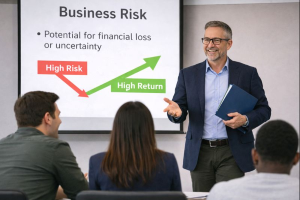
Risk–Return Link:
A firm with high business risk must earn higher operating returns (EBIT) to compensate.
Operating Risk: Cost Structure Risk
Operating risk arises due to high fixed operating costs.
- High operating leverage
- Sales fluctuation — large EBIT fluctuation
Risk–Return Link:
Higher operating risk — higher variability in operating profits –higher expected return.
Financial Risk:
Then he adds:
Financial risk arises due to use of debt.
- Interest is a fixed obligation
- Must be paid regardless of profits
Risk–Return Link:
Higher financial risk — equity shareholders demand higher return.
Total Risk = Business Risk + Operating Risk + Financial Risk
As total risk increases, expected return must increase, otherwise investors will not invest.
Let’s discuss this example
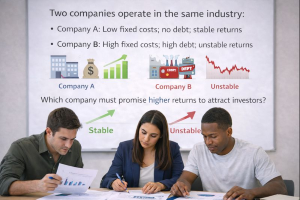
Two companies operate in the same industry:
- Company A: Low fixed costs; no debt; stable returns
- Company B: High fixed costs; high debt; unstable returns
The professor asks:
Which company must promise higher returns to attract investors?
Students respond: Company B.
The professor replies: Yes
A company with high fixed costs (high operating leverage) and high debt (high financial leverage) is considered a high-risk investment, requiring a significantly higher expected return.
Let’s discuss this case study
Two IIT graduates start an online retail company (Flipkart) from a small apartment. At the beginning:
- Small team; limited inventory; minimal technology; mostly self-financed
The professor asks:
What kind of risk is this?
Students reply:
Business risk — but controlled
He nods.
Returns are modest, but stable.
The Big Decision: Scale or Stay Small
As demand grows, the founders face a choice:
Option 1: Grow slowly
- Use internal funds; low fixed costs; less pressure
Option 2: Scale fast
- Huge warehouses; advanced logistics; marketing blitz; external funding
Flipkart chooses Scale Fast.
Operating Risk Enters the Story
To deliver faster than competitors:
- Large fulfilment centers; technology infrastructure; fixed employee costs
The professor writes:
High Fixed Costs = High Operating Leverage
Now:
- Small increase in sales — big jump in profits
- Small drop in sales — big fall in profits
Risk increases.
Financial Risk Joins In
To fund expansion: alternatives are
- Venture capital;
- Later, private equity
- Structured debt
The professor asks:
Does debt create sales risk?
Students reply: no
But does it create pressure?
Students reply: yes
Financial risk has entered.
Investor’s View: Risk demands return
Early investors know:
- Cash flows are volatile
- Profits may come later
- Failure is possible
So, they demand: Higher ownership; higher expected return
The professor explains: This higher return expectation is nothing but higher beta.
Note: According to the Capital Asset Pricing Model (CAPM) higher beta (more than one) indicates higher volatility than the market, which translates to higher potential returns in a bull market, but steeper losses in a downturn.
And adds: More operating risk + more financial risk = more premium
Highlights
When growth succeeds:
- Revenue explodes; valuation multiplies; early investors earn extraordinary returns
But the professor warns: If growth had failed, leverage would have destroyed value just as fast.
Takeaway
The professor concludes softly:
- Flipkart didn’t earn high returns because it sold books online.
- It earned high returns because it carried high risk.
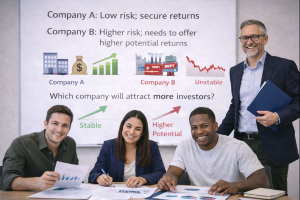
In startups and corporations alike, leverage turns ordinary success into extraordinary returns — and small mistakes into disasters.