
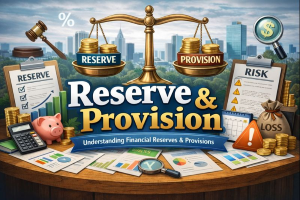
Reserve is the term which refers to a sum or percentage of profit that a company retains or keeps aside at the end of a financial year towards meeting future contingencies that may occur. It is also used to strengthen the business.
There are two types of reserves in an organisation
- Capital Reserve
- Revenue Reserve
A capital reserve is created from the capital profits and is not available for distribution to shareholders in the form of dividends. Therefore, it cannot be created from the profits earned from the core operations of a company.
Revenue reserve is created from the profits earned from the core operations of a company or organisation. A profit and loss appropriation account needs to be made for creating Revenue Reserve. It appears in the Balance sheet under Reserve and Surplus.
Provision refers to an amount that is kept aside from a company’s profit in order to cover probable expenses arising in future or a possible reduction in the value of an asset. Provisions should not be regarded as savings as these are created to meet expenses for an anticipated liability in future. Provision appears in the income statement in the form of expenses and is recorded as a current liability in the balance sheet.
Let’s go through the case of Sunshine Electronics:

Sunshine Electronics is a small but growing business dealing in electronic goods. At the end of the year, the owner Mr. Suman sits with his Accounts Manager Preeti to finalise the accounts
After preparing the Trading and Profit & Loss Account, Preeti says:
Sir, this year our net profit is Rs.1,00,00,000.
Suman smiles and says to Neha — it is not finished yet.
A known problem — Provision
Preeti continues:
Sir, some customers still owe us money. From experience, we feel about Rs.5,00,000 may not be recovered.
Suman frowns: but they haven’t defaulted yet!
Preeti explains calmly:
True, but the loss is expected and measurable. Accounting rules say we must recognise it now.
So, they create a Provision for Bad Debts of Rs.5,00,000.
Meaning:
This amount is not saved — it is treated as an expense.

Profit reduces from Rs.1,00,00,000 to Rs.95,00,000.
Preeti adds:
Sir, this is compulsory, whether we like it or not.
A prudent decision – Reserve
After accounting for all provisions, Preeti says:
Sir, after all charges, we still have a healthy profit.
Suman thinks and says:
Let us set aside Rs.20,00,000 for future expansion or any emergency.
Preeti nods:
That’s a reserve, sir. There is no obligation, but it strengthens the business.
They create a General Reserve of Rs.20,00,000.
Meaning:
- This is not an expense
- It is an appropriation of profit
- Profit is already earned
Takeaway:
Lesson 1:
- Provision is created for a known loss or liability
- It is charged to Profit & Loss Account
Lesson 2:
- Reserve is created to strengthen the business
- It is made after profit is known
| Situation in the Story | Accounting Term |
| Expected bad debts | Provision |
| Amount set aside for future | Reserve |
| Compulsory deduction | Provision |
| Optional saving | Reserve |
At the end, Preeti says,
Sir, now we can declare the profit in the financial statements after making provision and creating reserve. Suman replies with satisfaction: Sure
Preeti smiles and adds playfully:
Sir, then we all can expect a party to celebrate Suman nods happily and say: Yeaahh!

Thank you sir for A very clear and insightful explanation of Provision and Reserve . The way the concept is connected with its treatment in financial statements makes it easy to understand and practically relevant.
Very good… Get your concept clear. Thank you.
Good to know that the concept is clear now.
Very clearly explained, Sir. The practical example makes the difference between provision and reserve easy to understand and remember, truly helpful.
Good and keep yourself updated for your knowledge.