
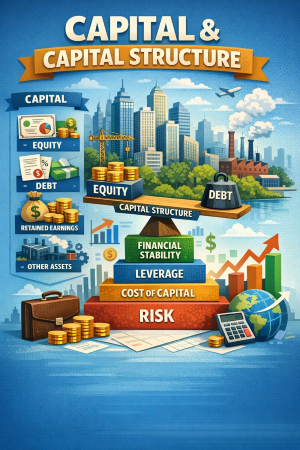
Capital structure refers to the mix of debt, equity, and hybrid securities that a business uses to finance its operations and growth.
Debt includes loans and bonds that require repayment, while equity involves raising funds through selling shares that give investors ownership stakes.
When we discuss capital structure, the focus is on achieving the optimum capital structure.
What Does “Optimum” Really Mean?
Debt + Equity = Capital Structure
Optimum Capital Structure is that combination of debt and equity at which:
- The overall cost of capital (WACC) is minimum
- The value of the firm is maximum
- The risk is balanced—not too low, not too high
Minimum Cost + Maximum Value + Acceptable Risk = Optimum Capital Structure
But the decision of selecting the best source of finance can be taken on the basis of
1. Return on Equity (ROE)
2. Market Price per Share (MPS)
3. Earnings per Share (EPS) etc.
Before proceeding to the discussion of capital structure, it is essential to understand the concepts of capitalisation, undercapitalization, and overcapitalization.
Capitalisation refers to the total amount of long-term funds invested in a business to earn profits.
It includes:
- Equity share capital
- Preference share capital
- Reserves and surplus
- Long-term debt
Why concept of Capitalisation is important?
- It determines the earning capacity of the firm
- It affects the risk, profitability, and market value
- Proper capitalisation supports smooth operations and growth
Overcapitalisation
- Excess funds raised
- Low return on capital
- Share value falls

Undercapitalisation
- Insufficient capital
- Over-dependence on debt
- Excessive risk
Trade-off Theory
A company increases debt to enjoy tax savings on interest, but only up to the point where the risk and cost of financial distress start outweighing those benefits
Trade-off Theory of Capital Structure states that a firm determines its optimum capital structure by balancing the tax benefits of debt against the costs of financial distress and bankruptcy.
What is “Optimum Capital Structure”?
Optimum Capital Structure is that ideal mix of debt and equity at which:
The company’s overall cost of capital (WACC) is minimum and the value of the firm is maximum.
100% Equity finance:
- No financial risk
- But equity is expensive
- EPS is diluted
- WACC is high
100% Debt finance:
- Debt is cheaper (tax benefit)
- But too much debt increases:
- Interest burden
- Bankruptcy risk
- Financial distress
Hence, companies search for an optimum point.
Case Study
FMC Ltd. started with 100% equity.
- Cost of equity = 15%
- No debt — No risk — But equity is costly
Phase 1: Reasonable Debt
- Debt: 30%, Equity: 70%
- Interest is tax-deductible
- WACC falls
- Profits improve
- Share price rises
Phase 2: High Debt
- Debt: 70%, Equity: 30%
- Interest burden increases
- Risk of default rises
- Equity holders demand higher returns
- Lenders increase interest rate
- WACC increases
The best structure lies in Phase 1 — that is the optimum capital structure.
Let’s take an example
| Capital Structure | Debt (%) | Equity (%) | Cost of Debt (After Tax) | Cost of Equity |
| Plan X | 0 | 100 | — | 15% |
| Plan XL | 40 | 60 | 8% | 16% |
| Plan XLL | 70 | 30 | 10% | 20% |
Calculate WACC
Plan X:
WACC = 15%
Plan XL:
WACC = (0.4 × 8%) + (0.6 × 16%)
= 3.2% + 9.6%
= 12.8%
Plan XLL:
WACC = (0.7 × 10%) + (0.3 × 20%)
= 7% + 6%
= 13%

Plan XL is the Optimum Capital Structure. The above table indicates that the optimum capital structure is the combination of debt and equity at which the cost of capital is minimum and the value of the firm (and MPS) is maximized. Up to this level, financial leverage may improve EPS; beyond it, increased financial risk adversely affects returns.