
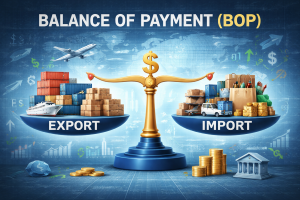
The balance of payments (BOP) summarizes the economic transactions of an economy with the rest of the world. This statement includes all the transactions made by individuals, corporates and the government and helps in monitoring the flow of funds to develop the economy.
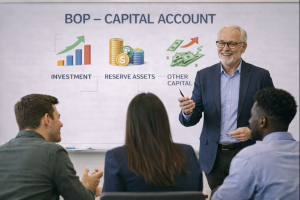
Whenever goods, services, capital, or investments move across countries, they leave a financial track — and BOP captures that entire track. Whether a company exports software, imports crude oil, machinery, receives foreign investment, sets up a subsidiary abroad, or pays royalties under a licensing agreement, every such transaction influences the country’s foreign exchange position and appears somewhere in the BOP. By studying BOP, we can understand how international business decisions affect the strength of a domestic currency, its foreign exchange reserves, and its global financial stability.
Once we understand these accounts clearly, it becomes much easier to connect international business activities — like exports, imports, FDI, licensing, franchising, and profit repatriation — with their financial impact on the economy.
How BOP is shown
1. Current Account: Goods, services, income, transfers
2. Capital Account: small items (capital transfers, non-produced assets)
3. Financial Account: big items (FDI, FPI, loans, deposits) = (Capital + Financial Account = Capital Flows
4. Official Reserve Account: RBI’s change in forex reserves
5. Errors & Omissions: Statistical adjustments
Quick View of BOP Accounts
| BOP account | What it Covers | Example-I | Example-II | Account Impact | Component |
| Current Account | Goods export | When Tata Steel exports to Europe | foreign exchange flows into India | Current Account=Cr | Goods, services, income, transfers |
| Goods import | When India imports crude oil | foreign exchange flows out | Current Account=Dr | ||
| Trade in Services | IT services, tourism, transport, banking, insurance | TCS provides IT services to a US company and earns USD 10 million. | Current Account=Cr | ||
| Income | dividends, interest, profits | TCS receives dividends of USD 1 million from its US subsidiary.Repatriation of profits: Hyundai India sends USD 2 million profit to South Korea. | Current Account=Cr Current Account=Dr | ||
| Current transfers | remittances, gifts, grants, pensions | Indian students paying university fees in the UK worth Pound 50,000.An NRI sends USD 1,000 to his family in IndiaIndia donates USD 10 million as aid to a neighbouring country | Current Account=Dr Outflow Current Account=Cr Inflow Current Account=Dr Outflow | ||
| Capital Account | capital transfer | Japan forgives a loan of USD 10 million given earlier to India (debt forgiveness). | Capital Account=Cr (Inflow) | Capital transfers, non-produced assets | |
| non-produced asset | An Indian company purchases a foreign trademark worth USD 2 million | Capital Account=Dr (Outflow) | |||
| Financial Account | Foreign Direct Investment (FDI) Foreign Portfolio Investment (FPI) External Commercial Borrowing (ECB) | US Company invests USD 500 million in Indian subsidiary.Tata Steel acquires a company in Europe for USD 300 million.Indian investors buy shares of Apple worth USD 1 million. Reliance raises USD 200 million loan from a UK bankAn Indian company repays Pound 80 million of an earlier foreign loan | Financial account=Cr (Inflow) Financial account=Dr (Outflow) Financial account=Dr (Outflow) Financial account=Cr (Inflow) Financial account=Dr (Outflow) | FDI, FPI, loans, deposits, investments | |
| Official Reserve | Changes in foreign currency assets, gold reserves, SDRs (Special Drawing Rights) | RBI sells USD 1 billion to control rupee depreciation | Outflow (reserves decrease) | RBI’s change in forex reserves | |
| Errors & Omissions | Statistical errors, unrecorded transactions and timing differences | Adjusted under Errors & Omissions to keep BOP balanced. | A private remittance of USD 1 million not reported due to timing difference | Statistical adjustments |
let’s look at a small example that brings all BOP concepts together
Imagine an Indian company SINTECH decides to enter the global market. The moment it starts cross-border activities, it unknowingly creates a chain of entries in India’s Balance of Payments.
Step 1: Import of Machinery (Current Account – Outflow)
SINTECH imports electronic machines worth USD 1 million from Germany.
Effect on BOP- Foreign currency outflow under Current Account – Goods.
Step 2: Hiring a UK Consultant (Current Account – Services)
It pays USD 100,000 to a UK expert for installation.
Effect on BOP – Outflow under Services.
Step 3: Export of Electronics (Current Account – Inflow)
After production, the company exports tablets to South Africa worth USD 5 million.
Effect on BOP – Inflow under Goods.
Step 4: Foreign Direct Investment (Financial Account – Inflow)
A French investor buys 20% stake in SINTECH for USD 7 million.
Effect on BOP –Inflow under FDI.
Step 5: External Loan (Financial Account – Inflow)
The company takes a USD 1 million low-interest loan from a UK bank.
Effect on BOP- Inflow under External Commercial Borrowing.
Step 6: Royalty Payment (Current Account – Outflow)
SINTECH pays USD 2,00,000 yearly royalty to a US firm for technology licensing.
Effect on BOP – Outflow under Income (Current Account).
Step 7: RBI Intervention (Official Reserve Account)
Due to high import demand, the rupee weakens. RBI sells USD 1000 million in the market
to stabilise the currency.
Effect on BOP – Decrease in reserves under Official Reserve Account.
Takeaway from this example
- Goods & services → Current Account
- FDI & loans → Financial Account
- Licensing payments → Income Account
- RBI currency action → Official Reserve Account
Closing Note
Balance of Payments is not just an economic document — it is the financial diary of all international business activities. Any international transaction—whether by the country, its residents, or its companies—ultimately affects the nation’s BOP. Understanding BOP helps students connect business actions with currency flows and the overall stability of the economy.